

Ready & Packaged Foods
All →Vegetables & Legumes
All →Desserts & Confectionery
All →Meat & Protein
All →Grains & Bakery
All →Beverages
All →Milk & Dairy
All →

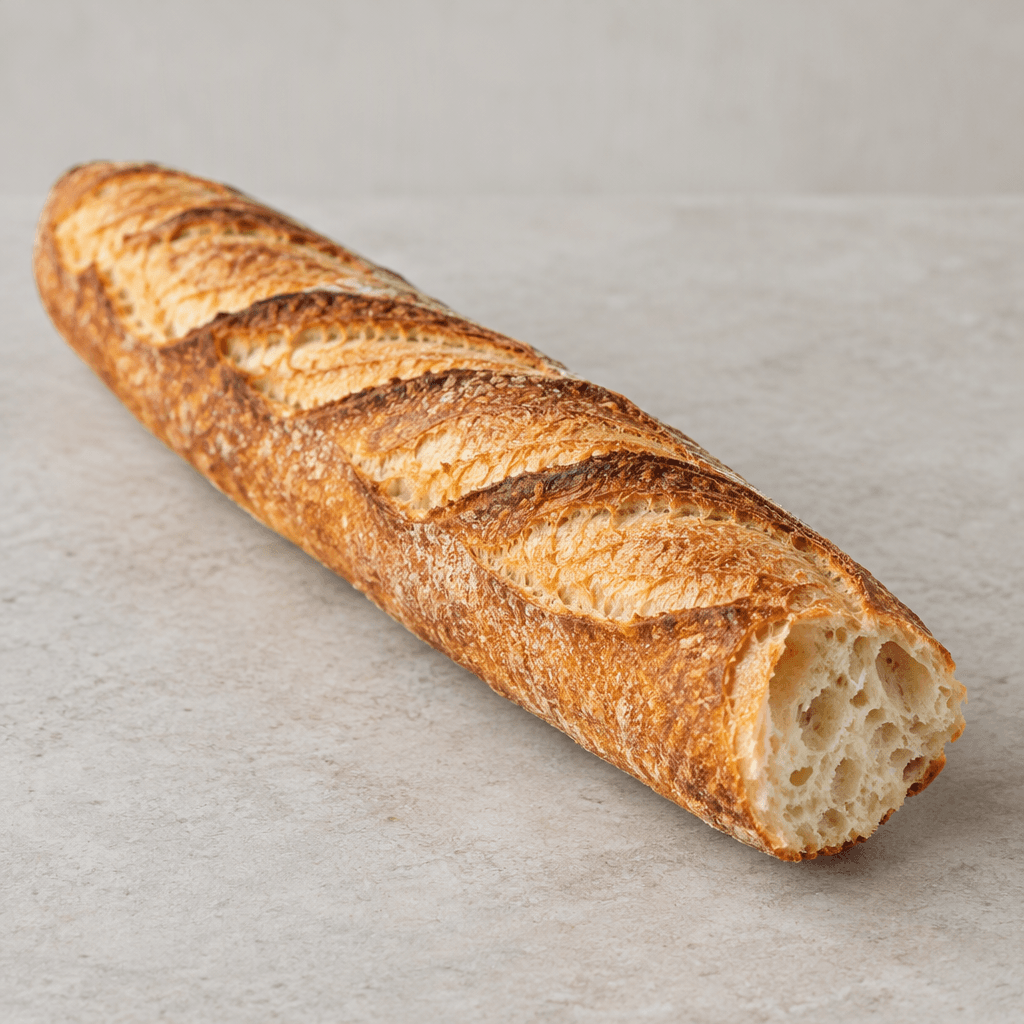
Baguette Calories
French bread, crusty, white flour
In season: Spring · Summer · Autumn · Winter
CALORIES
GI
POTASSIUM
FIBER
Quick answer
1 slice (medium) of Baguette (35 g) has 95 calories. That works out to 270 calories per 100 g. It contains 19.6 g of carbs, 3 g of protein, 0.3 g of fat and 0.9 g of fiber. Its 182 mg of Sodium covers 8% of the Daily Value. Its glycemic index is 95 (high), so it raises blood sugar quickly.
What is Baguette?
The baguette is a long, slender French loaf traditionally made with flour, water, yeast and salt. Its deep diagonal slashes let the crust expand as it bakes, leaving a crisp, ridged exterior and a pale, airy crumb.
In France, it is commonly bought fresh from a bakery and eaten throughout the day, plain or with cheese, butter or jam; it is also a classic base for sandwiches. Elsewhere, the same loaf works well alongside soup or a salad. Made mainly with white flour, it is rich in carbohydrates and relatively low in fat. For a more filling meal, pair it with eggs, cheese or vegetables, and enjoy it while the crust is still crisp.
Baguette Nutrition Facts
Selected: 100 g
270
KCAL / 100G
Carbs
56g
· 20% DV
Protein
8.5g
· 17% DV
Fat
0.8g
· 1% DV
Fiber
2.7g
· 10% DV
DV is the share of the daily value covered, on a 2,000 kcal reference diet.
Calories come from: Carbs 84% · Protein 13% · Fat 3%
Baguette Vitamins & Minerals
Vitamins
B1
0.25mg · 21% DV
B3
2.6mg · 16% DV
Folate
30µg · 8% DV
Biotin
1.5µg · 5% DV
Minerals
Selenium
13µg · 24% DV
Sodium
520mg · 23% DV
Iron
2mg · 11% DV
Zinc
1mg · 9% DV
How Nutritious Is Baguette?
Nutrient density
Low
How many vitamins, minerals and how much fiber this food carries per calorie. A high score means a lot of nutrition for few calories.
Satiety score
Medium
An EatBetter score computed from fiber, protein and calorie density. A high score means staying full longer on the same calories.
Both scores are calculated per 100 g and do not change with the selected portion. The satiety score is EatBetter's own calculation, not a clinical measure.
Baguette Glycemic Index
GLYCEMIC INDEX
GLYCEMIC LOAD
Accounts for portion size — a more realistic measure than GI alone.
How to Burn Off Baguette
To burn the 270 calories in 100 g:
🚶
Walking (5 km/h)
🏃
Running (8 km/h)
🚴
Cycling
🏊
Swimming
Times are calculated with the MET equation for a 70 kg adult. Actual burn varies with your weight, age and pace.
Is Baguette Processed?
NOVA 3
Processed
1. Unprocessed
2. Minimally Processed
3. Processed
4. Ultra-Processed
NOVA classifies foods into 4 groups by industrial processing. NOVA 1 (unprocessed) is the healthiest.
Does Baguette Contain Allergens?
Contains these allergens:
Which Diets Is Baguette Good For?
Vegan
— Not suitable
Vegetarian
✓ Suitable
Gluten-Free
— Not suitable
Dairy-Free
— Not suitable
Mediterranean
— Not suitable
Paleo
— Not suitable
Whole30
— Not suitable
DASH
— Not suitable
Keto
— Not suitable
Low FODMAP
— Not suitable
Baguette Fat Profile
SATURATED
0.15g
MONOUNSATURATED
0.13g
POLYUNSATURATED
0.14g
Omega 6:3 ratio 13:1
Above the ideal 4:1 (13:1).
Compare Baguette
Foods Similar to Baguette
Frequently Asked Questions About Baguette
What is a baguette?
A baguette is a long, narrow French-style loaf with a crisp crust and an airy interior. It is commonly made with flour, water, yeast, and salt, and is served alongside meals or used for sandwiches.
Why are baguettes scored before baking?
Baguettes are scored with shallow cuts so the dough can expand in a controlled way in the oven. Those cuts also create the loaf’s familiar ridged appearance; without them, the crust may split unpredictably.
How do you keep a baguette fresh?
Keep a baguette at room temperature in a paper bag or wrapped in a clean cloth to help preserve its crust. A plastic bag traps moisture and softens the crust, so baguettes are best eaten the day they are bought.
Can you freeze a baguette?
Yes, a baguette freezes well. Freeze it whole or sliced in an airtight wrapping, then thaw it and warm it briefly in the oven before serving. The heat helps bring back some of the crust’s crispness.
How is a traditional baguette made?
A traditional baguette is made by fermenting a simple dough of flour, water, yeast, and salt, then shaping it into a long, thin loaf. The dough is scored and baked in a hot oven, often with steam to develop a crisp crust.
What is the difference between a baguette and a regular loaf of bread?
A baguette is longer and narrower than most standard loaves, with a higher proportion of crust to soft interior. Its shape makes it easy to slice lengthwise for sandwiches, while a regular loaf is often softer and more evenly shaped.
Why is a baguette crust so hard and crispy?
A baguette’s crust becomes crisp because its surface dries and browns during baking in a hot oven. Steam at the start of baking helps the crust form well; after baking, moisture loss can make it turn harder over time.
What can you make with a baguette?
A baguette works well for sandwiches, garlic bread, and crostini. Slice it across for small toasted bites or lengthwise for a filled sandwich; its airy crumb absorbs sauces readily, so add moist fillings shortly before serving.
What can you do with a stale baguette?
Turn a stale baguette into croutons by cutting it into cubes, tossing them with oil and seasoning, and baking until crisp. You can also use slices for French toast or make garlic bread.
Does eating baguette cause weight gain?
A baguette does not cause weight gain on its own, but its soft interior is easy to eat in large portions. Pair a measured serving with filling foods such as eggs, beans, or vegetables rather than relying on bread alone.
Have another question about Baguette?
Ask the AI nutrition coach — calories, portions, alternatives and more, answered in seconds in the app.

Scan calories with your camera
Instant AI nutrition analysis

Nutrition data compiled from USDA FoodData Central and scientific sources.