

Ready & Packaged Foods
All →Vegetables & Legumes
All →Desserts & Confectionery
All →Meat & Protein
All →Grains & Bakery
All →Beverages
All →Milk & Dairy
All →

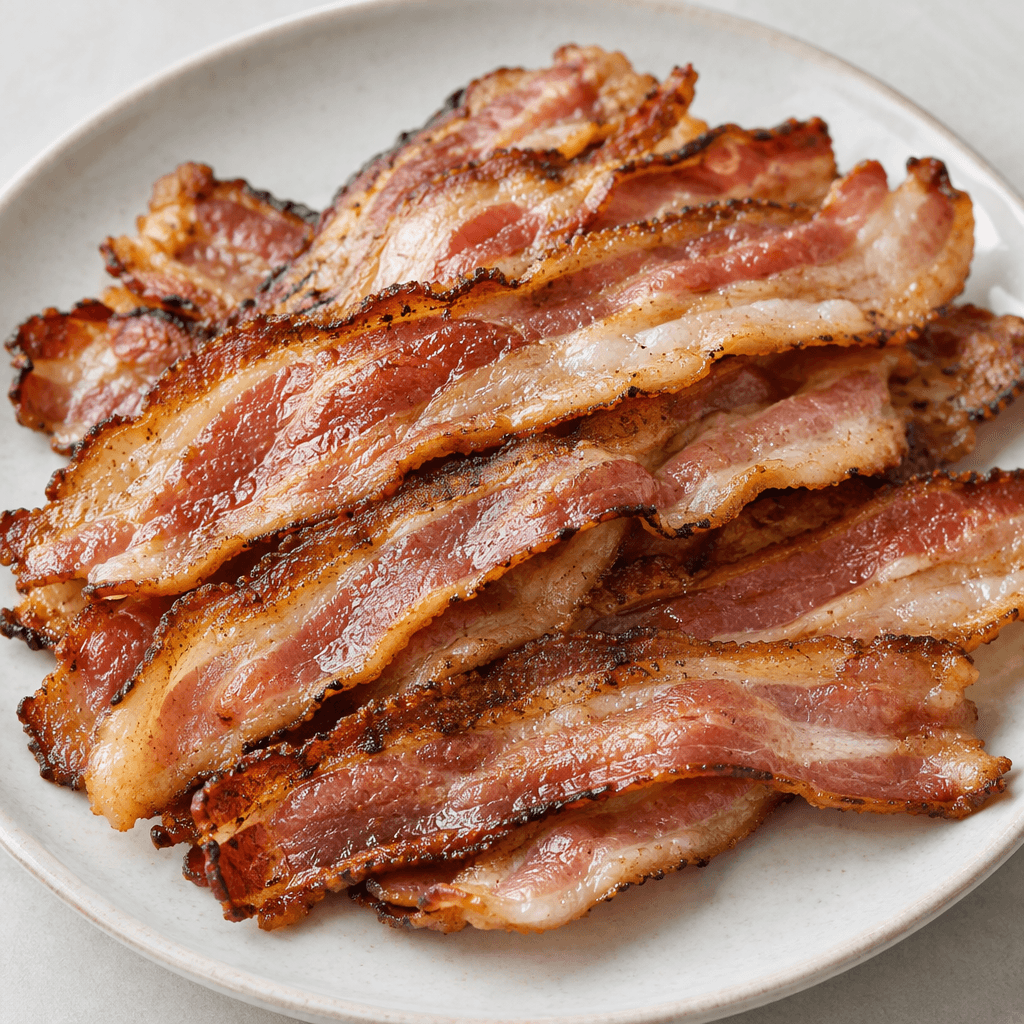
Bacon Calories
High protein and fat, salty, breakfast staple
In season: Spring · Summer · Autumn · Winter
CALORIES
GI
POTASSIUM
FIBER
Quick answer
2 slice (medium) of Bacon (32 g) has 173 calories. That works out to 541 calories per 100 g. It contains 0.4 g of carbs, 11.8 g of protein, 13.4 g of fat and 0 g of fiber. Its 549.4 mg of Sodium covers 24% of the Daily Value. Its glycemic index is 0 (low), so it raises blood sugar slowly.
What is Bacon?
Slanina is a Central and Eastern European cured pork product made from fatty cuts, often with streaks of meat; it may also be smoked. When sliced and cooked, the fat renders and the edges turn crisp, while the flavour stays savoury and salty. In its home region it is served with bread or used to add richness to cooked dishes. Elsewhere, bacon is often eaten at breakfast, alongside eggs or in sandwiches. It is high in both protein and fat, so a little can bring plenty of flavour. Pair it with vegetables or use a smaller portion if you want a less rich meal.
Bacon Nutrition Facts
Selected: 100 g
541
KCAL / 100G
Carbs
1.4g
· 1% DV
Protein
37g
· 74% DV
Fat
42g
· 54% DV
Fiber
0g
· 0% DV
DV is the share of the daily value covered, on a 2,000 kcal reference diet.
Calories come from: Carbs 1% · Protein 28% · Fat 71%
Bacon Vitamins & Minerals
Vitamins
B12
1.5µg · 63% DV
B3
7.8mg · 49% DV
B1
0.54mg · 45% DV
B5
1.1mg · 22% DV
Minerals
Sodium
1717mg · 75% DV
Phosphorus
320mg · 46% DV
Selenium
23µg · 42% DV
Zinc
3mg · 27% DV
How Nutritious Is Bacon?
Nutrient density
Medium
How many vitamins, minerals and how much fiber this food carries per calorie. A high score means a lot of nutrition for few calories.
Satiety score
Low
An EatBetter score computed from fiber, protein and calorie density. A high score means staying full longer on the same calories.
Both scores are calculated per 100 g and do not change with the selected portion. The satiety score is EatBetter's own calculation, not a clinical measure.
Bacon Glycemic Index
GLYCEMIC INDEX
GLYCEMIC LOAD
Accounts for portion size — a more realistic measure than GI alone.
How to Burn Off Bacon
To burn the 541 calories in 100 g:
🚶
Walking (5 km/h)
🏃
Running (8 km/h)
🚴
Cycling
🏊
Swimming
Times are calculated with the MET equation for a 70 kg adult. Actual burn varies with your weight, age and pace.
Is Bacon Processed?
NOVA 3
Processed
1. Unprocessed
2. Minimally Processed
3. Processed
4. Ultra-Processed
NOVA classifies foods into 4 groups by industrial processing. NOVA 1 (unprocessed) is the healthiest.
Does Bacon Contain Allergens?
No known major allergens
Which Diets Is Bacon Good For?
Vegan
— Not suitable
Vegetarian
— Not suitable
Gluten-Free
✓ Suitable
Dairy-Free
— Not suitable
Mediterranean
✓ Suitable
Paleo
✓ Suitable
Whole30
— Not suitable
DASH
— Not suitable
Keto
✓ Suitable
Low FODMAP
— Not suitable
Bacon Fat Profile
SATURATED
14g
MONOUNSATURATED
19g
POLYUNSATURATED
4g
Omega 6:3 ratio 24.6:1
Above the ideal 4:1 (24.6:1).
Compare Bacon
Foods Similar to Bacon
Frequently Asked Questions About Bacon
Is bacon pork?
Yes, bacon is usually made from pork, most often from the belly or back. The cut and curing style vary by region; turkey or beef products sold as bacon are alternatives, not pork bacon.
What cut of meat is bacon made from?
Bacon is most often made from pork belly, which gives it its characteristic layers of meat and fat. Back bacon comes from the loin and is leaner; the cut used depends on the country and style.
How do you cook bacon so it gets crispy?
For crispy bacon, lay the slices in a cold pan in a single layer and cook over medium heat, turning as they brown. Starting slowly lets the fat render; high heat can burn the edges before the slices crisp evenly.
Why does bacon shrink when you cook it?
Bacon shrinks because heat renders out its fat and evaporates moisture from the meat. Slices with more fat may shrink more, especially over high heat; cooking them slowly in a roomy pan helps them brown more evenly.
Can you eat bacon raw?
Ordinary bacon is not ready to eat just because it has been cured or smoked. Cook it thoroughly unless the package specifically says it is fully cooked and ready to eat.
Can you freeze bacon?
Yes, bacon freezes well. Separate the slices into portions and wrap them airtight so you can thaw only what you need. Thaw it in the refrigerator and do not refreeze it after thawing.
How long does bacon last in the fridge after opening?
Opened raw bacon generally keeps in the refrigerator for up to seven days when stored cold and tightly wrapped. Follow the package directions if they give a shorter period, and discard bacon that smells off or feels unusually slimy.
What is the difference between bacon and ham?
Bacon and ham are both commonly made from pork, but they usually come from different cuts and are cured differently. Bacon is often belly or loin and is typically cooked before eating; ham is usually from the hind leg and may be sold ready to eat.
Does eating bacon increase cancer risk?
Frequent consumption of bacon, like other processed meats, is linked with a higher risk of colorectal cancer. That does not mean eating bacon guarantees cancer, but limiting how often and how much you eat is a sensible choice.
Can you cook bacon in an air fryer?
Yes, bacon can be cooked in an air fryer. Arrange the slices in a single layer so hot air can circulate, and watch closely near the end because thin slices can crisp and burn quickly.
Have another question about Bacon?
Ask the AI nutrition coach — calories, portions, alternatives and more, answered in seconds in the app.

Scan calories with your camera
Instant AI nutrition analysis

Nutrition data compiled from USDA FoodData Central and scientific sources.