

Ready & Packaged Foods
All →Vegetables & Legumes
All →Desserts & Confectionery
All →Meat & Protein
All →Grains & Bakery
All →Beverages
All →Milk & Dairy
All →

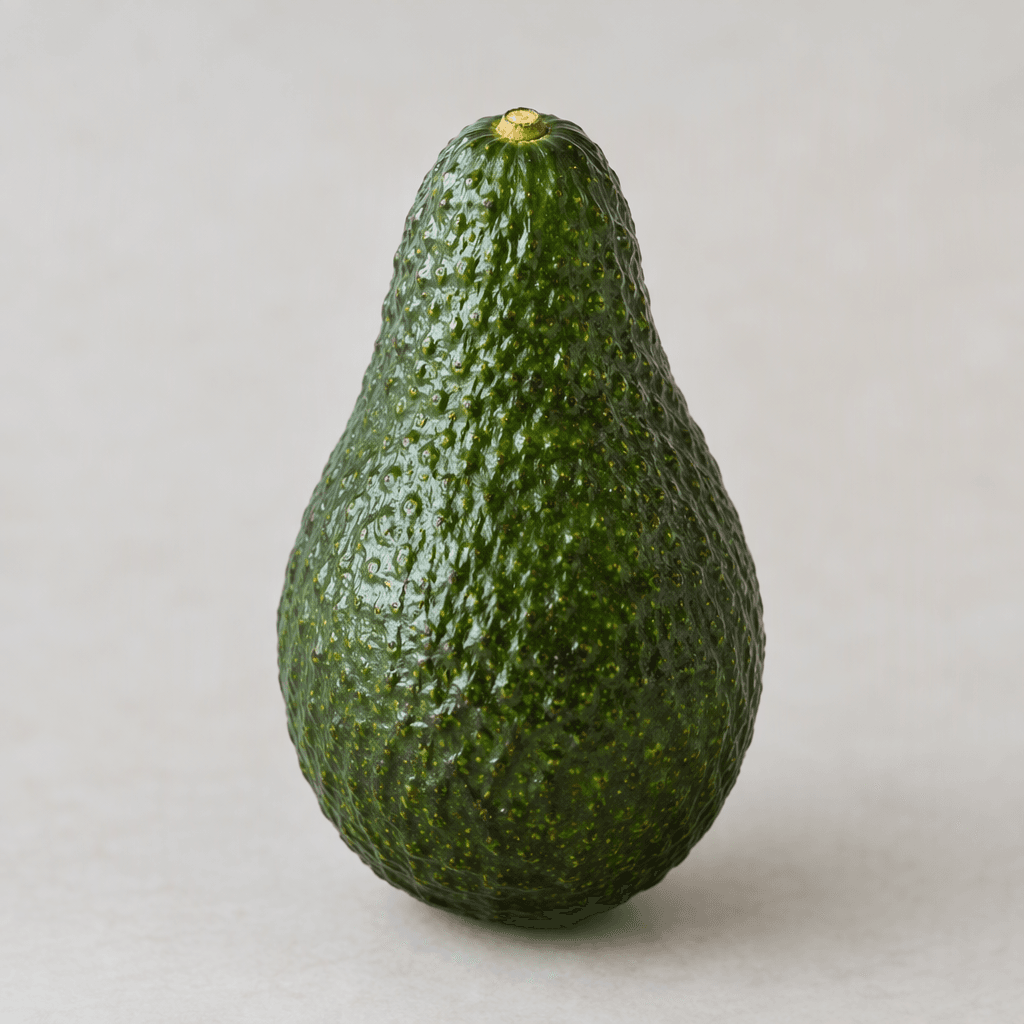
Avocado (Extra Small) Calories
Source of healthy fats, fiber, vitamin E and potassium
In season: Spring · Summer · Autumn · Winter
CALORIES
GI
POTASSIUM
FIBER
Quick answer
1 piece (extra small) of Avocado (Extra Small) (80 g) has 128 calories. That works out to 160 calories per 100 g. It contains 6.8 g of carbs, 1.6 g of protein, 11.8 g of fat and 5.4 g of fiber. Its 1.1 mg of B5 covers 22% of the Daily Value. Its glycemic index is 15 (low), so it raises blood sugar slowly.
What is Avocado (Extra Small)?
An extra-small avocado is the fruit of a tree native to Mexico and Central America. When ripe, its flesh is soft and creamy, with a mild, buttery flavour; it is ready to eat when the skin has darkened and the fruit yields slightly to gentle pressure. Remove the pit and slice it, or mash the flesh for a spread.
Avocado is commonly served on toast, in salads and sandwiches, or alongside eggs and grains, with lime or lemon to brighten its richness. It is a fruit notably rich in unsaturated fat and fibre, so even a small one can add a satisfying, creamy element to a meal. Pair it with crisp vegetables or salsa, and use it in place of a richer spread when you want a lighter topping.
Avocado (Extra Small) Nutrition Facts
Selected: 100 g
160
KCAL / 100G
Carbs
8.5g
· 3% DV
Protein
2g
· 4% DV
Fat
14.7g
· 19% DV
Fiber
6.7g
· 24% DV
DV is the share of the daily value covered, on a 2,000 kcal reference diet.
Calories come from: Carbs 20% · Protein 5% · Fat 75%
Avocado (Extra Small) Vitamins & Minerals
Vitamins
B5
1.39mg · 28% DV
Folate
81µg · 20% DV
Vitamin K
21µg · 18% DV
B6
0.26mg · 15% DV
Minerals
Potassium ⭐
485mg · 14% DV
Zinc
1mg · 9% DV
Magnesium
29mg · 7% DV
Phosphorus
52mg · 7% DV
How Nutritious Is Avocado (Extra Small)?
Nutrient density
Very high
How many vitamins, minerals and how much fiber this food carries per calorie. A high score means a lot of nutrition for few calories.
Satiety score
Medium
An EatBetter score computed from fiber, protein and calorie density. A high score means staying full longer on the same calories.
Both scores are calculated per 100 g and do not change with the selected portion. The satiety score is EatBetter's own calculation, not a clinical measure.
Avocado (Extra Small) Glycemic Index
GLYCEMIC INDEX
GLYCEMIC LOAD
Accounts for portion size — a more realistic measure than GI alone.
How to Burn Off Avocado (Extra Small)
To burn the 160 calories in 100 g:
🚶
Walking (5 km/h)
🏃
Running (8 km/h)
🚴
Cycling
🏊
Swimming
Times are calculated with the MET equation for a 70 kg adult. Actual burn varies with your weight, age and pace.
Is Avocado (Extra Small) Processed?
NOVA 1
Unprocessed
1. Unprocessed
2. Minimally Processed
3. Processed
4. Ultra-Processed
NOVA classifies foods into 4 groups by industrial processing. NOVA 1 (unprocessed) is the healthiest.
Does Avocado (Extra Small) Contain Allergens?
No known major allergens
Which Diets Is Avocado (Extra Small) Good For?
Vegan
✓ Suitable
Vegetarian
✓ Suitable
Gluten-Free
✓ Suitable
Dairy-Free
— Not suitable
Mediterranean
✓ Suitable
Paleo
✓ Suitable
Whole30
— Not suitable
DASH
— Not suitable
Keto
✓ Suitable
Low FODMAP
— Not suitable
Avocado (Extra Small) Fat Profile
SATURATED
2.13g
MONOUNSATURATED
9.8g
POLYUNSATURATED
1.8g
Omega 6:3 ratio 15.2:1
Above the ideal 4:1 (15.2:1).
Compare Avocado (Extra Small)
Foods Similar to Avocado (Extra Small)
Frequently Asked Questions About Avocado (Extra Small)
How can you tell when an extra-small avocado is ripe?
A ripe extra-small avocado yields slightly when you press it gently, without feeling mushy. Check around the stem too: avoid fruit with mold or a sour smell. Don’t squeeze hard, since bruising can make the flesh brown.
Can you eat an extra-small avocado raw?
Yes, an extra-small avocado is commonly eaten raw. Cut it open, remove the pit, and scoop out the flesh for toast, salads, or dips. Its creamy texture also works well with a little lime or lemon juice.
Can you freeze an extra-small avocado?
Yes, but an extra-small avocado will be softer after thawing, so it works better in spreads or smoothies than in slices. Remove the skin and pit, mash the flesh with a little lemon or lime juice, and freeze it in an airtight container.
Why does an extra-small avocado turn brown after it’s cut?
An extra-small avocado turns brown when enzymes in its flesh react with oxygen in the air. This surface discoloration is usually oxidation, not spoilage. Brush the cut surface with lemon juice and cover it tightly to slow the change.
Is the pit of an extra-small avocado edible?
No, the pit of an extra-small avocado is not normally eaten. It is hard and can pose a choking risk, and grinding it at home doesn’t make it a practical food. Remove the pit before serving the flesh.
How do you cut an extra-small avocado safely?
Set the extra-small avocado on a stable cutting board and slice around the pit lengthwise, turning the fruit rather than forcing the knife through it. Twist the halves apart, then scoop out the pit with a spoon instead of striking it with a blade.
How should you store a ripe extra-small avocado?
Keep a ripe extra-small avocado in the refrigerator to slow further softening. If it has already been cut, cover the exposed flesh tightly or place it in an airtight container and use it soon, since air causes browning.
Can dogs eat extra-small avocado?
It’s best not to give dogs extra-small avocado as a treat. The pit can cause choking or an intestinal blockage, and the flesh may upset a dog’s stomach. Keep the whole fruit out of reach, especially if your dog may swallow the pit.
How can you tell if an extra-small avocado has gone bad?
Discard an extra-small avocado if it has mold, a sour or rancid smell, or flesh that is slimy or extensively discolored. A small brown patch from air exposure can often be trimmed away if the rest smells fresh and has a normal texture.
Can you cook an extra-small avocado?
Yes, you can cook an extra-small avocado, but prolonged high heat can make it bitter and mushy. Add slices near the end of cooking, or briefly grill the halves; raw avocado is usually better for dips and creamy toppings.
Have another question about Avocado (Extra Small)?
Ask the AI nutrition coach — calories, portions, alternatives and more, answered in seconds in the app.

Scan calories with your camera
Instant AI nutrition analysis

Nutrition data compiled from USDA FoodData Central and scientific sources.