

Ready & Packaged Foods
All →Vegetables & Legumes
All →Desserts & Confectionery
All →Meat & Protein
All →Grains & Bakery
All →Beverages
All →Milk & Dairy
All →

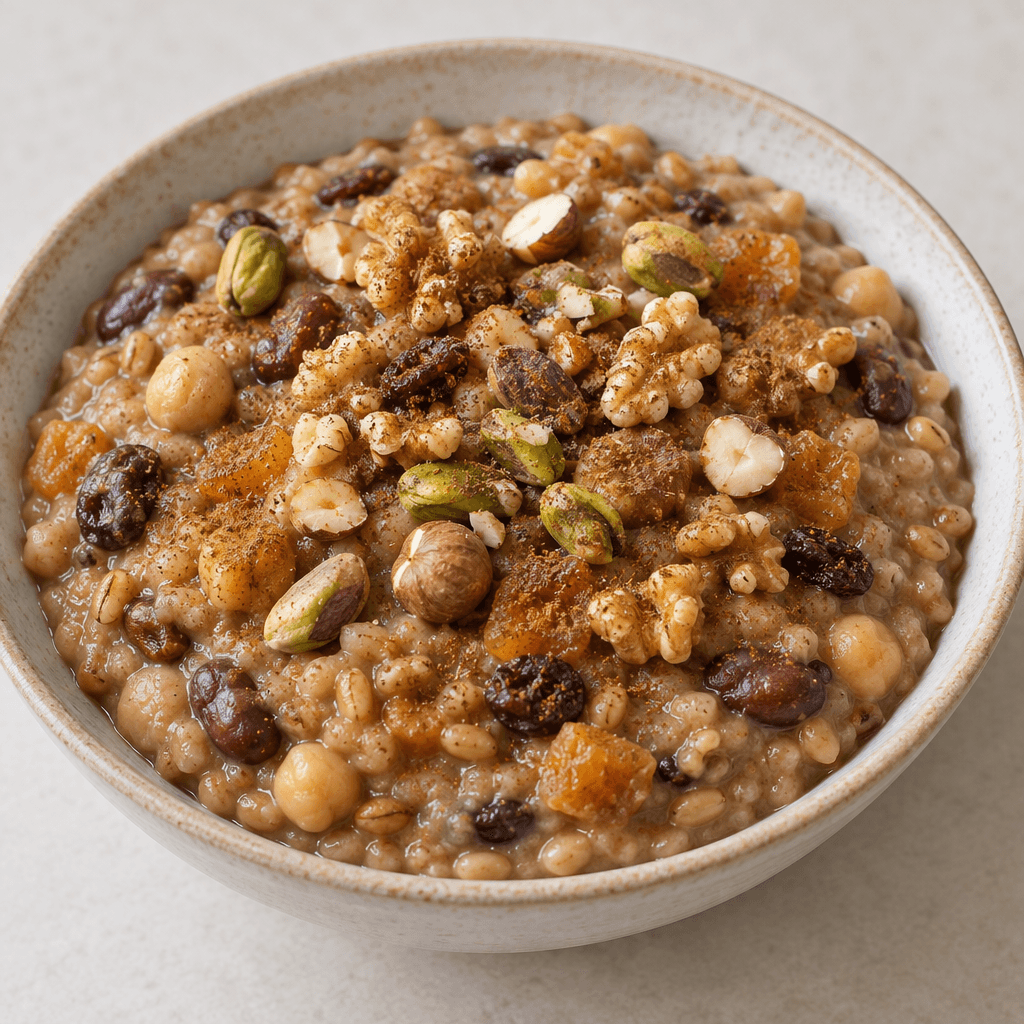
Ashure (Noah's Pudding) Calories
Traditional Turkish dessert, multi-grain and legume, dried fruits and nuts
In season: Autumn · Winter
CALORIES
GI
POTASSIUM
FIBER
Quick answer
1 bottle (medium) of Ashure (Noah's Pudding) (200 g) has 240 calories. That works out to 120 calories per 100 g. It contains 51 g of carbs, 5.2 g of protein, 3.6 g of fat and 5 g of fiber. Its 0.2 mg of Copper covers 18% of the Daily Value. Its glycemic index is 65 (medium), so it raises blood sugar at a moderate pace.
What is Ashure (Noah's Pudding)?
Ashure, often called Noah’s Pudding, is a Turkish dessert made by simmering wheat with chickpeas, beans and dried fruit. Recipes vary, but raisins, apricots and figs are common additions, with nuts often used as a garnish.
Thick and spoonable, it is usually served cool or at room temperature, topped with cinnamon and chopped nuts. In Turkey, families traditionally make a large batch during Muharram and share bowls with neighbours and relatives; Turkish communities abroad often keep the custom too. The grains, legumes and fruit give ashure a mix of carbohydrates and fibre, with 2.5 g of fibre per 100 g. For a less sweet bowl, choose a serving with modest added sugar and a lighter hand with the toppings.
Ashure (Noah's Pudding) Nutrition Facts
Selected: 100 g
120
KCAL / 100G
Carbs
25.5g
· 9% DV
Protein
2.6g
· 5% DV
Fat
1.8g
· 2% DV
Fiber
2.5g
· 9% DV
DV is the share of the daily value covered, on a 2,000 kcal reference diet.
Calories come from: Carbs 79% · Protein 8% · Fat 13%
Ashure (Noah's Pudding) Vitamins & Minerals
Vitamins
B1
0.04mg · 3% DV
B5
0.13mg · 3% DV
B2
0.03mg · 2% DV
B3
0.3mg · 2% DV
Minerals
Iron
1mg · 6% DV
Phosphorus
32mg · 5% DV
Magnesium
13mg · 3% DV
Calcium
18mg · 2% DV
How Nutritious Is Ashure (Noah's Pudding)?
Nutrient density
Medium
How many vitamins, minerals and how much fiber this food carries per calorie. A high score means a lot of nutrition for few calories.
Satiety score
Medium
An EatBetter score computed from fiber, protein and calorie density. A high score means staying full longer on the same calories.
Both scores are calculated per 100 g and do not change with the selected portion. The satiety score is EatBetter's own calculation, not a clinical measure.
Ashure (Noah's Pudding) Glycemic Index
GLYCEMIC INDEX
GLYCEMIC LOAD
Accounts for portion size — a more realistic measure than GI alone.
How to Burn Off Ashure (Noah's Pudding)
To burn the 120 calories in 100 g:
🚶
Walking (5 km/h)
🏃
Running (8 km/h)
🚴
Cycling
🏊
Swimming
Times are calculated with the MET equation for a 70 kg adult. Actual burn varies with your weight, age and pace.
Is Ashure (Noah's Pudding) Processed?
NOVA 2
Minimally Processed
1. Unprocessed
2. Minimally Processed
3. Processed
4. Ultra-Processed
NOVA classifies foods into 4 groups by industrial processing. NOVA 1 (unprocessed) is the healthiest.
Does Ashure (Noah's Pudding) Contain Allergens?
Contains these allergens:
Which Diets Is Ashure (Noah's Pudding) Good For?
Vegan
✓ Suitable
Vegetarian
✓ Suitable
Gluten-Free
— Not suitable
Dairy-Free
— Not suitable
Mediterranean
✓ Suitable
Paleo
— Not suitable
Whole30
— Not suitable
DASH
— Not suitable
Keto
— Not suitable
Low FODMAP
— Not suitable
Ashure (Noah's Pudding) Fat Profile
SATURATED
0.3g
MONOUNSATURATED
0.6g
POLYUNSATURATED
0.7g
Omega 6:3 ratio 3:1
Below the ideal 4:1 — a good omega balance.
Compare Ashure (Noah's Pudding)
Foods Similar to Ashure (Noah's Pudding)
Frequently Asked Questions About Ashure (Noah's Pudding)
What is Ashure (Noah's Pudding)?
Ashure (Noah's Pudding) is a Turkish spoonable dessert made by cooking wheat with legumes, dried fruit, and sweetener. It is commonly finished with toppings such as nuts, cinnamon, or pomegranate, and its ingredients vary between households.
Why is Ashure (Noah's Pudding) made and shared?
Ashure (Noah's Pudding) is traditionally prepared and shared in Turkey during Muharram as a gesture of community and generosity. It is also linked in popular tradition to Noah's Ark, though stories and customs surrounding the dessert vary.
What ingredients go into Ashure (Noah's Pudding)?
Ashure (Noah's Pudding) commonly contains wheat berries, chickpeas, beans, raisins, and other dried fruit, cooked with water and sweetener. Chopped walnuts, hazelnuts, pistachios, cinnamon, or pomegranate are often added on top; family recipes differ.
How do you make Ashure (Noah's Pudding)?
To make Ashure (Noah's Pudding), cook softened wheat until tender, then add cooked chickpeas and beans, dried fruit, sweetener, and enough water to make a thick pudding. Simmer until the flavors combine, then serve in bowls with toppings.
When is Ashure (Noah's Pudding) traditionally eaten?
Ashure (Noah's Pudding) is most closely associated with Muharram, the first month of the Islamic calendar, and is often shared around the Day of Ashura. The date shifts on the Gregorian calendar, and people also make it at other times.
Is Ashure (Noah's Pudding) the same as Noah's pudding?
Yes, “Noah's Pudding” is a common English name for Ashure, the Turkish dessert. The name reflects a traditional story connecting the dish with Noah's Ark; it does not mean every version follows one fixed recipe.
Why does Ashure (Noah's Pudding) thicken as it cools?
Ashure (Noah's Pudding) thickens because wheat releases starch into the cooking liquid, and the mixture sets further as it cools. If it becomes too thick, stir in a little hot water before serving and warm it gently if needed.
How long does Ashure (Noah's Pudding) last in the fridge?
Ashure (Noah's Pudding) keeps for about 3–4 days in the refrigerator when stored promptly in a covered container. Refrigerate leftovers rather than leaving them at room temperature, and add crunchy nut toppings just before serving.
Can you freeze Ashure (Noah's Pudding)?
Yes, you can freeze Ashure (Noah's Pudding), although thawing may soften the grains and change its texture. Freeze it in sealed portions without the nut garnish, thaw it in the refrigerator, and stir well before serving.
Can people with diabetes eat Ashure (Noah's Pudding)?
People with diabetes may be able to include Ashure (Noah's Pudding) in a meal, but should account for its wheat, legumes, dried fruit, and added sweetener. Portion size and individual glucose responses matter, so a clinician or dietitian can help tailor advice.
Have another question about Ashure (Noah's Pudding)?
Ask the AI nutrition coach — calories, portions, alternatives and more, answered in seconds in the app.

Scan calories with your camera
Instant AI nutrition analysis

Nutrition data compiled from USDA FoodData Central and scientific sources.