

Ready & Packaged Foods
All →Vegetables & Legumes
All →Desserts & Confectionery
All →Meat & Protein
All →Grains & Bakery
All →Beverages
All →Milk & Dairy
All →

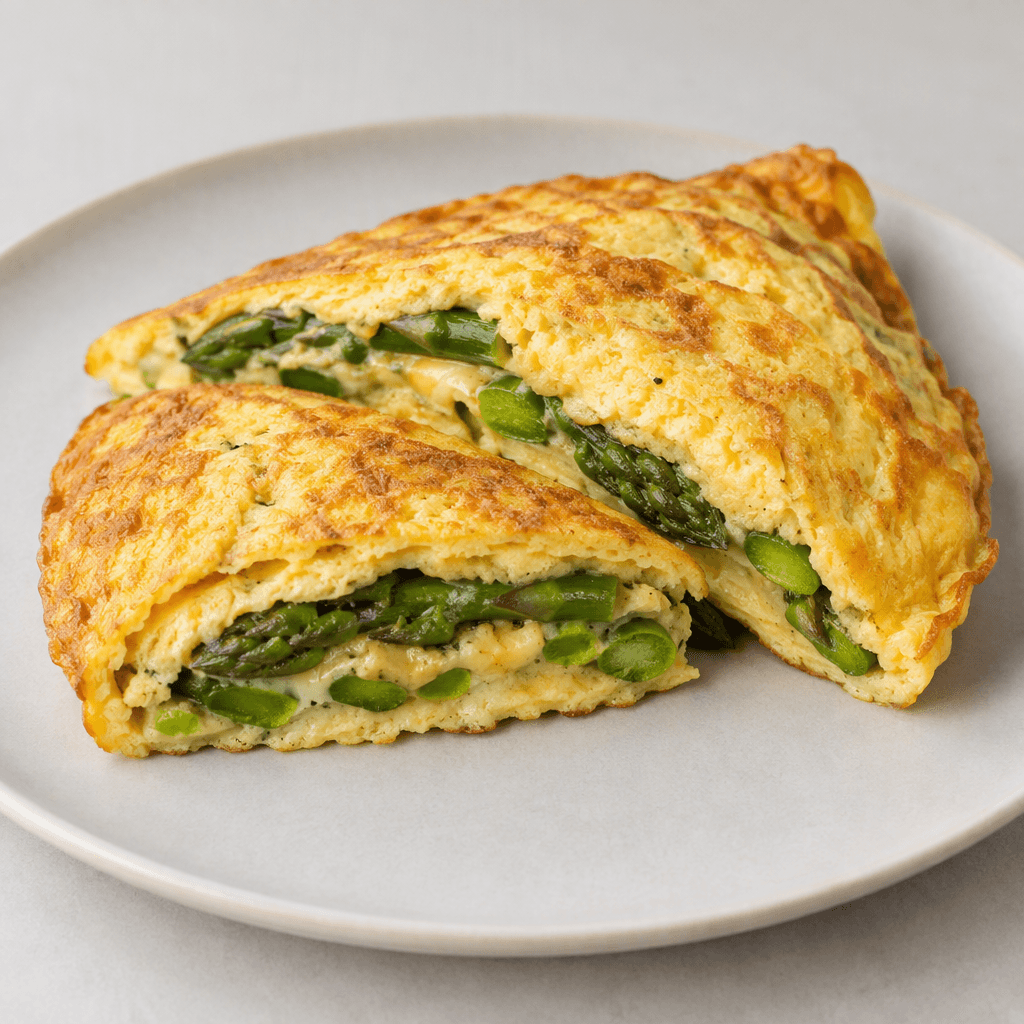
Asparagus omelette Calories
Protein-rich omelette with asparagus, high in vitamins and minerals.
In season: Spring
CALORIES
GI
POTASSIUM
FIBER
Quick answer
1 piece (medium) of Asparagus omelette (120 g) has 144 calories. That works out to 120 calories per 100 g. It contains 3.7 g of carbs, 11.6 g of protein, 9.2 g of fat and 1.8 g of fiber. Its 15.6 µg of Biotin covers 52% of the Daily Value. Its glycemic index is 25 (low), so it raises blood sugar slowly.
What is Asparagus omelette?
An asparagus omelette brings briefly cooked asparagus together with beaten eggs, cooked in a pan and often folded over. It is an easy home-cooked dish rather than a preparation tied to one specific region, and works especially well when fresh asparagus is in season.
The eggs make a soft, tender base, while the asparagus adds a fresh, mildly grassy flavour and a little bite. Serve it warm for brunch or a light lunch, with toast, salad or simply dressed greens; it also makes a quick supper. It provides 9.7 g of protein per 100 g, so it can make a satisfying meal. For a lighter version, use a little oil and avoid overcooking the asparagus.
Asparagus omelette Nutrition Facts
Selected: 100 g
120
KCAL / 100G
Carbs
3.1g
· 1% DV
Protein
9.7g
· 19% DV
Fat
7.7g
· 10% DV
Fiber
1.5g
· 5% DV
DV is the share of the daily value covered, on a 2,000 kcal reference diet.
Calories come from: Carbs 10% · Protein 32% · Fat 58%
Asparagus omelette Vitamins & Minerals
Vitamins
Biotin
13µg · 43% DV
B12
0.7µg · 29% DV
Vitamin K
28µg · 23% DV
Vitamin A
160µg · 18% DV
Minerals
Selenium
13µg · 24% DV
Phosphorus
155mg · 22% DV
Iodine
18µg · 12% DV
Zinc
1mg · 9% DV
How Nutritious Is Asparagus omelette?
Nutrient density
High
How many vitamins, minerals and how much fiber this food carries per calorie. A high score means a lot of nutrition for few calories.
Satiety score
Medium
An EatBetter score computed from fiber, protein and calorie density. A high score means staying full longer on the same calories.
Both scores are calculated per 100 g and do not change with the selected portion. The satiety score is EatBetter's own calculation, not a clinical measure.
Asparagus omelette Glycemic Index
GLYCEMIC INDEX
GLYCEMIC LOAD
Accounts for portion size — a more realistic measure than GI alone.
How to Burn Off Asparagus omelette
To burn the 120 calories in 100 g:
🚶
Walking (5 km/h)
🏃
Running (8 km/h)
🚴
Cycling
🏊
Swimming
Times are calculated with the MET equation for a 70 kg adult. Actual burn varies with your weight, age and pace.
Is Asparagus omelette Processed?
NOVA 2
Minimally Processed
1. Unprocessed
2. Minimally Processed
3. Processed
4. Ultra-Processed
NOVA classifies foods into 4 groups by industrial processing. NOVA 1 (unprocessed) is the healthiest.
Does Asparagus omelette Contain Allergens?
Contains these allergens:
Which Diets Is Asparagus omelette Good For?
Vegan
— Not suitable
Vegetarian
✓ Suitable
Gluten-Free
✓ Suitable
Dairy-Free
— Not suitable
Mediterranean
✓ Suitable
Paleo
— Not suitable
Whole30
— Not suitable
DASH
— Not suitable
Keto
— Not suitable
Low FODMAP
— Not suitable
Asparagus omelette Fat Profile
SATURATED
2.3g
MONOUNSATURATED
2.7g
POLYUNSATURATED
1g
Omega 6:3 ratio 7.8:1
Above the ideal 4:1 (7.8:1).
Compare Asparagus omelette
Foods Similar to Asparagus omelette
Frequently Asked Questions About Asparagus omelette
How do you make an asparagus omelette?
To make an asparagus omelette, sauté trimmed asparagus until tender, then pour beaten eggs into the pan. Cook over moderate-low heat until the eggs are set, fold the omelette, and serve. Cutting the spears into bite-sized pieces helps distribute them evenly.
Do you need to blanch asparagus before making an asparagus omelette?
No, blanching is not necessary for an asparagus omelette; sautéing the asparagus in the pan is usually enough. Very thick spears may need extra cooking, so soften them before adding the eggs to prevent crisp, undercooked pieces in the finished omelette.
What cheese goes best in an asparagus omelette?
Parmesan, goat cheese, feta, and Gruyère all pair well with an asparagus omelette. Parmesan adds a savory finish, while goat cheese or feta brings tanginess. Add salty cheeses sparingly so they do not overpower the asparagus or make the eggs too salty.
Can you use leftover cooked asparagus in an asparagus omelette?
Yes, leftover cooked asparagus works well in an asparagus omelette. Drain or blot away any moisture first, then warm the pieces briefly in the pan before adding the eggs. Since the asparagus is already cooked, avoid prolonged heating that could make it mushy.
Why does asparagus make an omelette watery?
Asparagus can make an omelette watery when it releases moisture into the eggs during cooking. Sauté the spears first until excess liquid evaporates, and avoid crowding the pan. If using thawed or canned asparagus, drain it thoroughly before adding it.
What herbs go well in an asparagus omelette?
Chives, parsley, dill, and tarragon all complement an asparagus omelette. Chives give a mild onion note, while dill and tarragon make the flavor more aromatic. Add fresh herbs near the end of cooking so their flavor stays bright.
Can you make an asparagus omelette without milk?
Yes, an asparagus omelette needs no milk; eggs alone set into a tender omelette when cooked gently. Milk is optional, but adding too much can loosen the egg mixture and make the omelette harder to cook through without becoming watery.
Is an asparagus omelette the same as a frittata?
No, an asparagus omelette is usually cooked in a pan and folded around its filling. A frittata mixes the asparagus into the eggs and is cooked as a thicker, open-faced dish, often finished in the oven. Both can use similar ingredients.
What should you serve with an asparagus omelette?
An asparagus omelette pairs well with toast, a green salad, or roasted potatoes. For brunch, serve it with fruit or grilled tomatoes; for a lighter meal, a simple salad keeps the asparagus and eggs at the center of the plate.
Can you eat an asparagus omelette cold?
Yes, you can eat an asparagus omelette cold if it was refrigerated promptly after cooking. Keep it covered in the refrigerator and do not leave it sitting out for a long time. Its texture is usually better warm, but it also works in a packed lunch.
Have another question about Asparagus omelette?
Ask the AI nutrition coach — calories, portions, alternatives and more, answered in seconds in the app.

Scan calories with your camera
Instant AI nutrition analysis

Nutrition data compiled from USDA FoodData Central and scientific sources.