

Ready & Packaged Foods
All →Vegetables & Legumes
All →Desserts & Confectionery
All →Meat & Protein
All →Grains & Bakery
All →Beverages
All →Milk & Dairy
All →

Ajwa date Calories
Rich in minerals and fiber, natural source of sugars
In season: Autumn · Winter
CALORIES
GI
POTASSIUM
FIBER
Quick answer
3 piece (medium) of Ajwa date (24 g) has 66 calories. That works out to 277 calories per 100 g. It contains 18 g of carbs, 0.4 g of protein, 0 g of fat and 1.6 g of fiber. Its 0.1 mg of Copper covers 8% of the Daily Value. Its glycemic index is 42 (medium), so it raises blood sugar at a moderate pace.
What is Ajwa date?
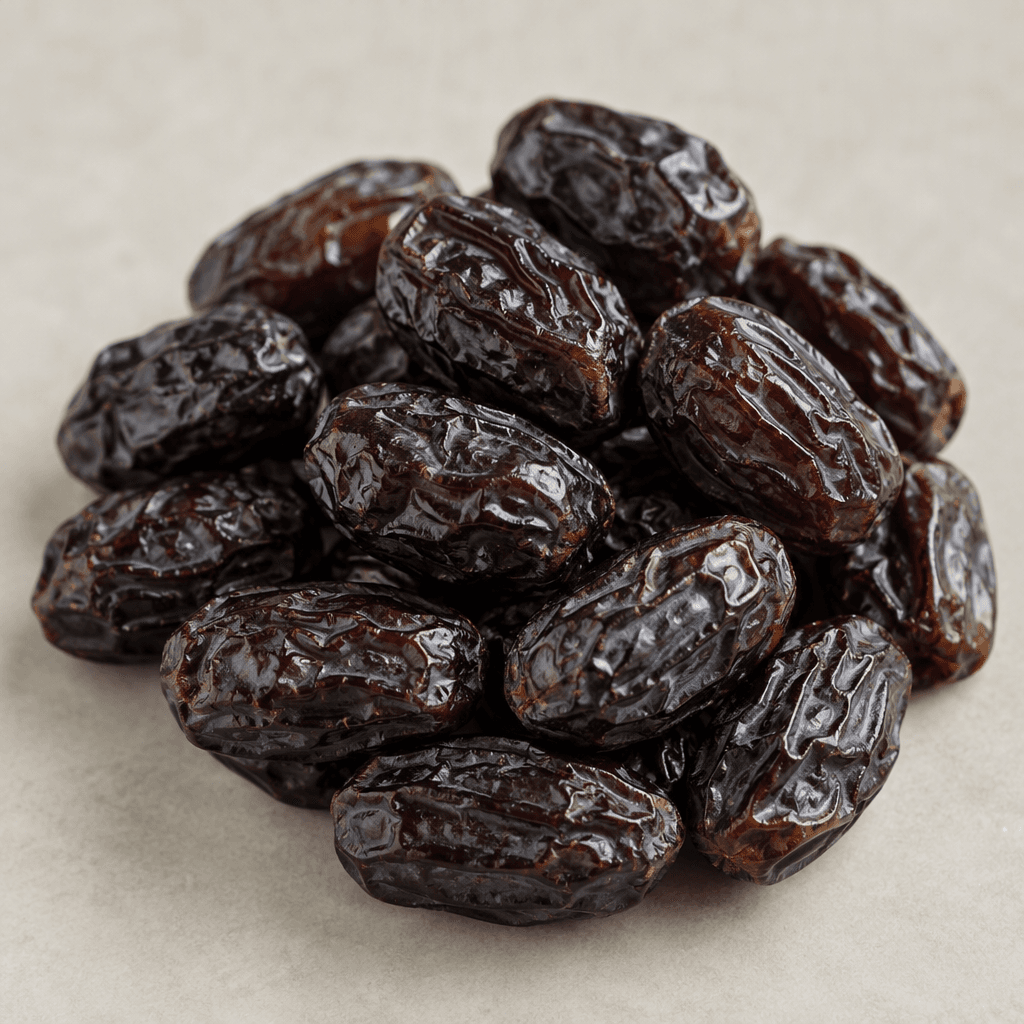
Ajwa dates are a small, dark variety of date traditionally associated with Medina in Saudi Arabia. Their wrinkled skins give way to a soft, dense bite, with a mellow caramel-like sweetness. In the places where they are grown, they are commonly eaten as a snack and are especially familiar at Ramadan, often served to break the fast. They also work well chopped into porridge, yoghurt or baked goods; for readers elsewhere, pair them with nuts or coffee for a simple snack.
They provide natural sugars along with fibre, so they are sweet and energy-dense rather than a low-sugar fruit. Their concentrated sweetness means one or a few can be satisfying on their own.
Ajwa date Nutrition Facts
Selected: 100 g
277
KCAL / 100G
Carbs
74.9g
· 27% DV
Protein
1.8g
· 4% DV
Fat
0.2g
· 0% DV
Fiber
6.7g
· 24% DV
DV is the share of the daily value covered, on a 2,000 kcal reference diet.
Calories come from: Carbs 97% · Protein 2% · Fat 1%
Ajwa date Vitamins & Minerals
Vitamins
B5
0.8mg · 16% DV
B6
0.24mg · 14% DV
B3
1.6mg · 10% DV
B2
0.06mg · 5% DV
Minerals
Potassium ⭐
696mg · 20% DV
Magnesium
54mg · 13% DV
Phosphorus
62mg · 9% DV
Calcium
64mg · 6% DV
How Nutritious Is Ajwa date?
Nutrient density
High
How many vitamins, minerals and how much fiber this food carries per calorie. A high score means a lot of nutrition for few calories.
Satiety score
Medium
An EatBetter score computed from fiber, protein and calorie density. A high score means staying full longer on the same calories.
Both scores are calculated per 100 g and do not change with the selected portion. The satiety score is EatBetter's own calculation, not a clinical measure.
Ajwa date Glycemic Index
GLYCEMIC INDEX
GLYCEMIC LOAD
Accounts for portion size — a more realistic measure than GI alone.
How to Burn Off Ajwa date
To burn the 277 calories in 100 g:
🚶
Walking (5 km/h)
🏃
Running (8 km/h)
🚴
Cycling
🏊
Swimming
Times are calculated with the MET equation for a 70 kg adult. Actual burn varies with your weight, age and pace.
Is Ajwa date Processed?
NOVA 1
Unprocessed
1. Unprocessed
2. Minimally Processed
3. Processed
4. Ultra-Processed
NOVA classifies foods into 4 groups by industrial processing. NOVA 1 (unprocessed) is the healthiest.
Does Ajwa date Contain Allergens?
No known major allergens
Which Diets Is Ajwa date Good For?
Vegan
✓ Suitable
Vegetarian
✓ Suitable
Gluten-Free
✓ Suitable
Dairy-Free
— Not suitable
Mediterranean
✓ Suitable
Paleo
✓ Suitable
Whole30
— Not suitable
DASH
— Not suitable
Keto
— Not suitable
Low FODMAP
— Not suitable
Ajwa date Fat Profile
SATURATED
0.05g
MONOUNSATURATED
0.03g
POLYUNSATURATED
0.04g
Omega 6:3 ratio 3:1
Below the ideal 4:1 — a good omega balance.
Compare Ajwa date
Foods Similar to Ajwa date
Frequently Asked Questions About Ajwa date
What are Ajwa dates known for?
Ajwa dates are known for their dark, small, oval shape and their association with Medina, Saudi Arabia. They have a mildly sweet, dense flesh and a distinctive cultural and religious significance, which sets them apart from many larger, softer date varieties.
Are Ajwa dates really from Medina?
Ajwa dates are traditionally associated with Medina, where the variety has been cultivated for generations. The name refers to a particular date variety, though dates sold as Ajwa may be grown elsewhere; origin and authenticity are best confirmed by the seller.
How many Ajwa dates should you eat a day?
There is no fixed daily number that suits everyone. Three medium Ajwa dates are a typical serving; they contain natural sugars, so consider that portion within your overall meals rather than treating dates as an unlimited snack.
What is the difference between Ajwa and Medjool dates?
Ajwa dates are usually smaller, darker, and less plump than Medjool dates, which tend to be large, soft, and caramel-sweet. They are distinct varieties, but either can work in recipes; expect a difference in sweetness and texture.
How do you store Ajwa dates, and how long do they last?
Keep Ajwa dates in an airtight container in a cool, dry place, or refrigerate them to help preserve their quality for longer. Discard them if you see mold or notice a sour, fermented smell; drying or wrinkling alone is common in dates.
Can you eat Ajwa dates during pregnancy?
Ajwa dates can be eaten during pregnancy as a food, but claims that they guarantee an easier labor are not established for this specific variety. If you have gestational diabetes or another dietary restriction, ask your clinician how to include them.
Do Ajwa dates have a pit, and can you eat it?
Ajwa dates have a hard central pit that should be removed rather than swallowed. Split the date or bite carefully and take the pit out before eating; the flesh is the part normally eaten, while the seed is not a usual snack.
Are Ajwa dates traditionally eaten seven at a time?
Some Muslims eat seven Ajwa dates in keeping with a religious narration about the variety. This is a faith-based tradition, not a medically established dose or a guarantee of protection from poisoning or illness.
What do Ajwa dates taste like?
Ajwa dates taste gently sweet, with a dense, slightly chewy flesh rather than the very soft, syrupy texture of some larger dates. Their dark skin can be finely wrinkled; the exact sweetness and softness vary with ripeness and storage.
How can you tell if Ajwa dates are authentic?
You cannot reliably verify an Ajwa date from appearance alone: its small size and deep color are clues, not proof of origin. Buy from a seller who identifies the harvest or source, and be cautious of claims that promise health effects.
Have another question about Ajwa date?
Ask the AI nutrition coach — calories, portions, alternatives and more, answered in seconds in the app.

Scan calories with your camera
Instant AI nutrition analysis

Nutrition data compiled from USDA FoodData Central and scientific sources.