

Ready & Packaged Foods
All →Vegetables & Legumes
All →Desserts & Confectionery
All →Meat & Protein
All →Grains & Bakery
All →Beverages
All →Milk & Dairy
All →

Acika Calories
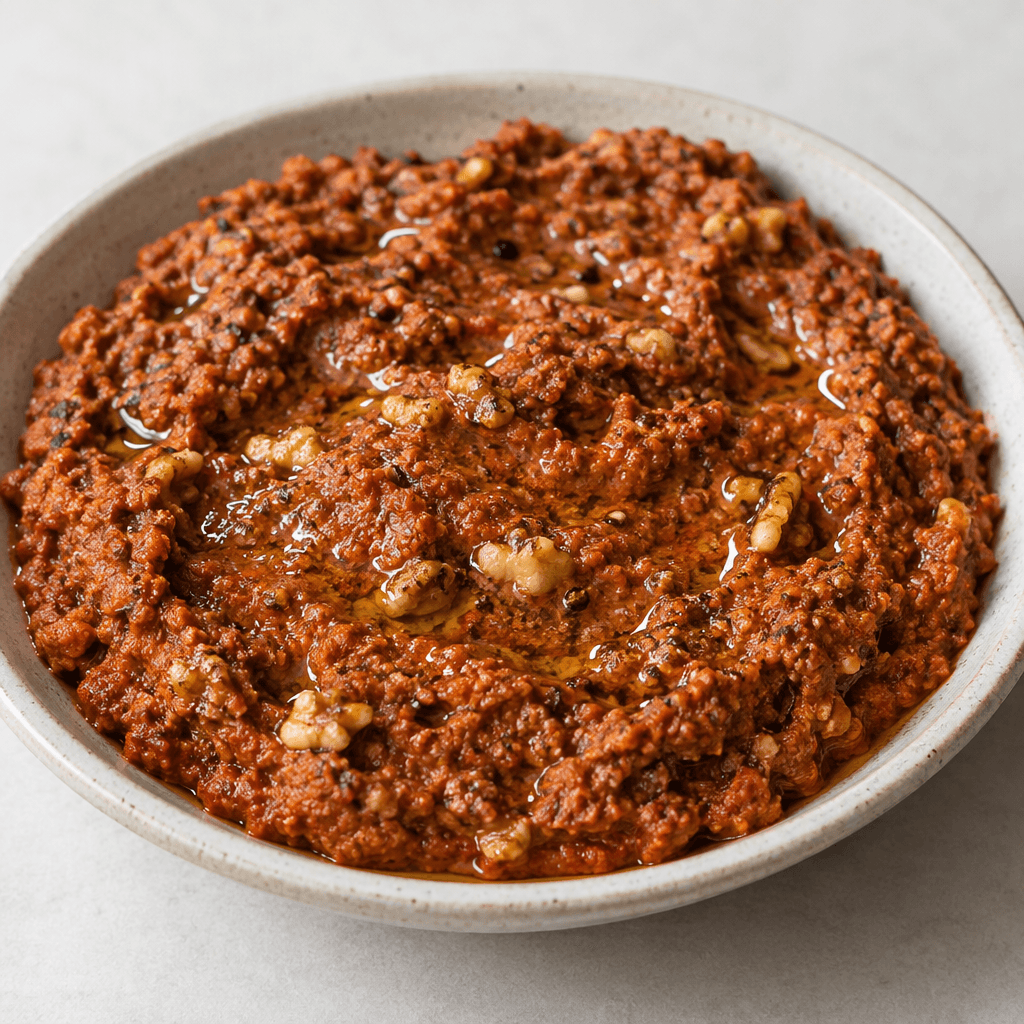
Spicy, walnut-based, breakfast spread
In season: Spring · Summer · Autumn · Winter
CALORIES
GI
POTASSIUM
FIBER
Quick answer
2 tablespoon (medium) of Acika (30 g) has 96 calories. That works out to 320 calories per 100 g. It contains 5.4 g of carbs, 2.2 g of protein, 7.2 g of fat and 1.7 g of fiber. Its 0.2 mg of Copper covers 17% of the Daily Value. Its glycemic index is 35 (low), so it raises blood sugar slowly.
What is Acika?
Acika is a thick, spicy spread inspired by Caucasian pepper pastes and commonly made in Turkey with walnuts, pepper or tomato paste, garlic and spices; some recipes also use breadcrumbs. The exact mix varies from kitchen to kitchen. Coarsely ground walnuts give it a rich, slightly crunchy texture, while the peppers and seasonings bring a savoury heat.
In Turkey, it is often spread on bread at breakfast and served alongside cheese, olives and tea. Elsewhere, it works well as a bold bread spread, a dip for raw vegetables or a small accompaniment to grilled foods. It is rich and satisfying, so a little goes a long way; pair it with fresh vegetables or plain yoghurt to balance its intensity.
Acika Nutrition Facts
Selected: 100 g
320
KCAL / 100G
Carbs
18g
· 7% DV
Protein
7.2g
· 14% DV
Fat
24g
· 31% DV
Fiber
5.5g
· 20% DV
DV is the share of the daily value covered, on a 2,000 kcal reference diet.
Calories come from: Carbs 23% · Protein 9% · Fat 68%
Acika Vitamins & Minerals
Vitamins
Vitamin C
18mg · 20% DV
Vitamin E
2.8mg · 19% DV
B6
0.3mg · 18% DV
B1
0.18mg · 15% DV
Minerals
Copper
1mg · 111% DV
Manganese
1mg · 43% DV
Sodium
480mg · 21% DV
Phosphorus
110mg · 16% DV
How Nutritious Is Acika?
Nutrient density
Medium
How many vitamins, minerals and how much fiber this food carries per calorie. A high score means a lot of nutrition for few calories.
Satiety score
Medium
An EatBetter score computed from fiber, protein and calorie density. A high score means staying full longer on the same calories.
Both scores are calculated per 100 g and do not change with the selected portion. The satiety score is EatBetter's own calculation, not a clinical measure.
Acika Glycemic Index
GLYCEMIC INDEX
GLYCEMIC LOAD
Accounts for portion size — a more realistic measure than GI alone.
How to Burn Off Acika
To burn the 320 calories in 100 g:
🚶
Walking (5 km/h)
🏃
Running (8 km/h)
🚴
Cycling
🏊
Swimming
Times are calculated with the MET equation for a 70 kg adult. Actual burn varies with your weight, age and pace.
Is Acika Processed?
NOVA 3
Processed
1. Unprocessed
2. Minimally Processed
3. Processed
4. Ultra-Processed
NOVA classifies foods into 4 groups by industrial processing. NOVA 1 (unprocessed) is the healthiest.
Does Acika Contain Allergens?
Contains these allergens:
Which Diets Is Acika Good For?
Vegan
— Not suitable
Vegetarian
✓ Suitable
Gluten-Free
— Not suitable
Dairy-Free
— Not suitable
Mediterranean
✓ Suitable
Paleo
— Not suitable
Whole30
— Not suitable
DASH
— Not suitable
Keto
— Not suitable
Low FODMAP
— Not suitable
Acika Fat Profile
SATURATED
2.2g
MONOUNSATURATED
7.8g
POLYUNSATURATED
11.9g
Omega 6:3 ratio 6:1
Above the ideal 4:1 (6:1).
Compare Acika
Foods Similar to Acika
Frequently Asked Questions About Acika
What is Acika made of?
Acika is typically a coarse spread made with walnuts, pepper paste, oil, garlic and spices. Some recipes add tomato paste or breadcrumbs, so its color, texture and heat can vary between homemade and regional versions.
How do you eat Acika?
Acika is usually spread on bread or served as a small dip alongside vegetables, cheese or grilled food. Its bold, spicy flavor also works in sandwiches; start with a little because it can be quite intense.
How do you make Acika at home?
To make Acika, grind walnuts with pepper paste, garlic, oil and seasonings until the mixture forms a coarse spread. Add breadcrumbs if you want a firmer texture, and adjust the oil and chili to taste.
Is Acika the same as Georgian adjika?
No, Acika and Georgian adjika are related in name but are not necessarily the same condiment. Acika commonly refers to a walnut-based spread, while adjika is often a hot pepper-and-herb paste and may contain no walnuts.
Where does Acika come from?
Acika is associated with food traditions across the Caucasus and nearby regions, and recipes have travelled and changed over time. The name and exact ingredients vary, so it is difficult to assign every version to one place.
How long does Acika keep in the fridge?
Keep Acika in a sealed, clean container in the refrigerator and always serve it with a clean utensil. Homemade versions are best used within several days; a layer of oil on top does not make them shelf-stable.
What can you serve with Acika besides bread?
Serve Acika with raw or roasted vegetables, crackers, grilled meat, or a cheese board. You can also spread a thin layer inside a sandwich or wrap, where its walnuts and spices add richness and heat.
How can you make Acika less spicy?
To make Acika milder, mix in more ground walnuts or a little plain yogurt when serving. For a fresh batch, reduce the hot pepper and rely on sweet pepper paste for color and flavor.
Can you use Acika as a marinade?
Yes, Acika can flavor a marinade or coat vegetables before roasting, but loosen it with oil or yogurt so the thick spread covers evenly. Watch the cooking closely because its nuts and paste can brown quickly.
Why is Acika so oily?
Acika can look oily because recipes use oil to bind the walnuts and pepper paste, and some oil may rise to the surface while it rests. Stir it before serving; a small amount of separation is normal.
Have another question about Acika?
Ask the AI nutrition coach — calories, portions, alternatives and more, answered in seconds in the app.

Scan calories with your camera
Instant AI nutrition analysis

Nutrition data compiled from USDA FoodData Central and scientific sources.