

Ready & Packaged Foods
All →Vegetables & Legumes
All →Desserts & Confectionery
All →Meat & Protein
All →Grains & Bakery
All →Beverages
All →Milk & Dairy
All →

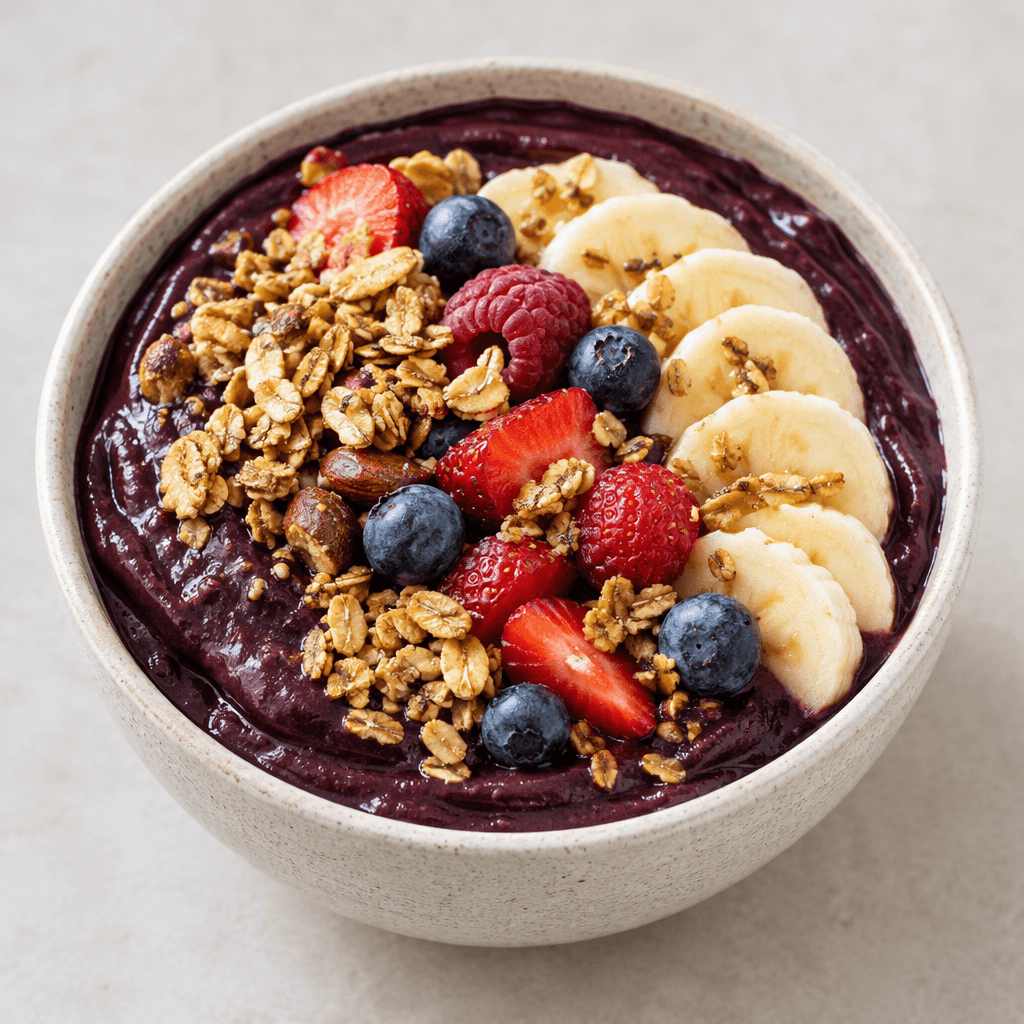
Acai bowl Calories
Antioxidant-rich açaí-based bowl, typically served with fruit and granola
In season: Spring · Summer · Autumn · Winter
CALORIES
GI
POTASSIUM
FIBER
Quick answer
1 bottle (medium) of Acai bowl (300 g) has 330 calories. That works out to 110 calories per 100 g. It contains 55.5 g of carbs, 7.2 g of protein, 10.8 g of fat and 12.6 g of fiber. Its 2 mg of Manganese covers 85% of the Daily Value. Its glycemic index is 48 (low), so it raises blood sugar slowly.
What is Acai bowl?
An acai bowl is made with a thick purée of açaí berries, native to the Amazon region of South America, usually blended while frozen and topped with fruit and crunchy additions. Banana, granola and berries are common toppings. Its tart, berry-like flavour and icy, smooth base contrast with the sweetness and crunch on top. In Brazil it is often enjoyed as a snack or meal, while elsewhere it is popular for breakfast or after exercise. It provides fibre, though generous granola or sweeteners can make a serving more filling. For a lighter bowl, use less granola and add fresh fruit.
Acai bowl Nutrition Facts
Selected: 100 g
110
KCAL / 100G
Carbs
18.5g
· 7% DV
Protein
2.4g
· 5% DV
Fat
3.6g
· 5% DV
Fiber
4.2g
· 15% DV
DV is the share of the daily value covered, on a 2,000 kcal reference diet.
Calories come from: Carbs 64% · Protein 8% · Fat 28%
Acai bowl Vitamins & Minerals
Vitamins
Vitamin C
12mg · 13% DV
Vitamin K
9µg · 8% DV
Vitamin E
1.1mg · 7% DV
Folate
18µg · 5% DV
Minerals
Manganese
1mg · 43% DV
Magnesium
32mg · 8% DV
Iron
1mg · 6% DV
Phosphorus
42mg · 6% DV
How Nutritious Is Acai bowl?
Nutrient density
High
How many vitamins, minerals and how much fiber this food carries per calorie. A high score means a lot of nutrition for few calories.
Satiety score
Medium
An EatBetter score computed from fiber, protein and calorie density. A high score means staying full longer on the same calories.
Both scores are calculated per 100 g and do not change with the selected portion. The satiety score is EatBetter's own calculation, not a clinical measure.
Acai bowl Glycemic Index
GLYCEMIC INDEX
GLYCEMIC LOAD
Accounts for portion size — a more realistic measure than GI alone.
How to Burn Off Acai bowl
To burn the 110 calories in 100 g:
🚶
Walking (5 km/h)
🏃
Running (8 km/h)
🚴
Cycling
🏊
Swimming
Times are calculated with the MET equation for a 70 kg adult. Actual burn varies with your weight, age and pace.
Is Acai bowl Processed?
NOVA 3
Processed
1. Unprocessed
2. Minimally Processed
3. Processed
4. Ultra-Processed
NOVA classifies foods into 4 groups by industrial processing. NOVA 1 (unprocessed) is the healthiest.
Does Acai bowl Contain Allergens?
No known major allergens
Which Diets Is Acai bowl Good For?
Vegan
✓ Suitable
Vegetarian
✓ Suitable
Gluten-Free
— Not suitable
Dairy-Free
— Not suitable
Mediterranean
✓ Suitable
Paleo
— Not suitable
Whole30
— Not suitable
DASH
— Not suitable
Keto
— Not suitable
Low FODMAP
— Not suitable
Acai bowl Fat Profile
SATURATED
0.9g
MONOUNSATURATED
1.4g
POLYUNSATURATED
0.5g
Omega 6:3 ratio 8.4:1
Above the ideal 4:1 (8.4:1).
Compare Acai bowl
Foods Similar to Acai bowl
Frequently Asked Questions About Acai bowl
What is an acai bowl?
An acai bowl is a thick, spoonable blend made with acai fruit, usually served with toppings such as banana, berries, and granola. It is often eaten as breakfast or a snack, and its texture is closer to soft-serve than to a drink.
How do you make an acai bowl at home?
Blend frozen acai with a small splash of milk or juice until smooth but thick, then spoon it into a bowl. Add fruit and granola on top; using too much liquid makes the base runny rather than spoonable.
Is an acai bowl healthy?
An acai bowl can provide fruit and fiber, but its overall nutrition depends greatly on the toppings and sweeteners. Choose unsweetened acai and add whole fruit; large amounts of granola, honey, or syrup can make it a much sweeter meal.
What does an acai bowl taste like?
An acai bowl tastes fruity and slightly tart, with an earthy, berry-like flavor. Banana and sweet toppings soften that tartness, while the frozen base gives it a thick, cold texture similar to a sorbet or smoothie bowl.
Are acai bowls Brazilian?
Yes, acai bowls are inspired by açaí eaten in Brazil, especially in the Amazon region. The familiar smoothie-style bowl topped with granola and fruit is a modern serving style; traditional ways of eating açaí can be quite different.
What is the difference between an acai bowl and a smoothie bowl?
An acai bowl is a type of smoothie bowl whose blended base includes acai. A smoothie bowl can use other fruits instead, so it may not have acai’s deep-purple color or its distinctive tart, earthy flavor.
Do acai bowls have added sugar?
Some acai bowls contain added sugar, while others do not. Sweetened frozen acai blends, juice, honey, and flavored granola can all add sweetness, so a homemade bowl with unsweetened acai is the easiest way to control it.
What are the best toppings for an acai bowl?
Banana, berries, and granola are classic acai bowl toppings because they add sweetness and contrasting textures. Chia seeds, coconut, or nut butter also work well; add crunchy ingredients just before eating so they do not soften.
Can you freeze an acai bowl?
You can freeze an acai bowl, but fresh fruit toppings and granola may lose their texture. For better results, freeze the acai base separately in an airtight container and add the toppings after blending or thawing it.
Is an acai bowl a breakfast or a dessert?
An acai bowl can be either breakfast or dessert, depending on its portion and toppings. For breakfast, pair the fruit base with a source of protein such as yogurt or nuts; extra syrup and sweet toppings make it more dessert-like.
Have another question about Acai bowl?
Ask the AI nutrition coach — calories, portions, alternatives and more, answered in seconds in the app.

Scan calories with your camera
Instant AI nutrition analysis

Nutrition data compiled from USDA FoodData Central and scientific sources.