

Ready & Packaged Foods
All →Vegetables & Legumes
All →Desserts & Confectionery
All →Meat & Protein
All →Grains & Bakery
All →Beverages
All →Milk & Dairy
All →

Acai Calories
Rich in antioxidants, high fiber, low sugar
In season: Summer · Autumn
CALORIES
GI
POTASSIUM
FIBER
Quick answer
100 g of Acai has 70 calories. It contains 4 g of carbs, 1.5 g of protein, 5 g of fat and 2 g of fiber. Its 0.6 mg of Manganese covers 26% of the Daily Value. Its glycemic index is 12 (low), so it raises blood sugar slowly.
What is Acai?
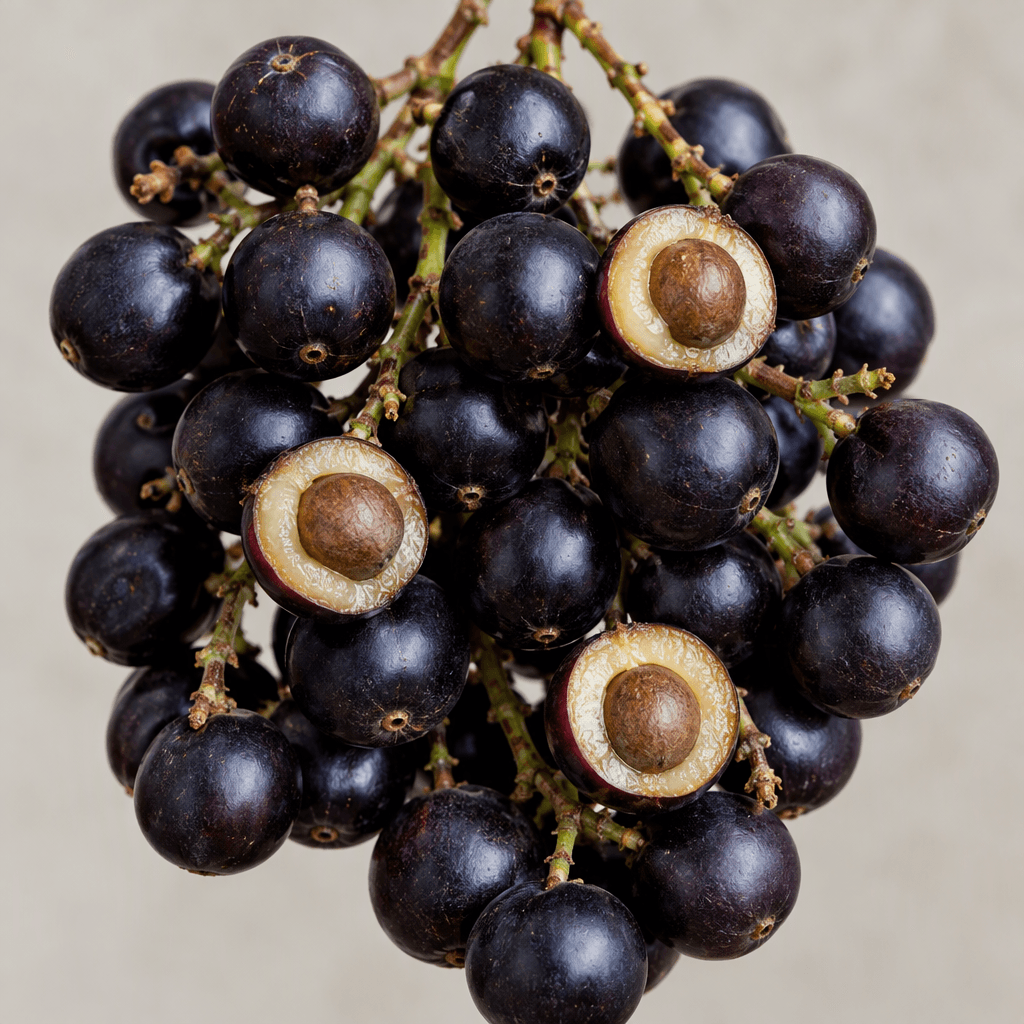
Acai is the small, deep-purple fruit of a palm native to the Amazon basin. Its large seed leaves relatively little fruit, so outside South America it is most often sold frozen as pulp or blended into powders rather than eaten fresh.
The flavour is earthy and gently berry-like, while the pulp makes a thick, smooth base. In Brazil, it is commonly served as a chilled bowl, often with banana and granola; elsewhere, it is also blended into smoothies. Acai is a source of fibre and naturally low in sugar. For a less sweet bowl, add fresh fruit and unsweetened toppings instead of syrup.
Acai Nutrition Facts
Selected: 100 g
70
KCAL / 100G
Carbs
4g
· 1% DV
Protein
1.5g
· 3% DV
Fat
5g
· 6% DV
Fiber
2g
· 7% DV
DV is the share of the daily value covered, on a 2,000 kcal reference diet.
Calories come from: Carbs 24% · Protein 9% · Fat 67%
Acai Vitamins & Minerals
Vitamins
Vitamin C
9mg · 10% DV
B1
0.1mg · 8% DV
Vitamin E
0.9mg · 6% DV
B2
0.05mg · 4% DV
Minerals
Manganese
1mg · 43% DV
Iron
2mg · 11% DV
Calcium
35mg · 4% DV
Magnesium
17mg · 4% DV
How Nutritious Is Acai?
Nutrient density
Very high
How many vitamins, minerals and how much fiber this food carries per calorie. A high score means a lot of nutrition for few calories.
Satiety score
Medium
An EatBetter score computed from fiber, protein and calorie density. A high score means staying full longer on the same calories.
Both scores are calculated per 100 g and do not change with the selected portion. The satiety score is EatBetter's own calculation, not a clinical measure.
Acai Glycemic Index
GLYCEMIC INDEX
GLYCEMIC LOAD
Accounts for portion size — a more realistic measure than GI alone.
How to Burn Off Acai
To burn the 70 calories in 100 g:
🚶
Walking (5 km/h)
🏃
Running (8 km/h)
🚴
Cycling
🏊
Swimming
Times are calculated with the MET equation for a 70 kg adult. Actual burn varies with your weight, age and pace.
Is Acai Processed?
NOVA 1
Unprocessed
1. Unprocessed
2. Minimally Processed
3. Processed
4. Ultra-Processed
NOVA classifies foods into 4 groups by industrial processing. NOVA 1 (unprocessed) is the healthiest.
Does Acai Contain Allergens?
No known major allergens
Which Diets Is Acai Good For?
Vegan
✓ Suitable
Vegetarian
✓ Suitable
Gluten-Free
✓ Suitable
Dairy-Free
— Not suitable
Mediterranean
✓ Suitable
Paleo
✓ Suitable
Whole30
— Not suitable
DASH
— Not suitable
Keto
— Not suitable
Low FODMAP
— Not suitable
Acai Fat Profile
SATURATED
1.5g
MONOUNSATURATED
2.2g
POLYUNSATURATED
1.2g
Omega 6:3 ratio 15:1
Above the ideal 4:1 (15:1).
Compare Acai
Foods Similar to Acai
Frequently Asked Questions About Acai
What is acai, and how do you eat it?
Acai is a dark purple fruit from a palm native to the Amazon region. Outside its growing areas, it is usually sold as frozen pulp or powder and added to smoothies, yogurt, or acai bowls.
What does acai taste like?
Acai tastes mildly tart and earthy, with flavors some people compare to blackberries or dark chocolate. Its flavor can be subtle on its own, so it is often blended with other fruit or served with toppings.
How do you make an acai bowl?
Blend frozen acai pulp with a small amount of liquid until thick and spoonable, then add toppings such as fruit, oats, or nuts. Using less liquid helps the mixture stay cold and firm rather than turning into a drink.
Is acai actually a berry?
No, acai is botanically a drupe, like a small stone fruit, rather than a true berry. Each fruit has a large hard seed surrounded by a thin layer of edible pulp.
Where does acai grow?
Acai grows in clusters on palms native to the Amazon basin in South America. The fruit is highly perishable after harvest, which is why it is commonly processed into pulp and frozen near where it is grown.
Can you eat acai berries fresh or raw?
Yes, the ripe fruit is edible, but fresh acai is rarely sold far from where it grows because it spoils quickly. Commercial acai is more commonly available as frozen pulp or powder.
Is acai powder the same as frozen acai pulp?
No, acai powder is made from dried fruit, while frozen acai pulp retains the fruit’s soft, moist texture. Powder is easy to stir into drinks or yogurt; pulp is more suitable for a thick acai bowl.
How should you store acai pulp?
Keep acai pulp frozen until you are ready to use it. Once thawed, refrigerate it and use it promptly; dividing the frozen pulp into portions before thawing makes it easier to avoid refreezing leftovers.
What are the health benefits of acai?
Acai provides antioxidants and fiber and can be part of a varied diet. It has not been shown to prevent or cure disease, and the nutritional value of an acai bowl also depends on its toppings.
Does acai help with weight loss?
No, acai does not cause weight loss on its own. It can fit into a meal or snack, but toppings such as granola, honey, and nut butter can add substantially to an acai bowl’s overall energy content.
Have another question about Acai?
Ask the AI nutrition coach — calories, portions, alternatives and more, answered in seconds in the app.

Scan calories with your camera
Instant AI nutrition analysis

Nutrition data compiled from USDA FoodData Central and scientific sources.