

Ready & Packaged Foods
All →Vegetables & Legumes
All →Desserts & Confectionery
All →Meat & Protein
All →Grains & Bakery
All →Beverages
All →Milk & Dairy
All →

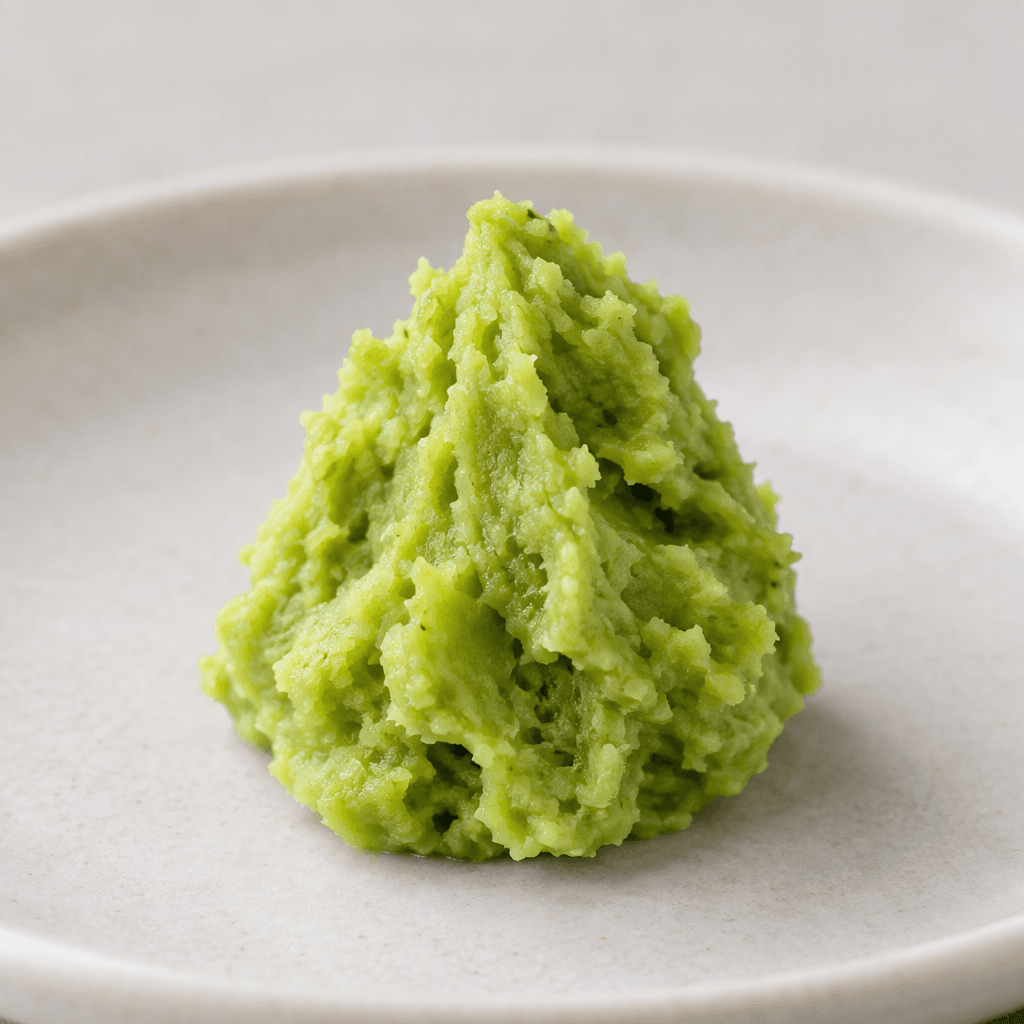
Wasabi Calories
Spicy Japanese condiment, strong flavor
In season: Spring · Summer
CALORIES
GI
POTASSIUM
FIBER
Quick answer
1 teaspoon (small) of Wasabi (5 g) has 5 calories. That works out to 109 calories per 100 g. It contains 1.2 g of carbs, 0.2 g of protein, 0 g of fat and 0.4 g of fiber. Its glycemic index is 40 (low), so it raises blood sugar slowly.
What is Wasabi?
Wasabi is a pungent Japanese condiment made by finely grating the stem-like rhizome of the wasabi plant. Freshly grated wasabi loses its aroma quickly, while prepared pastes can vary in what they contain. Its sharp heat rises into the nose and fades relatively quickly; the texture is thick and can be slightly fibrous. In Japan it commonly accompanies sushi and sashimi, either dabbed onto the fish or mixed sparingly with soy sauce. It is also familiar at sushi restaurants around the world, where a little goes a long way. Nutritionally, it is usually eaten in such small amounts that its main contribution is flavor rather than substance. Pair it with fish and rice, and start with a small dab if you prefer a gentler kick.
Wasabi Nutrition Facts
Selected: 100 g
109
KCAL / 100G
Carbs
23.5g
· 9% DV
Protein
4.8g
· 10% DV
Fat
0.6g
· 1% DV
Fiber
7.8g
· 28% DV
DV is the share of the daily value covered, on a 2,000 kcal reference diet.
Calories come from: Carbs 79% · Protein 16% · Fat 5%
Wasabi Vitamins & Minerals
Vitamins
Vitamin C
41mg · 46% DV
B6
0.18mg · 11% DV
B2
0.09mg · 7% DV
Folate
28µg · 7% DV
Minerals
Potassium ⭐
568mg · 17% DV
Phosphorus
69mg · 10% DV
Zinc
1mg · 9% DV
Iron
1mg · 6% DV
How Nutritious Is Wasabi?
Nutrient density
Medium
How many vitamins, minerals and how much fiber this food carries per calorie. A high score means a lot of nutrition for few calories.
Satiety score
High
An EatBetter score computed from fiber, protein and calorie density. A high score means staying full longer on the same calories.
Both scores are calculated per 100 g and do not change with the selected portion. The satiety score is EatBetter's own calculation, not a clinical measure.
Wasabi Glycemic Index
GLYCEMIC INDEX
GLYCEMIC LOAD
Accounts for portion size — a more realistic measure than GI alone.
How to Burn Off Wasabi
To burn the 109 calories in 100 g:
🚶
Walking (5 km/h)
🏃
Running (8 km/h)
🚴
Cycling
🏊
Swimming
Times are calculated with the MET equation for a 70 kg adult. Actual burn varies with your weight, age and pace.
Is Wasabi Processed?
NOVA 2
Minimally Processed
1. Unprocessed
2. Minimally Processed
3. Processed
4. Ultra-Processed
NOVA classifies foods into 4 groups by industrial processing. NOVA 1 (unprocessed) is the healthiest.
Does Wasabi Contain Allergens?
No known major allergens
Which Diets Is Wasabi Good For?
Vegan
✓ Suitable
Vegetarian
✓ Suitable
Gluten-Free
✓ Suitable
Dairy-Free
— Not suitable
Mediterranean
✓ Suitable
Paleo
✓ Suitable
Whole30
— Not suitable
DASH
— Not suitable
Keto
— Not suitable
Low FODMAP
— Not suitable
Wasabi Fat Profile
SATURATED
0.13g
MONOUNSATURATED
0.09g
POLYUNSATURATED
0.12g
Omega 6:3 ratio 2:1
Below the ideal 4:1 — a good omega balance.
Compare Wasabi
Foods Similar to Wasabi
Frequently Asked Questions About Wasabi
What is wasabi made from?
Wasabi is traditionally made from the grated rhizome of the wasabi plant, a relative of mustard and horseradish. Many prepared pastes instead use horseradish, mustard, and coloring, so the ingredient list can tell you whether a product contains actual wasabi.
Is wasabi hotter than chili peppers?
Wasabi feels sharp and nose-tingling, while chili peppers usually cause a lingering mouth burn. They create heat through different compounds, so which seems hotter depends on your sensitivity and how much you eat.
Why is wasabi served with sushi?
Wasabi adds a sharp, aromatic contrast to sushi and can complement the flavor of fish. It is a condiment, not a way to make raw fish safe; food safety still depends on proper sourcing, handling, and storage.
Does real wasabi taste different from wasabi paste?
Yes, fresh-grated wasabi usually has a brighter, more delicate, vegetal flavor that fades quickly. Many store-bought pastes are based mainly on horseradish and mustard, giving them a stronger, longer-lasting pungency.
How much wasabi should you put on sushi?
Start with a small dab of wasabi on the sushi, then add more only if you like the intensity. A little can complement fish without overwhelming it, and the strength varies between fresh wasabi and prepared pastes.
Can you eat wasabi on its own?
Yes, you can taste a small amount of wasabi on its own, but its sharpness can be intense. It is usually enjoyed in small quantities with sushi, sashimi, noodles, or other foods rather than eaten by the spoonful.
Why does freshly grated wasabi lose its flavor?
Fresh wasabi’s pungent aroma comes from volatile compounds that dissipate after grating. For the most vivid flavor, grate it shortly before serving and avoid leaving the exposed paste sitting out for a long time.
Is wasabi healthy?
Wasabi can add strong flavor to a meal without needing a large amount, but it is best thought of as a condiment rather than a health remedy. Prepared pastes can differ in ingredients, so their overall qualities vary by product.
What foods go well with wasabi besides sushi?
Wasabi pairs well with sashimi, soba noodles, seafood, and sauces for grilled foods. Its sharpness also works in small amounts in dressings or mayonnaise; add it gradually so it does not overpower the other flavors.
Can wasabi clear a stuffy nose?
Wasabi may briefly make your nose feel clearer because its pungent vapors stimulate the nasal passages. That sensation is temporary and does not treat the cause of congestion; eating more wasabi is not a reliable remedy.
Have another question about Wasabi?
Ask the AI nutrition coach — calories, portions, alternatives and more, answered in seconds in the app.

Scan calories with your camera
Instant AI nutrition analysis

Nutrition data compiled from USDA FoodData Central and scientific sources.