

Ready & Packaged Foods
All →Vegetables & Legumes
All →Desserts & Confectionery
All →Meat & Protein
All →Grains & Bakery
All →Beverages
All →Milk & Dairy
All →

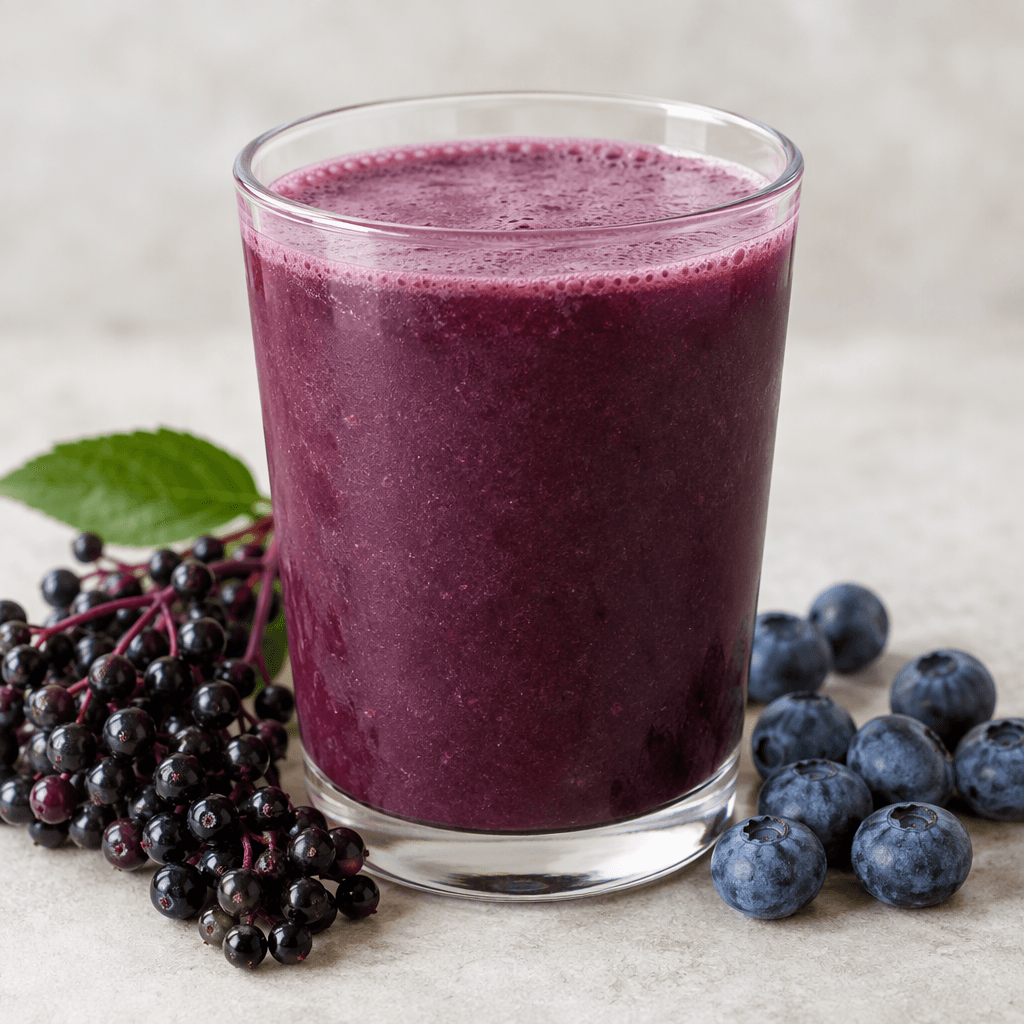
Probiotic Drink (Elderberry & Blueberry) Calories
Probiotic, antioxidant, immune-supporting
In season: Spring · Summer · Autumn · Winter
CALORIES
GI
POTASSIUM
FIBER
Quick answer
1 cup (medium) of Probiotic Drink (Elderberry & Blueberry) (200 g) has 76 calories. That works out to 38 calories per 100 g. It contains 16.4 g of carbs, 1.4 g of protein, 0.4 g of fat and 2.2 g of fiber. Its 26 mg of Vitamin C covers 29% of the Daily Value. Its glycemic index is 25 (low), so it raises blood sugar slowly.
What is Probiotic Drink (Elderberry & Blueberry)?
Probiotic Drink (Elderberry & Blueberry) is a fruit-flavoured beverage made with probiotic cultures and the distinctive berry notes of elderberry and blueberry. It offers a lighter, more drinkable alternative to thicker cultured foods, with the berries lending a gently tart, sweet-fruity character.
Serve it chilled at breakfast, as a refreshing snack, or alongside a light meal; it also works well in a smoothie if you want a fruitier blend. Its energy comes mainly from carbohydrate, with 38 calories per 100 g, so it can fit easily into a modest snack. Check the serving size if you are pairing it with other sweet foods, or enjoy it on its own between meals.
Probiotic Drink (Elderberry & Blueberry) Nutrition Facts
Selected: 100 g
38
KCAL / 100G
Carbs
8.2g
· 3% DV
Protein
0.7g
· 1% DV
Fat
0.2g
· 0% DV
Fiber
1.1g
· 4% DV
DV is the share of the daily value covered, on a 2,000 kcal reference diet.
Calories come from: Carbs 88% · Protein 7% · Fat 5%
Probiotic Drink (Elderberry & Blueberry) Vitamins & Minerals
Vitamins
Vitamin C
13mg · 14% DV
Vitamin K
17µg · 14% DV
Vitamin E
0.7mg · 5% DV
B12
0.1µg · 4% DV
Minerals
Calcium
18mg · 2% DV
Magnesium
7mg · 2% DV
Phosphorus
13mg · 2% DV
Potassium ⭐
60mg · 2% DV
How Nutritious Is Probiotic Drink (Elderberry & Blueberry)?
Nutrient density
Medium
How many vitamins, minerals and how much fiber this food carries per calorie. A high score means a lot of nutrition for few calories.
Satiety score
Medium
An EatBetter score computed from fiber, protein and calorie density. A high score means staying full longer on the same calories.
Both scores are calculated per 100 g and do not change with the selected portion. The satiety score is EatBetter's own calculation, not a clinical measure.
Probiotic Drink (Elderberry & Blueberry) Glycemic Index
GLYCEMIC INDEX
GLYCEMIC LOAD
Accounts for portion size — a more realistic measure than GI alone.
How to Burn Off Probiotic Drink (Elderberry & Blueberry)
To burn the 38 calories in 100 g:
🚶
Walking (5 km/h)
🏃
Running (8 km/h)
🚴
Cycling
🏊
Swimming
Times are calculated with the MET equation for a 70 kg adult. Actual burn varies with your weight, age and pace.
Is Probiotic Drink (Elderberry & Blueberry) Processed?
NOVA 2
Minimally Processed
1. Unprocessed
2. Minimally Processed
3. Processed
4. Ultra-Processed
NOVA classifies foods into 4 groups by industrial processing. NOVA 1 (unprocessed) is the healthiest.
Does Probiotic Drink (Elderberry & Blueberry) Contain Allergens?
No known major allergens
Which Diets Is Probiotic Drink (Elderberry & Blueberry) Good For?
Vegan
✓ Suitable
Vegetarian
✓ Suitable
Gluten-Free
✓ Suitable
Dairy-Free
— Not suitable
Mediterranean
✓ Suitable
Paleo
— Not suitable
Whole30
— Not suitable
DASH
— Not suitable
Keto
— Not suitable
Low FODMAP
— Not suitable
Probiotic Drink (Elderberry & Blueberry) Fat Profile
SATURATED
0.02g
MONOUNSATURATED
0.03g
POLYUNSATURATED
0.07g
Omega 6:3 ratio 1.3:1
Below the ideal 4:1 — a good omega balance.
Compare Probiotic Drink (Elderberry & Blueberry)
Foods Similar to Probiotic Drink (Elderberry & Blueberry)
Frequently Asked Questions About Probiotic Drink (Elderberry & Blueberry)
What are the benefits of an elderberry and blueberry probiotic drink?
It can provide probiotic cultures alongside antioxidant compounds from the berries. Those features may support gut health as part of a varied diet, but the drink is not a treatment for infections or a guaranteed way to prevent illness.
Is an elderberry and blueberry probiotic drink fermented?
It may be fermented, but “probiotic” alone does not confirm how it was made. Some drinks are fermented, while others have cultures added later; processing can also affect whether live cultures remain in the finished product.
Does an elderberry and blueberry probiotic drink need to be refrigerated?
Follow the storage directions for the particular drink. If it is sold chilled or says to refrigerate after opening, keep it cold; temperature can affect live cultures, and an opened drink should not be kept beyond its stated use period.
Can you use an elderberry and blueberry probiotic drink in a smoothie?
Yes, it works as a fruity liquid in a smoothie and pairs well with banana or oats. Add it after blending or use it without heating, since high temperatures can reduce the number of live probiotic cultures.
How does an elderberry and blueberry probiotic drink compare with kombucha?
Kombucha is fermented tea, while an elderberry and blueberry probiotic drink is fruit-based. Kombucha often has tea flavor and may contain small amounts of caffeine; the cultures, sweetness, and fermentation of the berry drink depend on its recipe.
Can an elderberry and blueberry probiotic drink be taken with breakfast?
Yes, it can be served with breakfast, and there is no special need to drink it on an empty stomach. Pairing it with food may be more comfortable for people who find tart or fermented drinks bothersome by themselves.
Is an elderberry and blueberry probiotic drink safe for children?
It can be suitable for some children, but the product’s ingredients and the child’s age matter. Young children should not be given raw or unripe elderberries; use only a drink made with properly prepared fruit and follow age-specific guidance.
Does an elderberry and blueberry probiotic drink contain alcohol?
Not necessarily. Fermentation can produce small amounts of alcohol, but the amount varies and some probiotic drinks are not fermented. A fruit-and-berry name does not establish whether the finished drink contains alcohol.
Can an elderberry and blueberry probiotic drink upset your stomach?
Yes, it can cause bloating or discomfort in some people, particularly when they are unaccustomed to probiotic drinks or drink a large serving. Try a smaller amount, and stop drinking it if symptoms persist.
Can you heat an elderberry and blueberry probiotic drink?
You can heat it, but heating may reduce or destroy live probiotic cultures. For the probiotic benefit, drink it chilled or at room temperature rather than boiling it or adding it to a hot drink.
Have another question about Probiotic Drink (Elderberry & Blueberry)?
Ask the AI nutrition coach — calories, portions, alternatives and more, answered in seconds in the app.

Scan calories with your camera
Instant AI nutrition analysis

Nutrition data compiled from USDA FoodData Central and scientific sources.