

Ready & Packaged Foods
All →Vegetables & Legumes
All →Desserts & Confectionery
All →Meat & Protein
All →Grains & Bakery
All →Beverages
All →Milk & Dairy
All →

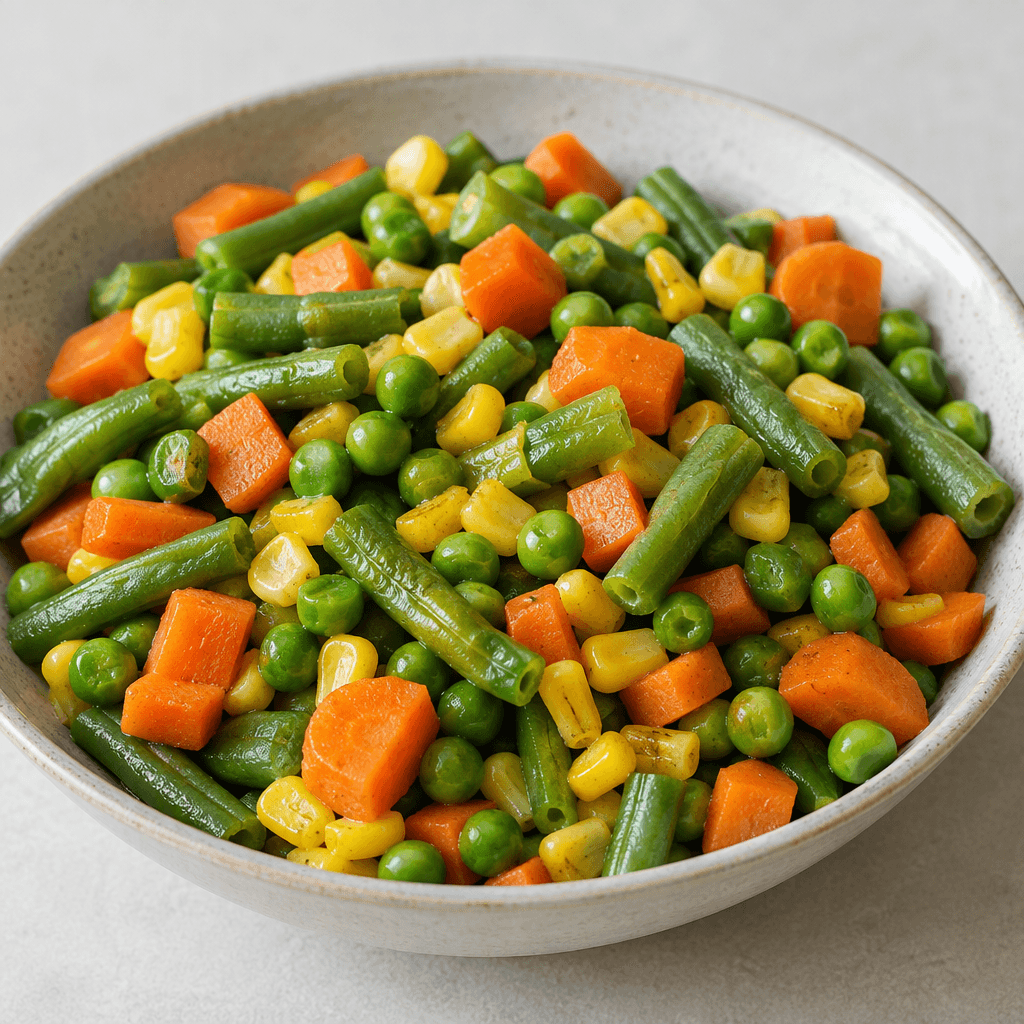
Cooked mixed vegetables Calories
Low-calorie, fiber-rich, vitamin- and mineral-dense
In season: Spring · Summer · Autumn · Winter
CALORIES
GI
POTASSIUM
FIBER
Quick answer
1 cup (chopped) of Cooked mixed vegetables (160 g) has 56 calories. That works out to 35 calories per 100 g. It contains 11.5 g of carbs, 3.4 g of protein, 0.6 g of fat and 4.8 g of fiber. Its 51.2 µg of Vitamin K covers 43% of the Daily Value. Its glycemic index is 35 (low), so it raises blood sugar slowly.
What is Cooked mixed vegetables?
Cooked mixed vegetables are a simple side dish made by cooking bite-sized vegetables together; a common combination includes carrots, peas, corn and green beans. There is no single place of origin: mixes vary with the season, local produce and whether fresh or frozen vegetables are used.
The vegetables turn tender and mildly sweet, and are usually served warm alongside a main course. They also work well stirred into rice, pasta, soups or a grain bowl, making them an easy addition to everyday meals across many cuisines. They offer fibre and a range of vitamins and minerals while remaining low in calories. For a lighter preparation, steam or briefly simmer them and finish with herbs, pepper and lemon rather than a heavy sauce.
Cooked mixed vegetables Nutrition Facts
Selected: 100 g
35
KCAL / 100G
Carbs
7.2g
· 3% DV
Protein
2.1g
· 4% DV
Fat
0.4g
· 1% DV
Fiber
3g
· 11% DV
DV is the share of the daily value covered, on a 2,000 kcal reference diet.
Calories come from: Carbs 71% · Protein 21% · Fat 8%
Cooked mixed vegetables Vitamins & Minerals
Vitamins
Vitamin K
32µg · 27% DV
Vitamin A
180µg · 20% DV
Vitamin C
18mg · 20% DV
Folate
28µg · 7% DV
Minerals
Iron
1mg · 6% DV
Phosphorus
42mg · 6% DV
Potassium ⭐
210mg · 6% DV
Magnesium
18mg · 4% DV
How Nutritious Is Cooked mixed vegetables?
Nutrient density
Very high
How many vitamins, minerals and how much fiber this food carries per calorie. A high score means a lot of nutrition for few calories.
Satiety score
Medium
An EatBetter score computed from fiber, protein and calorie density. A high score means staying full longer on the same calories.
Both scores are calculated per 100 g and do not change with the selected portion. The satiety score is EatBetter's own calculation, not a clinical measure.
Cooked mixed vegetables Glycemic Index
GLYCEMIC INDEX
GLYCEMIC LOAD
Accounts for portion size — a more realistic measure than GI alone.
How to Burn Off Cooked mixed vegetables
To burn the 35 calories in 100 g:
🚶
Walking (5 km/h)
🏃
Running (8 km/h)
🚴
Cycling
🏊
Swimming
Times are calculated with the MET equation for a 70 kg adult. Actual burn varies with your weight, age and pace.
Is Cooked mixed vegetables Processed?
NOVA 2
Minimally Processed
1. Unprocessed
2. Minimally Processed
3. Processed
4. Ultra-Processed
NOVA classifies foods into 4 groups by industrial processing. NOVA 1 (unprocessed) is the healthiest.
Does Cooked mixed vegetables Contain Allergens?
No known major allergens
Which Diets Is Cooked mixed vegetables Good For?
Vegan
✓ Suitable
Vegetarian
✓ Suitable
Gluten-Free
✓ Suitable
Dairy-Free
— Not suitable
Mediterranean
✓ Suitable
Paleo
✓ Suitable
Whole30
— Not suitable
DASH
— Not suitable
Keto
— Not suitable
Low FODMAP
— Not suitable
Cooked mixed vegetables Fat Profile
SATURATED
0.08g
MONOUNSATURATED
0.03g
POLYUNSATURATED
0.11g
Omega 6:3 ratio 2.7:1
Below the ideal 4:1 — a good omega balance.
Compare Cooked mixed vegetables
Foods Similar to Cooked mixed vegetables
Frequently Asked Questions About Cooked mixed vegetables
How do you cook cooked mixed vegetables without making them soggy?
Steam or sauté the carrots, peas, corn, and green beans until just tender rather than boiling them in plenty of water. Drain off excess liquid promptly; prolonged cooking makes the peas soft and can dull the vegetables’ colour.
Can you roast cooked mixed vegetables?
Yes, you can roast cooked mixed vegetables, though they brown better if they are uncooked or only briefly cooked first. Pat them dry, spread them in a single layer, and use a hot oven so their moisture can evaporate.
How do you season cooked mixed vegetables?
Olive oil, black pepper, garlic, and dried herbs are simple ways to season cooked mixed vegetables. Add lemon juice or a little butter just before serving for brightness or richness without masking the taste of the vegetables.
Can you cook frozen mixed vegetables straight from the freezer?
Yes, add frozen mixed vegetables straight to a pan, steamer, or soup without thawing them first. Thawing can release water and leave the carrots, peas, corn, and green beans softer than intended.
How long do cooked mixed vegetables last in the fridge?
Cooked mixed vegetables keep for about 3–4 days in a covered container in the refrigerator. Cool and refrigerate them promptly, and reheat only the portion you plan to eat.
Can cooked mixed vegetables be frozen?
Yes, cooked mixed vegetables can be frozen in airtight portions. Their texture may be softer after thawing, especially for peas and green beans, so use thawed portions in soups, stews, or casseroles.
Can you add cooked mixed vegetables to fried rice?
Yes, cooked mixed vegetables work well in fried rice. Drain them first and stir them in near the end, so they heat through without releasing too much moisture or turning mushy.
Why are my cooked mixed vegetables watery?
Cooked mixed vegetables often turn watery because they were boiled in excess water or cooked from frozen in a crowded pan. Steam them, sauté in a wide pan, or drain them well before adding seasonings.
Can you microwave cooked mixed vegetables?
Yes, place cooked mixed vegetables in a microwave-safe dish, cover loosely, and heat until steaming, stirring once for even warmth. Add a small splash of water only if they seem dry.
What can you make with leftover cooked mixed vegetables?
Leftover cooked mixed vegetables can go into soup, omelettes, pasta, or a savoury pie filling. Add them toward the end of cooking so the carrots, peas, corn, and green beans retain some texture.
Have another question about Cooked mixed vegetables?
Ask the AI nutrition coach — calories, portions, alternatives and more, answered in seconds in the app.

Scan calories with your camera
Instant AI nutrition analysis

Nutrition data compiled from USDA FoodData Central and scientific sources.