

Ready & Packaged Foods
All →Vegetables & Legumes
All →Desserts & Confectionery
All →Meat & Protein
All →Grains & Bakery
All →Beverages
All →Milk & Dairy
All →

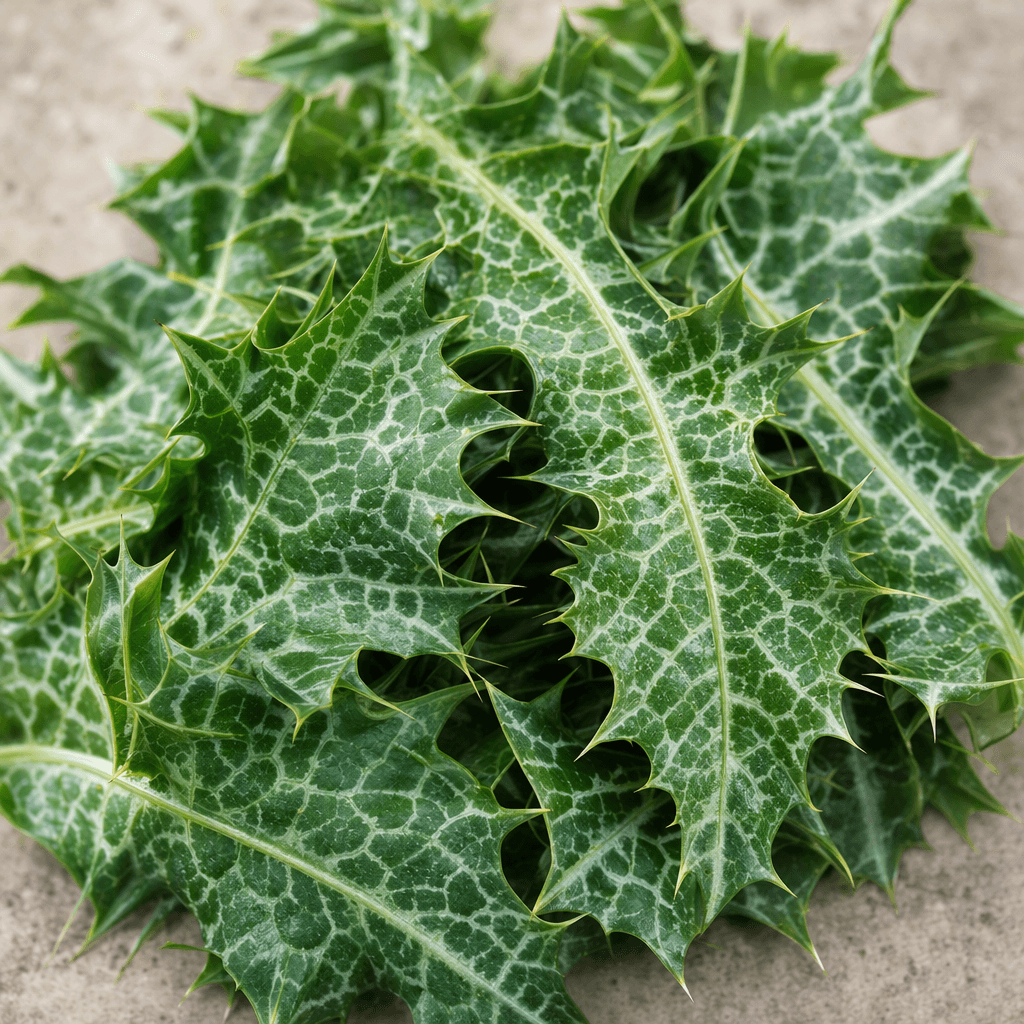
Milk Thistle Calories
Liver support, antioxidant, traditional herbal remedy
In season: Spring · Summer
CALORIES · 100 G
GI
POTASSIUM · 100 G
FIBER · 100 G
Quick answer
1 tablespoon (medium) of Milk Thistle (7 g) has 33 calories. That works out to 475 calories per 100 g. It contains 2.4 g of carbs, 1.4 g of protein, 1.8 g of fat and 2.5 g of fiber. Its 26.6 mg of Magnesium covers 6% of the Daily Value. Its glycemic index is 5 (low), so it raises blood sugar slowly.
Milk Thistle Nutrition Facts
Selected: 1 tablespoon (medium) · 7 g
33
KCAL / 7G
Carbs
2.4g
· 1% DV
Protein
1.4g
· 3% DV
Fat
1.8g
· 2% DV
Fiber
2.5g
· 9% DV
DV is the share of the daily value covered, on a 2,000 kcal reference diet.
Calories come from: Carbs 31% · Protein 18% · Fat 51%
Milk Thistle nutrition facts table · 1 tablespoon (medium) (7 g)
| Nutrient | Amount | % DV |
|---|---|---|
| Calories | 33 kcal | |
| Total fat | 1.8 g | 2% |
| Saturated fat | 0.15 g | 1% |
| Trans fat | 0 g | |
| Sodium | 0.7 mg | 0% |
| Total carbohydrate | 2.4 g | 1% |
| Fiber | 2.5 g | 9% |
| Protein | 1.4 g | 3% |
Calories: Calories measure energy. Average daily need is 2,000 kcal. Excess calories are stored as fat, too few cause weight loss.
Carbs: Your body's primary energy source. The brain runs exclusively on carbs. Daily need: 275g.
Protein: Essential for muscle repair and cell growth. Daily need: 50g. Keeps you full and boosts metabolism.
Fat: Needed for hormone production and vitamin absorption. Daily need: 78g. Limit saturated fats, choose unsaturated.
Fiber: Critical for digestive health and satiety. Daily need: 28g. Stabilizes blood sugar, lowers cholesterol.

Log this food in EatBetter
100,000+ people use it
- Get your daily calorie target
- Snap your meal, log it in seconds
- See every vitamin and mineral

📸 Scan the code to get the app free.

How Many Calories in 1 Tablespoon of Milk Thistle?
| Serving | Amount | Calories |
|---|---|---|
| 1 tablespoon (medium) | 7 g | 33 kcal |
| 1 piece (whole) | 1 g | 5 kcal |
| 1 teaspoon (small) | 2.5 g | 12 kcal |
| 1 serving (small) | 5 g | 24 kcal |
| 10 g | 10 g | 48 kcal |
| 1 serving (large) | 10 g | 48 kcal |
| 2 tablespoon (large) | 14 g | 67 kcal |
| 1 cup (whole) | 90 g | 428 kcal |
| 100 g | 100 g | 475 kcal |
Calculated from 475 calories per 100 g.
Frequently Asked Questions About Milk Thistle
What is milk thistle used for?
Milk thistle is a flowering plant whose seeds are used in traditional herbal products, especially for liver support. Its seeds contain silymarin compounds, but milk thistle is not a proven cure or replacement for treatment of liver disease.
Can milk thistle help with fatty liver?
Milk thistle has been studied for fatty liver, but there is not enough reliable evidence to show that it treats or reverses the condition. It should not replace medical care or established steps such as addressing the causes of fatty liver.
Are milk thistle seeds edible?
Yes, milk thistle seeds can be eaten, though they are hard and are often ground before being added to food. Eating the seeds is different from taking a concentrated extract, which can deliver a much more concentrated amount of plant compounds.
Is milk thistle tea effective?
Milk thistle tea can be made by steeping crushed seeds, but silymarin does not dissolve well in water. Tea may therefore provide less of these compounds than an extract, and it should not be relied on to treat a liver condition.
What is the difference between milk thistle seeds and milk thistle extract?
Milk thistle seeds are the whole plant food, while extracts concentrate selected compounds, commonly silymarin. Extract products can vary in strength and formulation, so their effects and use cannot be assumed to match eating ground seeds.
What are the side effects of milk thistle?
Milk thistle can cause digestive upset, nausea, diarrhea, or headache in some people. It may also trigger an allergic reaction, particularly in people sensitive to plants in the daisy family; stop using it and seek urgent help for breathing difficulty or severe swelling.
Does milk thistle interact with medications?
Yes, milk thistle may affect how the body processes some medicines, and it may also influence blood sugar. If you take prescription medicines or diabetes medication, ask your doctor or pharmacist before using a milk thistle supplement.
Is milk thistle safe during pregnancy or breastfeeding?
The safety of milk thistle supplements during pregnancy and breastfeeding has not been established. It is prudent to avoid concentrated supplements during these periods; the small amounts that might occur in food are not equivalent to a medicinal extract.
Can milk thistle detox or cleanse your liver?
No, milk thistle has not been shown to detox or cleanse the liver. The liver already processes substances in the body, and milk thistle products should not be treated as a way to remove toxins or undo the effects of alcohol or other exposures.
When should you take milk thistle, with food or on an empty stomach?
There is no established best time to take milk thistle. If a supplement causes stomach discomfort, taking it with food may be easier to tolerate, but follow the directions for that specific product rather than assuming all extracts are alike.
Milk Thistle Vitamins & Minerals
Vitamins
B1
0.03mg · 3% DV
B6
0.03mg · 2% DV
B2
0.02mg · 2% DV
B5
0.06mg · 1% DV
Minerals
Magnesium
27mg · 6% DV
Manganese
0.12mg · 5% DV
Phosphorus
31mg · 4% DV
Copper
0.01mg · 1% DV
Potassium ⭐
30mg · 1% DV
Sodium
0.7mg · 0% DV
Milk Thistle Glycemic Index
GLYCEMIC INDEX
GLYCEMIC LOAD
Accounts for portion size — a more realistic measure than GI alone.
How to Burn Off Milk Thistle
To burn the 33 calories in 1 tablespoon (medium) (7 g):
🚶
Walking (5 km/h)
🏃
Running (8 km/h)
🚴
Cycling
🏊
Swimming
Times are calculated with the MET equation for a 70 kg adult. Actual burn varies with your weight, age and pace.
What is Milk Thistle?
Milk Thistle is a prickly Mediterranean plant, best known for its seeds, which are used in traditional herbal preparations and as an ingredient. The seeds have a mildly bitter, earthy, nutty flavour. They can be crushed or ground into tea, stirred into porridge or yoghurt, or sprinkled over soups and salads. In places where herbal teas and supplements are common, they are often sold whole or ground; elsewhere, a small amount can be an easy addition to everyday cooking.
Its seeds provide fibre and protein: per 100 g, they contain 35 g of fibre. The flavour pairs well with fruit or honey, and starting with a little helps keep its bitterness in balance.
How Nutritious Is Milk Thistle?
Nutrient density
High
How many vitamins, minerals and how much fiber this food carries per calorie. A high score means a lot of nutrition for few calories.
Satiety score
High
An EatBetter score computed from fiber, protein and calorie density. A high score means staying full longer on the same calories.
Both scores are calculated per 100 g and do not change with the selected portion. The satiety score is EatBetter's own calculation, not a clinical measure.
Is Milk Thistle Processed?
NOVA 1
Unprocessed
1. Unprocessed
2. Minimally Processed
3. Processed
4. Ultra-Processed
NOVA classifies foods into 4 groups by industrial processing. NOVA 1 (unprocessed) is the healthiest.
Does Milk Thistle Contain Allergens?
No known major allergens
Which Diets Is Milk Thistle Good For?
Vegan
✓ Suitable
Vegetarian
✓ Suitable
Gluten-Free
✓ Suitable
Dairy-Free
— Not suitable
Mediterranean
✓ Suitable
Paleo
✓ Suitable
Whole30
— Not suitable
DASH
— Not suitable
Keto
— Not suitable
Low FODMAP
— Not suitable
Milk Thistle Fat Profile
SATURATED
0.15g
MONOUNSATURATED
0.42g
POLYUNSATURATED
0.98g
Omega 6:3 ratio 14:1
Above the ideal 4:1 (14:1).
Compare Milk Thistle
Foods Similar to Milk Thistle
Have another question about Milk Thistle?
Ask the AI nutrition coach — calories, portions, alternatives and more, answered in seconds in the app.

Scan calories with your camera
Instant AI nutrition analysis

Nutrition data compiled from USDA FoodData Central and scientific sources.