

Ready & Packaged Foods
All →Vegetables & Legumes
All →Desserts & Confectionery
All →Meat & Protein
All →Grains & Bakery
All →Beverages
All →Milk & Dairy
All →

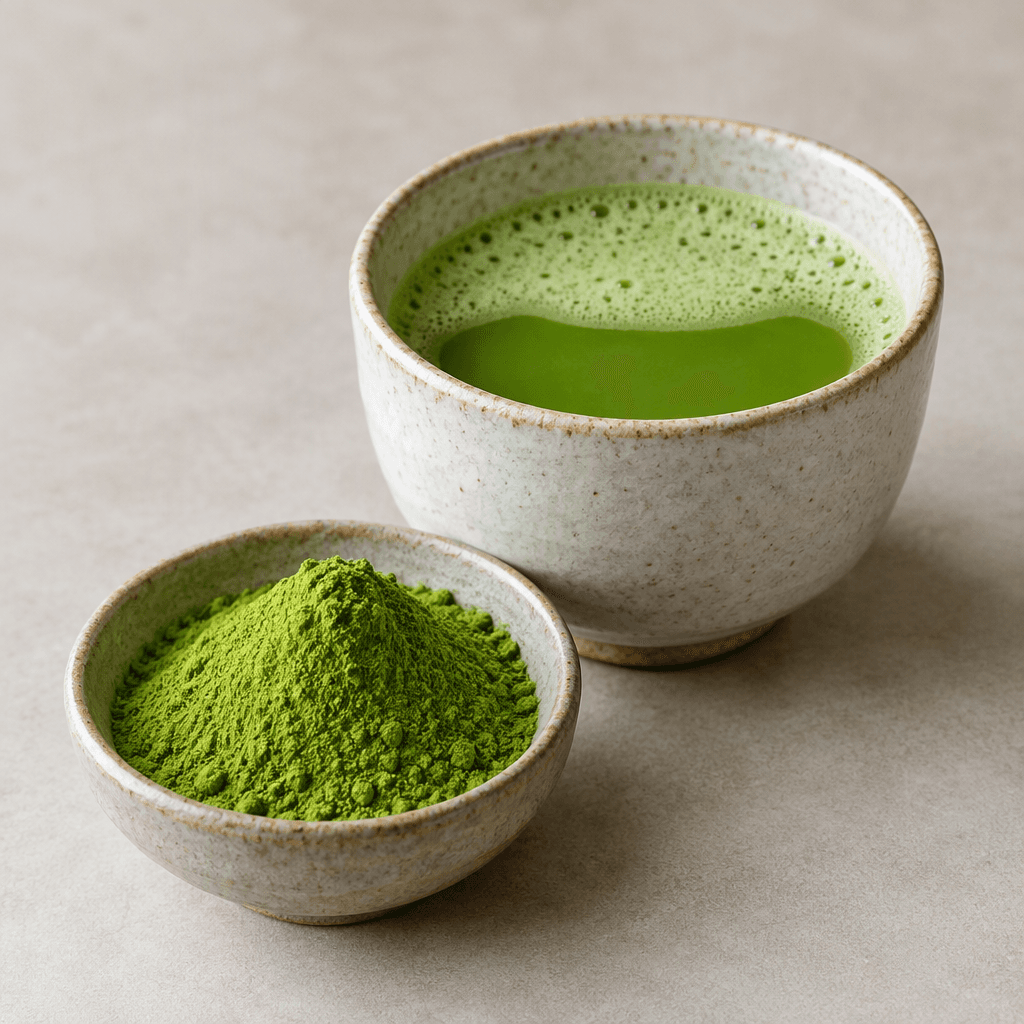
Matcha Calories
Rich in antioxidants, natural energy, traditional Japanese tea
In season: Spring · Summer · Autumn · Winter
CALORIES
GI
POTASSIUM
FIBER
Quick answer
1 teaspoon (small) of Matcha (2 g) has 7 calories. That works out to 325 calories per 100 g. It contains 0.8 g of carbs, 0.6 g of protein, 0.1 g of fat and 0.7 g of fiber. Its 5.8 µg of Vitamin K covers 5% of the Daily Value. Its glycemic index is 15 (low), so it raises blood sugar slowly.
What is Matcha?
Matcha is a finely milled Japanese green tea made from specially grown tea leaves. Unlike steeped tea, the powder is whisked into water and consumed, giving the drink its vivid colour and full-bodied, grassy flavour. It is traditionally prepared with hot water in Japan; elsewhere, it is also popular as a latte, iced drink or addition to smoothies. Plain matcha has no added sugar and is concentrated in plant compounds, with a naturally energising character. For a smooth cup, sift or whisk the powder with a little water first, then add more. A small amount of milk softens its earthy taste, while sweeteners can make a latte less light.
Matcha Nutrition Facts
Selected: 100 g
325
KCAL / 100G
Carbs
38g
· 14% DV
Protein
30g
· 60% DV
Fat
5g
· 6% DV
Fiber
34g
· 121% DV
DV is the share of the daily value covered, on a 2,000 kcal reference diet.
Calories come from: Carbs 48% · Protein 38% · Fat 14%
Matcha Vitamins & Minerals
Vitamins
Vitamin K
290µg · 242% DV
B2
1.35mg · 104% DV
Vitamin C
60mg · 67% DV
B1
0.6mg · 50% DV
Minerals
Copper
1mg · 111% DV
Manganese
2mg · 87% DV
Potassium ⭐
2700mg · 79% DV
Magnesium
230mg · 55% DV
How Nutritious Is Matcha?
Nutrient density
Very high
How many vitamins, minerals and how much fiber this food carries per calorie. A high score means a lot of nutrition for few calories.
Satiety score
High
An EatBetter score computed from fiber, protein and calorie density. A high score means staying full longer on the same calories.
Both scores are calculated per 100 g and do not change with the selected portion. The satiety score is EatBetter's own calculation, not a clinical measure.
Matcha Glycemic Index
GLYCEMIC INDEX
GLYCEMIC LOAD
Accounts for portion size — a more realistic measure than GI alone.
How to Burn Off Matcha
To burn the 325 calories in 100 g:
🚶
Walking (5 km/h)
🏃
Running (8 km/h)
🚴
Cycling
🏊
Swimming
Times are calculated with the MET equation for a 70 kg adult. Actual burn varies with your weight, age and pace.
Is Matcha Processed?
NOVA 2
Minimally Processed
1. Unprocessed
2. Minimally Processed
3. Processed
4. Ultra-Processed
NOVA classifies foods into 4 groups by industrial processing. NOVA 1 (unprocessed) is the healthiest.
Does Matcha Contain Allergens?
No known major allergens
Which Diets Is Matcha Good For?
Vegan
✓ Suitable
Vegetarian
✓ Suitable
Gluten-Free
✓ Suitable
Dairy-Free
— Not suitable
Mediterranean
✓ Suitable
Paleo
✓ Suitable
Whole30
— Not suitable
DASH
— Not suitable
Keto
✓ Suitable
Low FODMAP
— Not suitable
Matcha Fat Profile
SATURATED
1.5g
MONOUNSATURATED
1.6g
POLYUNSATURATED
1.3g
Omega 6:3 ratio 8:1
Above the ideal 4:1 (8:1).
Compare Matcha
Foods Similar to Matcha
Frequently Asked Questions About Matcha
What is matcha, and how is it different from green tea?
Matcha is a finely ground powder made from specially grown green tea leaves. With brewed green tea, you steep the leaves and remove them; with matcha, you whisk the powder into water and drink the whole leaf.
Does matcha have more caffeine than coffee?
Matcha contains caffeine, but whether a serving has more than coffee depends on how much matcha and coffee are used. Matcha also contains L-theanine, which can make its stimulating effect feel different from coffee for some people.
How do you make matcha without a bamboo whisk?
Sift matcha into a mug, add a small amount of warm water, and whisk with a small handheld frother until smooth. A tightly sealed jar can also work: shake the matcha and water together, then pour and serve.
What does matcha taste like, and why does it taste bitter?
Matcha tastes grassy and vegetal, often with a mild sweetness and savory umami notes. Water that is too hot, using too much powder, or choosing a more bitter grade can make it unpleasant; cooler water can soften the taste.
Is matcha healthier than coffee?
Matcha and coffee offer different benefits rather than one being universally healthier. Matcha provides green-tea compounds and caffeine, while coffee has its own plant compounds; whichever suits you better depends partly on caffeine sensitivity and how you prepare it.
How do you make a matcha latte?
Whisk matcha with a little warm water until smooth, then add steamed or cold milk. Dairy or plant-based milk both work; sweeten to taste if desired. Mixing the powder with water first helps keep the latte from turning lumpy.
What is the difference between ceremonial and culinary matcha?
Ceremonial matcha is generally selected for drinking on its own and tends to have a more delicate, smoother flavor. Culinary matcha is often bolder, making it a better fit for lattes, smoothies, and baking where other ingredients compete with its taste.
Why does matcha clump, and how can you prevent it?
Matcha clumps because its very fine powder can stick together when it meets water. Sift it before mixing, start with a small splash of water to make a smooth paste, then add the rest and whisk briskly.
How should you store matcha after opening?
Keep matcha in a tightly sealed, opaque container in a cool, dry place, away from heat, light, and moisture. Refrigeration can help preserve freshness, but let the closed container reach room temperature before opening to avoid condensation.
Can you drink matcha on an empty stomach?
Yes, you can drink matcha on an empty stomach, but its caffeine and tea compounds may cause nausea or stomach discomfort in some people. If that happens, have it with food or choose a gentler drink instead.
Have another question about Matcha?
Ask the AI nutrition coach — calories, portions, alternatives and more, answered in seconds in the app.

Scan calories with your camera
Instant AI nutrition analysis

Nutrition data compiled from USDA FoodData Central and scientific sources.