

Ready & Packaged Foods
All →Vegetables & Legumes
All →Desserts & Confectionery
All →Meat & Protein
All →Grains & Bakery
All →Beverages
All →Milk & Dairy
All →

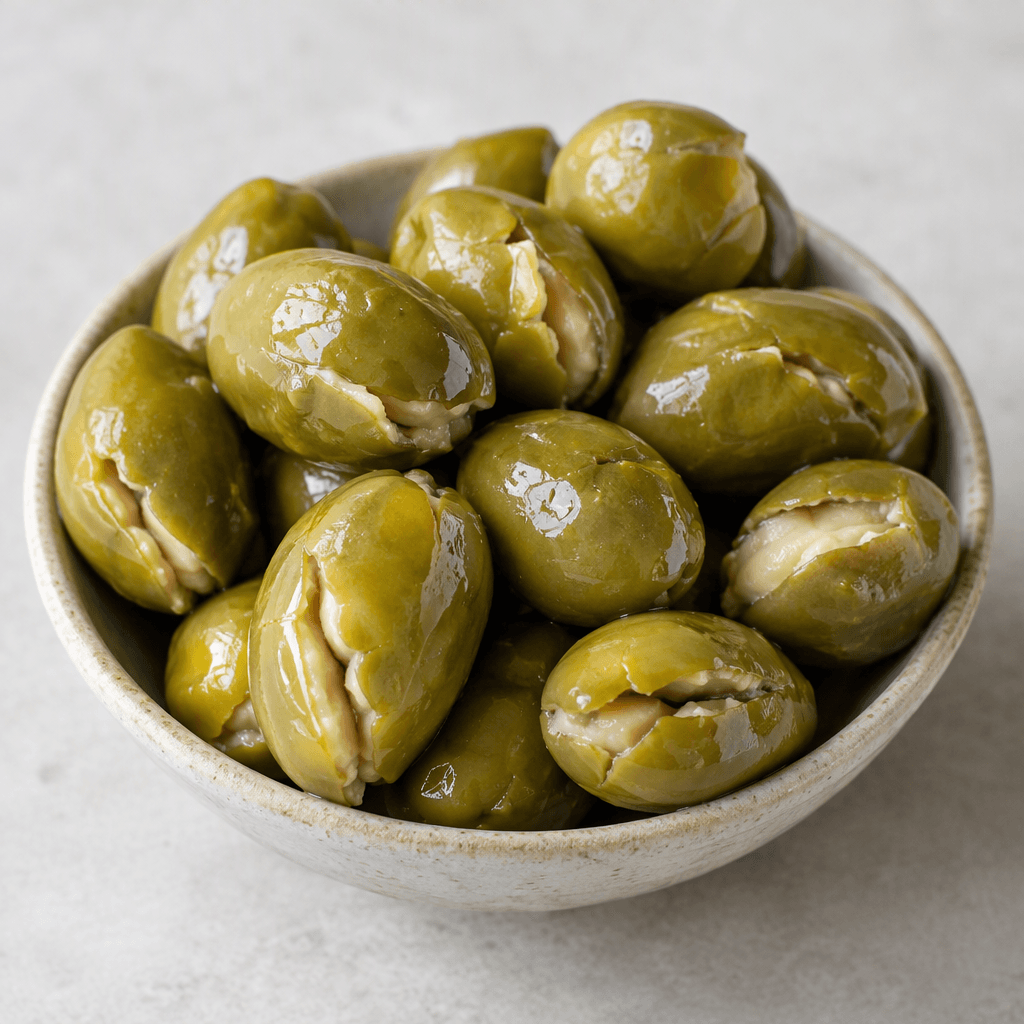
Green cracked olive Calories
Naturally fermented, salty, source of fiber and healthy fats
In season: Autumn · Winter
CALORIES
GI
POTASSIUM
FIBER
Quick answer
10 piece (medium) of Green cracked olive (40 g) has 58 calories. That works out to 145 calories per 100 g. It contains 1.5 g of carbs, 0.5 g of protein, 5.7 g of fat and 1.3 g of fiber. Its 620 mg of Sodium covers 27% of the Daily Value. Its glycemic index is 15 (low), so it raises blood sugar slowly.
What is Green cracked olive?
Green cracked olive is made by splitting firm green olives before curing them in brine, a familiar preparation around the Mediterranean, including Turkey. The cracks help the brine penetrate the fruit. It tastes pleasantly briny and slightly bitter, with a plump, meaty bite and a glossy surface.
Serve it as part of a Turkish-style breakfast, alongside bread and cheese, or as a small meze with drinks. Lemon, garlic and herbs make natural companions. It is mostly a source of fats, with some fibre, while the brine gives it a distinctly salty character. If you prefer a milder taste, rinse and drain the olives before serving.
Green cracked olive Nutrition Facts
Selected: 100 g
145
KCAL / 100G
Carbs
3.8g
· 1% DV
Protein
1.2g
· 2% DV
Fat
14.2g
· 18% DV
Fiber
3.3g
· 12% DV
DV is the share of the daily value covered, on a 2,000 kcal reference diet.
Calories come from: Carbs 10% · Protein 3% · Fat 87%
Green cracked olive Vitamins & Minerals
Vitamins
Vitamin E
3.8mg · 25% DV
B5
0.3mg · 6% DV
B1
0.03mg · 3% DV
Vitamin A
20µg · 2% DV
Minerals
Sodium
1550mg · 67% DV
Iron
1mg · 6% DV
Calcium
52mg · 5% DV
Magnesium
11mg · 3% DV
How Nutritious Is Green cracked olive?
Nutrient density
High
How many vitamins, minerals and how much fiber this food carries per calorie. A high score means a lot of nutrition for few calories.
Satiety score
Medium
An EatBetter score computed from fiber, protein and calorie density. A high score means staying full longer on the same calories.
Both scores are calculated per 100 g and do not change with the selected portion. The satiety score is EatBetter's own calculation, not a clinical measure.
Green cracked olive Glycemic Index
GLYCEMIC INDEX
GLYCEMIC LOAD
Accounts for portion size — a more realistic measure than GI alone.
How to Burn Off Green cracked olive
To burn the 145 calories in 100 g:
🚶
Walking (5 km/h)
🏃
Running (8 km/h)
🚴
Cycling
🏊
Swimming
Times are calculated with the MET equation for a 70 kg adult. Actual burn varies with your weight, age and pace.
Is Green cracked olive Processed?
NOVA 2
Minimally Processed
1. Unprocessed
2. Minimally Processed
3. Processed
4. Ultra-Processed
NOVA classifies foods into 4 groups by industrial processing. NOVA 1 (unprocessed) is the healthiest.
Does Green cracked olive Contain Allergens?
No known major allergens
Which Diets Is Green cracked olive Good For?
Vegan
✓ Suitable
Vegetarian
✓ Suitable
Gluten-Free
✓ Suitable
Dairy-Free
— Not suitable
Mediterranean
✓ Suitable
Paleo
— Not suitable
Whole30
— Not suitable
DASH
— Not suitable
Keto
✓ Suitable
Low FODMAP
— Not suitable
Green cracked olive Fat Profile
SATURATED
2.1g
MONOUNSATURATED
10.3g
POLYUNSATURATED
1.4g
Omega 6:3 ratio 10.9:1
Above the ideal 4:1 (10.9:1).
Compare Green cracked olive
Foods Similar to Green cracked olive
Frequently Asked Questions About Green cracked olive
What is a green cracked olive?
A green cracked olive is an unripe olive split or lightly crushed before curing, so its flesh is exposed to the brine. The cracks help it take on seasoning and lose some of its natural bitterness; it is commonly served as a table olive.
How are green cracked olives made?
Green cracked olives are made by splitting the fruit without crushing the pit, then curing the olives in brine. The exposed flesh helps the brine penetrate, and fermentation may develop their characteristic tangy flavor; recipes and curing times vary.
How do you serve green cracked olives?
Serve green cracked olives as a snack or alongside bread, cheese, salads, and grilled dishes. They are also often dressed with olive oil, lemon, herbs, or chili; taste them first, since the brine can make them salty enough without extra seasoning.
How do you remove bitterness from green cracked olives?
Brining gradually reduces the bitterness of green cracked olives. If homemade olives are still too bitter, refresh their brine and leave them to cure longer in a cool place, tasting periodically; do not expect a quick rinse to remove deep bitterness.
What is the difference between green cracked olives and green olives?
Green cracked olives have been split before curing, while ordinary green olives may be cured whole or prepared another way. Cracking exposes more flesh to the brine, often giving them a softer texture and letting them absorb seasoning more readily.
Do green cracked olives need to be refrigerated?
Refrigerate green cracked olives after opening, keeping them covered by their brine in a clean, sealed container. Use a clean utensil to take them out, and avoid leaving the jar open at room temperature for extended periods.
Should you rinse green cracked olives before eating them?
You do not need to rinse green cracked olives, but a quick rinse or brief soak can reduce their salty taste. Avoid soaking them for too long, since water can dilute their flavor; eat soaked olives promptly.
Can you eat the pit in a green cracked olive?
No, the pit in a green cracked olive is not meant to be eaten. The olive is cracked without intentionally crushing the pit, so bite carefully, especially when serving them to children, and discard the pit after eating.
How can you tell if green cracked olives have gone bad?
Discard green cracked olives if you see mold, notice an unpleasant off odor, or find that they have become slimy. Some brine cloudiness can occur during fermentation, but visible surface mold is not a reason to skim the top and keep eating.
Can green cracked olives be used in cooking?
Yes, green cracked olives can add a salty, tangy flavor to salads, pasta, grain dishes, and sauces. Remove the pits before chopping, and taste the dish before adding salt because the olives and their brine can season it substantially.
Have another question about Green cracked olive?
Ask the AI nutrition coach — calories, portions, alternatives and more, answered in seconds in the app.

Scan calories with your camera
Instant AI nutrition analysis

Nutrition data compiled from USDA FoodData Central and scientific sources.