

Ready & Packaged Foods
All →Vegetables & Legumes
All →Desserts & Confectionery
All →Meat & Protein
All →Grains & Bakery
All →Beverages
All →Milk & Dairy
All →

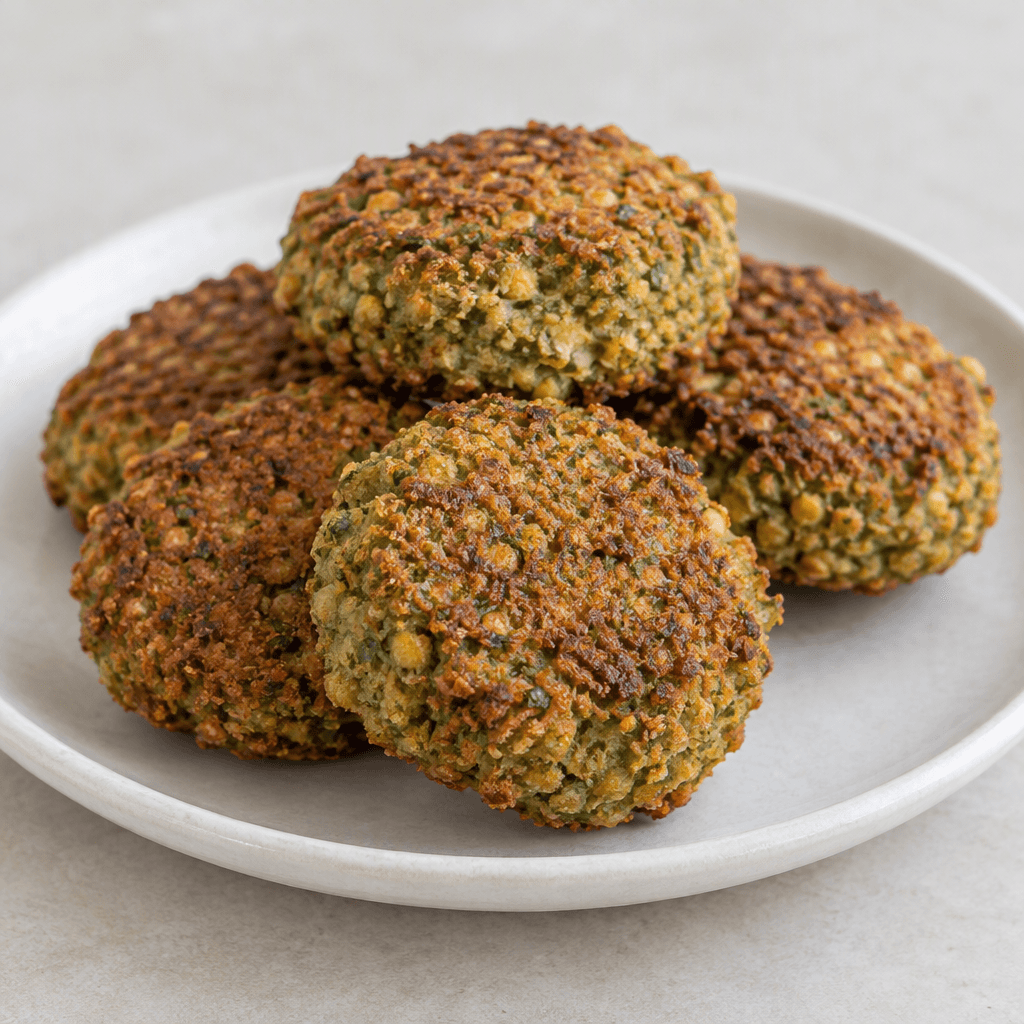
Baked falafel Calories
Middle Eastern chickpea patty baked with herbs and spices
In season: Spring · Summer · Autumn · Winter
CALORIES
GI
POTASSIUM
FIBER
Quick answer
3 piece (medium) of Baked falafel (90 g) has 162 calories. That works out to 180 calories per 100 g. It contains 21.6 g of carbs, 6.8 g of protein, 5 g of fat and 5.2 g of fiber. Its 0.3 mg of Copper covers 28% of the Daily Value. Its glycemic index is 35 (low), so it raises blood sugar slowly.
What is Baked falafel?
Baked falafel is made from chickpeas mixed with herbs and spices, shaped into small patties and cooked in the oven. It is associated with Levantine and wider Middle Eastern cooking, where falafel is a familiar street-food and home-cooked staple. The baked version develops a browned, craggy outside while staying tender and slightly coarse inside.
It is commonly tucked into pita or wraps with salad and pickles, or served alongside a grain bowl or as part of a mezze spread. Chickpeas make it a source of plant protein and fibre, with carbohydrates also contributing much of its energy. For an easy meal, pair baked falafel with plenty of fresh vegetables and a bright, lemony sauce.
Baked falafel Nutrition Facts
Selected: 100 g
180
KCAL / 100G
Carbs
24g
· 9% DV
Protein
7.5g
· 15% DV
Fat
5.5g
· 7% DV
Fiber
5.8g
· 21% DV
DV is the share of the daily value covered, on a 2,000 kcal reference diet.
Calories come from: Carbs 55% · Protein 17% · Fat 28%
Baked falafel Vitamins & Minerals
Vitamins
Biotin
6µg · 20% DV
Folate
65µg · 16% DV
B1
0.18mg · 15% DV
B6
0.18mg · 11% DV
Minerals
Manganese
1mg · 43% DV
Phosphorus
120mg · 17% DV
Sodium
320mg · 14% DV
Selenium
7µg · 13% DV
How Nutritious Is Baked falafel?
Nutrient density
High
How many vitamins, minerals and how much fiber this food carries per calorie. A high score means a lot of nutrition for few calories.
Satiety score
High
An EatBetter score computed from fiber, protein and calorie density. A high score means staying full longer on the same calories.
Both scores are calculated per 100 g and do not change with the selected portion. The satiety score is EatBetter's own calculation, not a clinical measure.
Baked falafel Glycemic Index
GLYCEMIC INDEX
GLYCEMIC LOAD
Accounts for portion size — a more realistic measure than GI alone.
How to Burn Off Baked falafel
To burn the 180 calories in 100 g:
🚶
Walking (5 km/h)
🏃
Running (8 km/h)
🚴
Cycling
🏊
Swimming
Times are calculated with the MET equation for a 70 kg adult. Actual burn varies with your weight, age and pace.
Is Baked falafel Processed?
NOVA 2
Minimally Processed
1. Unprocessed
2. Minimally Processed
3. Processed
4. Ultra-Processed
NOVA classifies foods into 4 groups by industrial processing. NOVA 1 (unprocessed) is the healthiest.
Does Baked falafel Contain Allergens?
Contains these allergens:
Which Diets Is Baked falafel Good For?
Vegan
✓ Suitable
Vegetarian
✓ Suitable
Gluten-Free
✓ Suitable
Dairy-Free
— Not suitable
Mediterranean
✓ Suitable
Paleo
— Not suitable
Whole30
— Not suitable
DASH
— Not suitable
Keto
— Not suitable
Low FODMAP
— Not suitable
Baked falafel Fat Profile
SATURATED
0.7g
MONOUNSATURATED
1.7g
POLYUNSATURATED
1.3g
Omega 6:3 ratio 15:1
Above the ideal 4:1 (15:1).
Compare Baked falafel
Foods Similar to Baked falafel
Frequently Asked Questions About Baked falafel
What is baked falafel made of?
Baked falafel is usually made from soaked dried chickpeas, onion, garlic, herbs such as parsley, and spices including cumin and coriander. The mixture is shaped into patties or balls and baked until browned; it should stay coarse rather than become a smooth paste.
How do you make baked falafel crispy?
For crispier baked falafel, drain the soaked chickpeas very well, avoid overcrowding the tray, and brush or spray the shaped pieces lightly with oil. Bake in a fully preheated oven and turn them once so more than one side browns.
Can you make baked falafel with canned chickpeas?
Yes, but canned chickpeas are already cooked and wetter than the soaked dried chickpeas traditionally used for falafel, so the mixture may fall apart. Drain and dry them thoroughly, add chickpea flour if needed, and chill the shaped falafel before baking.
Why does baked falafel fall apart?
Baked falafel often falls apart when the chickpeas are too wet, the mixture is blended too smoothly, or the patties are handled before they set. Use soaked dried chickpeas, keep the mixture slightly coarse, and chill it before shaping and baking.
Is baked falafel healthier than fried falafel?
Baked falafel is generally lower in added fat because it is not submerged in frying oil. Its chickpeas still provide fiber and plant protein, but toppings, sauces, and serving size affect the overall meal.
What is the difference between baked falafel and regular falafel?
The main difference is the cooking method: baked falafel cooks in the oven, while traditional falafel is usually deep-fried. Baking typically uses less oil and gives a less uniformly crisp crust; a light oil coating helps it brown.
What sauce goes best with baked falafel?
Tahini sauce is a classic match for baked falafel, and garlic yogurt or hummus also works well. For a quick tahini sauce, stir tahini with lemon juice, garlic, and enough water to make it pourable.
How do you keep baked falafel from drying out?
To keep baked falafel from drying out, avoid overbaking it and include a little oil in the mixture or on the surface. Serve it soon after baking, or store leftovers covered and reheat them briefly rather than leaving them in the oven.
Can you freeze baked falafel?
Yes, baked falafel freezes well. Cool it completely, freeze the pieces in a single layer so they do not stick together, then transfer them to an airtight container. Reheat from frozen in the oven until hot.
How long does baked falafel last in the fridge?
Cooked baked falafel keeps for about 3–4 days in a covered container in the refrigerator. Refrigerate it promptly after serving, and reheat only the portion you plan to eat so the remaining pieces keep their texture.
Have another question about Baked falafel?
Ask the AI nutrition coach — calories, portions, alternatives and more, answered in seconds in the app.

Scan calories with your camera
Instant AI nutrition analysis

Nutrition data compiled from USDA FoodData Central and scientific sources.