

Ready & Packaged Foods
All →Vegetables & Legumes
All →Desserts & Confectionery
All →Meat & Protein
All →Grains & Bakery
All →Beverages
All →Milk & Dairy
All →

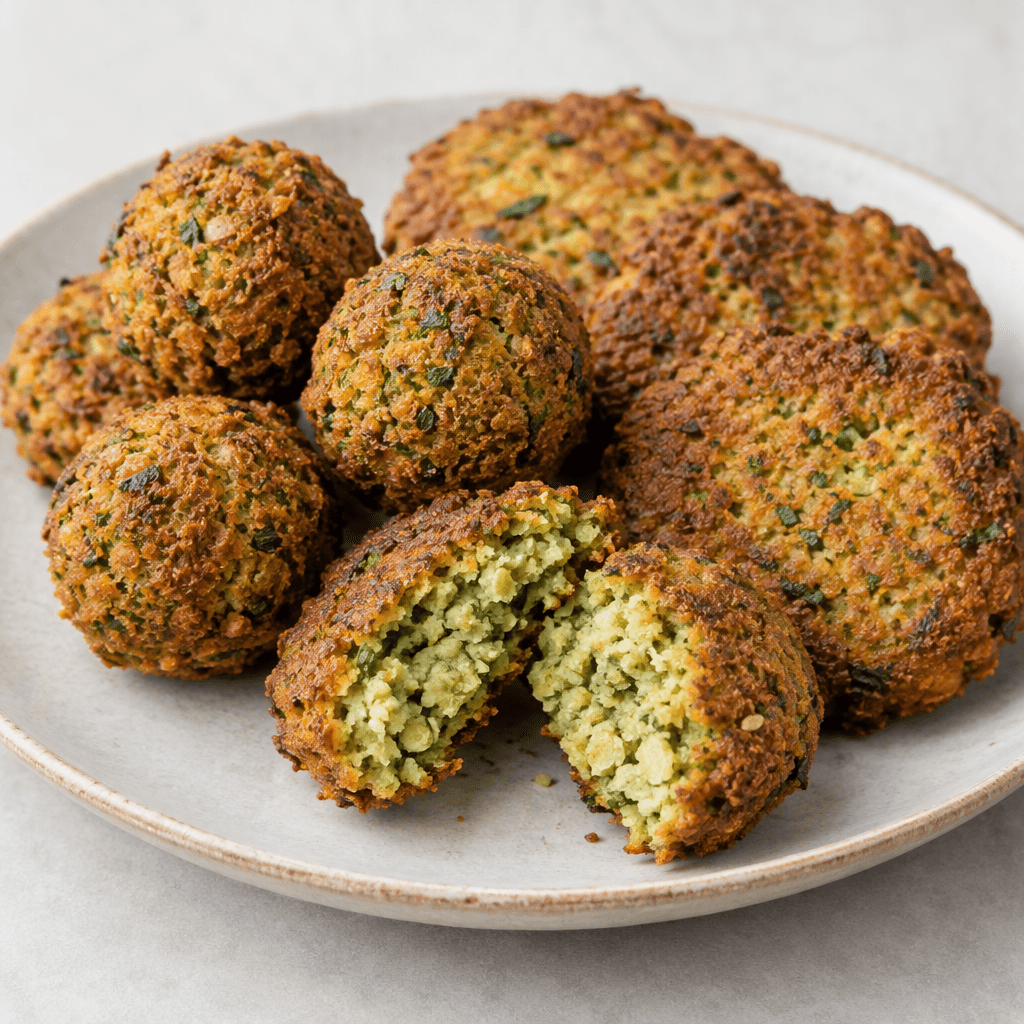
Falafel Calories
Chickpea fritter, vegan protein, fiber source
In season: Spring · Summer · Autumn · Winter
CALORIES
GI
POTASSIUM
FIBER
Quick answer
3 piece (medium) of Falafel (120 g) has 400 calories. That works out to 333 calories per 100 g. It contains 38.2 g of carbs, 16 g of protein, 21.4 g of fat and 9.4 g of fiber. Its 0.5 mg of Copper covers 55% of the Daily Value. Its glycemic index is 35 (low), so it raises blood sugar slowly.
What is Falafel?
Falafel is a Levantine and Middle Eastern dish made by shaping ground chickpeas—or, in some regional versions, fava beans—with herbs and spices into balls or patties, then frying them. The outside turns crisp and browned, while the inside stays tender and slightly crumbly, with a fresh, savoury flavour from the herbs.
You’ll find falafel tucked into pita or wraps, served with salad and tahini sauce, or offered as part of a mezze spread. It provides plant-based protein and fibre, though frying contributes a noticeable amount of fat. For a lighter meal, pair baked falafel with plenty of vegetables and use tahini sauce sparingly.
Falafel Nutrition Facts
Selected: 100 g
333
KCAL / 100G
Carbs
31.8g
· 12% DV
Protein
13.3g
· 27% DV
Fat
17.8g
· 23% DV
Fiber
7.8g
· 28% DV
DV is the share of the daily value covered, on a 2,000 kcal reference diet.
Calories come from: Carbs 37% · Protein 16% · Fat 47%
Falafel Vitamins & Minerals
Vitamins
Folate
125µg · 31% DV
Biotin
8µg · 27% DV
B1
0.28mg · 23% DV
B6
0.33mg · 19% DV
Minerals
Manganese
1mg · 43% DV
Phosphorus
180mg · 26% DV
Iron
3mg · 17% DV
Magnesium
62mg · 15% DV
How Nutritious Is Falafel?
Nutrient density
High
How many vitamins, minerals and how much fiber this food carries per calorie. A high score means a lot of nutrition for few calories.
Satiety score
Medium
An EatBetter score computed from fiber, protein and calorie density. A high score means staying full longer on the same calories.
Both scores are calculated per 100 g and do not change with the selected portion. The satiety score is EatBetter's own calculation, not a clinical measure.
Falafel Glycemic Index
GLYCEMIC INDEX
GLYCEMIC LOAD
Accounts for portion size — a more realistic measure than GI alone.
How to Burn Off Falafel
To burn the 333 calories in 100 g:
🚶
Walking (5 km/h)
🏃
Running (8 km/h)
🚴
Cycling
🏊
Swimming
Times are calculated with the MET equation for a 70 kg adult. Actual burn varies with your weight, age and pace.
Is Falafel Processed?
NOVA 2
Minimally Processed
1. Unprocessed
2. Minimally Processed
3. Processed
4. Ultra-Processed
NOVA classifies foods into 4 groups by industrial processing. NOVA 1 (unprocessed) is the healthiest.
Does Falafel Contain Allergens?
Contains these allergens:
Which Diets Is Falafel Good For?
Vegan
✓ Suitable
Vegetarian
✓ Suitable
Gluten-Free
✓ Suitable
Dairy-Free
— Not suitable
Mediterranean
✓ Suitable
Paleo
— Not suitable
Whole30
— Not suitable
DASH
— Not suitable
Keto
— Not suitable
Low FODMAP
— Not suitable
Falafel Fat Profile
SATURATED
2.1g
MONOUNSATURATED
6.1g
POLYUNSATURATED
7.2g
Omega 6:3 ratio 40:1
Above the ideal 4:1 (40:1).
Compare Falafel
Foods Similar to Falafel
Frequently Asked Questions About Falafel
What does falafel taste like?
Falafel tastes savory and herby, with earthy chickpeas or fava beans, garlic, and spices such as cumin. A well-cooked piece has a crisp exterior and a tender, crumbly center; tahini adds a nutty contrast.
What is falafel made of?
Falafel is usually made from ground, soaked dried chickpeas mixed with herbs, onion, garlic, and spices, then shaped and cooked. Some regional versions use fava beans instead, and the mixture is generally not made from cooked chickpeas.
Why does falafel fall apart when frying?
Falafel often falls apart when the mixture is too wet or made with cooked canned chickpeas. Use soaked but uncooked dried chickpeas, drain them thoroughly, and chill the shaped mixture so the patties hold together in the oil.
Can falafel be baked instead of fried?
Yes, falafel can be baked. Arrange the shaped pieces on a lined tray, brush or spray them lightly with oil, and bake until browned and cooked through. Baked falafel is usually less crisp than deep-fried falafel.
What do you serve with falafel?
Falafel is commonly served in pita or flatbread with salad, pickles, and tahini sauce. It also works in a grain bowl with hummus and vegetables, or as part of a mezze spread with dips.
Is falafel healthy?
Falafel provides plant protein and fiber from its legumes, herbs, and spices. Deep-fried falafel contains more oil, so baked falafel or a meal served with vegetables can be a lighter way to enjoy it.
Can you eat falafel cold?
Yes, cooked falafel can be eaten cold, such as in a salad or packed lunch. Its texture will be firmer and less crisp than when warm, so many people prefer to reheat it before serving.
How do you reheat falafel without making it soggy?
Reheat falafel in an oven, air fryer, or dry skillet rather than a microwave. These methods let moisture escape and help restore the crisp outside; turn the pieces once so they warm evenly.
Can you freeze falafel?
Yes, freeze cooked falafel or uncooked shaped patties. Freeze them in a single layer first, then transfer them to a sealed container or bag; cooked pieces can be reheated straight from frozen until hot throughout.
Where did falafel originate?
Falafel's exact origin is disputed, but Egypt and the Levant are commonly associated with its history. Egyptian taamiya is often made with fava beans, while chickpeas are more typical in many Levantine versions.
Have another question about Falafel?
Ask the AI nutrition coach — calories, portions, alternatives and more, answered in seconds in the app.

Scan calories with your camera
Instant AI nutrition analysis

Nutrition data compiled from USDA FoodData Central and scientific sources.