

Ready & Packaged Foods
All →Vegetables & Legumes
All →Desserts & Confectionery
All →Meat & Protein
All →Grains & Bakery
All →Beverages
All →Milk & Dairy
All →

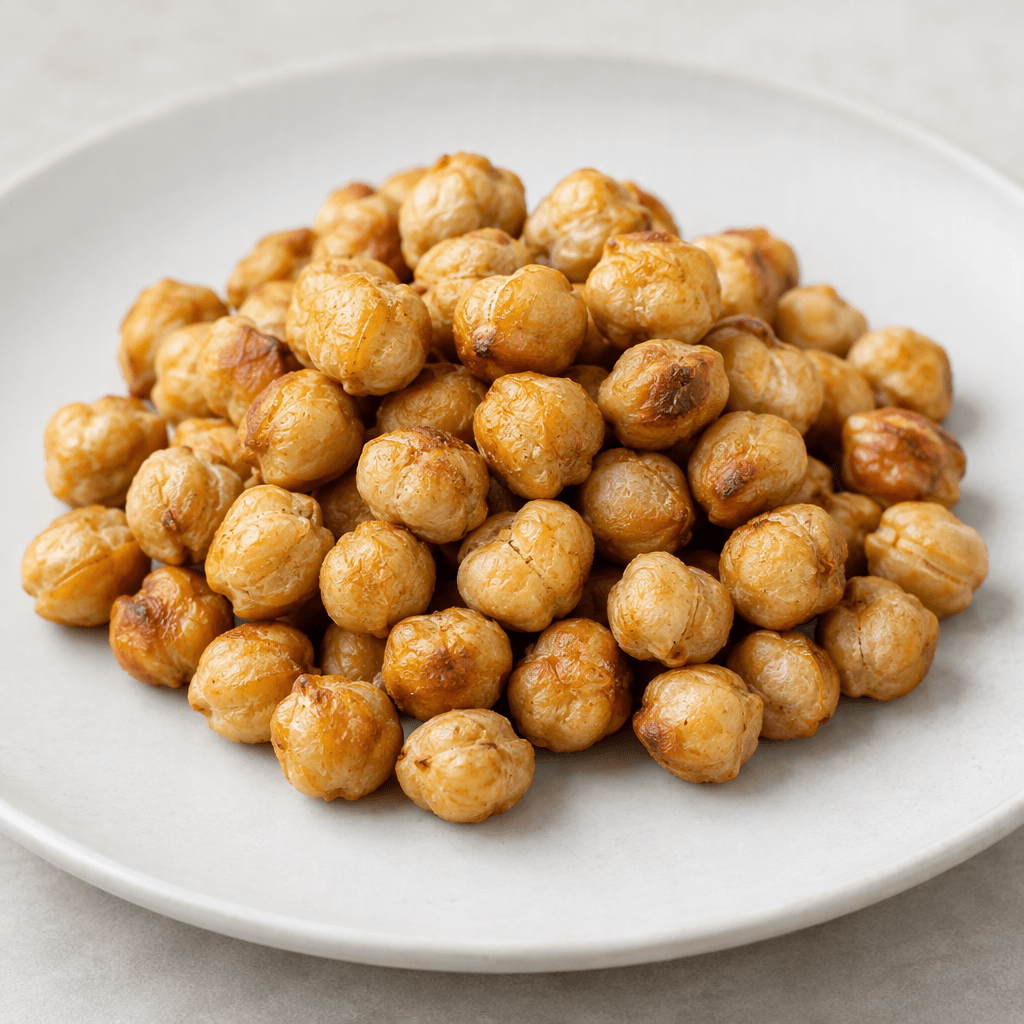
Chickpeas (lightly roasted) Calories
Plant protein, fiber, folate and iron source. Crunchy texture from light roasting.
In season: Spring · Summer · Autumn · Winter
CALORIES · 100 G
GI
POTASSIUM · 100 G
FIBER · 100 G
Quick answer
1 cup (medium) of Chickpeas (lightly roasted) (120 g) has 444 calories. That works out to 370 calories per 100 g. It contains 67.8 g of carbs, 23.4 g of protein, 7.4 g of fat and 13.4 g of fiber. Its 408 µg of Folate covers 102% of the Daily Value. Its glycemic index is 35 (low), so it raises blood sugar slowly.
Chickpeas (lightly roasted) Nutrition Facts
Selected: 1 cup (medium) · 120 g
444
KCAL / 120G
Carbs
67.8g
· 25% DV
Protein
23.4g
· 47% DV
Fat
7.4g
· 9% DV
Fiber
13.4g
· 48% DV
DV is the share of the daily value covered, on a 2,000 kcal reference diet.
Calories come from: Carbs 63% · Protein 22% · Fat 15%
Chickpeas (lightly roasted) nutrition facts table · 1 cup (medium) (120 g)
| Nutrient | Amount | % DV |
|---|---|---|
| Calories | 444 kcal | |
| Total fat | 7.4 g | 9% |
| Saturated fat | 0.72 g | 4% |
| Trans fat | 0 g | |
| Sodium | 22 mg | 1% |
| Total carbohydrate | 67.8 g | 25% |
| Fiber | 13.4 g | 48% |
| Protein | 23.4 g | 47% |
Calories: Calories measure energy. Average daily need is 2,000 kcal. Excess calories are stored as fat, too few cause weight loss.
Carbs: Your body's primary energy source. The brain runs exclusively on carbs. Daily need: 275g.
Protein: Essential for muscle repair and cell growth. Daily need: 50g. Keeps you full and boosts metabolism.
Fat: Needed for hormone production and vitamin absorption. Daily need: 78g. Limit saturated fats, choose unsaturated.
Fiber: Critical for digestive health and satiety. Daily need: 28g. Stabilizes blood sugar, lowers cholesterol.

Log this food in EatBetter
100,000+ people use it
- Get your daily calorie target
- Snap your meal, log it in seconds
- See every vitamin and mineral

📸 Scan the code to get the app free.

How Many Calories in 1 Cup of Chickpeas (lightly roasted)?
| Serving | Amount | Calories |
|---|---|---|
| 1 cup (medium) | 120 g | 444 kcal |
| 1 tablespoon (medium) | 12 g | 44 kcal |
| 1 piece (mini) | 25 g | 93 kcal |
| 1 serving (small) | 50 g | 185 kcal |
| 1 cup (small) | 80 g | 296 kcal |
| 100 g | 100 g | 370 kcal |
| 1 serving (medium) | 100 g | 370 kcal |
| 1 serving (large) | 150 g | 555 kcal |
| 1 cup (large) | 160 g | 592 kcal |
| 1 pack (jumbo) | 200 g | 740 kcal |
Calculated from 370 calories per 100 g.
Frequently Asked Questions About Chickpeas (lightly roasted)
How do you make lightly roasted chickpeas crunchy?
Lightly roasted chickpeas turn crunchy when their surface is dry before roasting. Drain and thoroughly dry cooked chickpeas, spread them in a single layer, then roast while stirring occasionally; crowding the pan traps moisture and softens them.
Are lightly roasted chickpeas a healthy snack?
Yes, lightly roasted chickpeas make a filling snack because they provide plant protein and fiber. Plain or lightly salted versions are a practical choice; heavily seasoned varieties can add a lot of salt or other ingredients.
Do lightly roasted chickpeas cause gas?
They can cause gas or bloating in some people. Chickpeas contain fermentable carbohydrates, and their fiber may be uncomfortable if you are not used to it; try a small portion and increase gradually.
How should you store lightly roasted chickpeas so they stay crunchy?
Store lightly roasted chickpeas in an airtight container in a cool, dry place. Moisture makes them lose their crunch, so avoid leaving the container open; briefly reheating softened chickpeas in an oven may help restore some crispness.
Can you eat the skins on lightly roasted chickpeas?
Yes, the skins on lightly roasted chickpeas are edible and do not need to be removed. They add texture and fiber, though some people find chickpea skins harder to digest; peel them off if they bother you.
Are lightly roasted chickpeas the same as leblebi?
Not necessarily. Leblebi is a traditional Turkish snack made by soaking, drying, and roasting chickpeas, often through repeated roasting; lightly roasted chickpeas may be prepared more simply and can have a different texture or retain their skins.
Do lightly roasted chickpeas need to be soaked before eating?
No, ready-to-eat lightly roasted chickpeas do not need soaking. Soaking is a preparation step for dried raw chickpeas before cooking, not for a snack that has already been cooked or roasted.
Can lightly roasted chickpeas help with weight loss?
They can fit into a weight-loss eating plan as a filling snack, but large portions can add substantial energy. Measure a portion into a bowl rather than eating straight from a bag, especially when snacking absent-mindedly.
Why do the skins come off lightly roasted chickpeas?
The skins can loosen as chickpeas dry and roast, and rough handling can make them shed more easily. Loose skins are harmless and can be eaten or discarded; they do not mean the chickpeas have gone bad.
Are lightly roasted chickpeas good for people with diabetes?
They can be included, but lightly roasted chickpeas still contain carbohydrates and may raise blood sugar. Fiber and protein influence how quickly they are digested; people with diabetes should fit the portion into their individual meal plan.
Chickpeas (lightly roasted) Vitamins & Minerals
Vitamins
Folate
408µg · 102% DV
Biotin
22.8µg · 76% DV
B6
0.65mg · 38% DV
B1
0.46mg · 38% DV
Minerals
Copper
0.7mg · 78% DV
Manganese
1.56mg · 68% DV
Phosphorus
348mg · 50% DV
Potassium ⭐
1050mg · 31% DV
Sodium
22mg · 1% DV
Chickpeas (lightly roasted) Glycemic Index
GLYCEMIC INDEX
GLYCEMIC LOAD
Accounts for portion size — a more realistic measure than GI alone.
How to Burn Off Chickpeas (lightly roasted)
To burn the 444 calories in 1 cup (medium) (120 g):
🚶
Walking (5 km/h)
🏃
Running (8 km/h)
🚴
Cycling
🏊
Swimming
Times are calculated with the MET equation for a 70 kg adult. Actual burn varies with your weight, age and pace.
What is Chickpeas (lightly roasted)?
Chickpeas (lightly roasted) are chickpeas gently roasted until dry and crisp, making them a simple savoury snack. They have a mild, earthy, nutty flavour; depending on the roast, the outside may be crunchy while the centre stays a little tender. Across the Mediterranean and Middle East they are enjoyed as a snack, while elsewhere they also make an easy alternative to crisps or crunchy toppings.
Eat them by the handful, add them to salads or soups, or scatter them over roasted vegetables for texture. They provide plant protein and fibre, with 19.5 g of protein per 100 g, so a small portion can make a satisfying snack. For a lighter option, choose an unsalted version and pair it with fresh vegetables or fruit.
How Nutritious Is Chickpeas (lightly roasted)?
Nutrient density
High
How many vitamins, minerals and how much fiber this food carries per calorie. A high score means a lot of nutrition for few calories.
Satiety score
High
An EatBetter score computed from fiber, protein and calorie density. A high score means staying full longer on the same calories.
Both scores are calculated per 100 g and do not change with the selected portion. The satiety score is EatBetter's own calculation, not a clinical measure.
Is Chickpeas (lightly roasted) Processed?
NOVA 2
Minimally Processed
1. Unprocessed
2. Minimally Processed
3. Processed
4. Ultra-Processed
NOVA classifies foods into 4 groups by industrial processing. NOVA 1 (unprocessed) is the healthiest.
Does Chickpeas (lightly roasted) Contain Allergens?
No known major allergens
Which Diets Is Chickpeas (lightly roasted) Good For?
Vegan
✓ Suitable
Vegetarian
✓ Suitable
Gluten-Free
✓ Suitable
Dairy-Free
— Not suitable
Mediterranean
✓ Suitable
Paleo
✓ Suitable
Whole30
— Not suitable
DASH
— Not suitable
Keto
— Not suitable
Low FODMAP
— Not suitable
Chickpeas (lightly roasted) Fat Profile
SATURATED
0.72g
MONOUNSATURATED
1.68g
POLYUNSATURATED
3.24g
Omega 6:3 ratio 44.6:1
Above the ideal 4:1 (44.6:1).
Compare Chickpeas (lightly roasted)
Foods Similar to Chickpeas (lightly roasted)
Have another question about Chickpeas (lightly roasted)?
Ask the AI nutrition coach — calories, portions, alternatives and more, answered in seconds in the app.

Scan calories with your camera
Instant AI nutrition analysis

Nutrition data compiled from USDA FoodData Central and scientific sources.