

Ready & Packaged Foods
All →Vegetables & Legumes
All →Desserts & Confectionery
All →Meat & Protein
All →Grains & Bakery
All →Beverages
All →Milk & Dairy
All →

Iceberg Lettuce Calories
Very low calorie, high water content, ideal for salads
In season: Spring · Summer · Autumn · Winter
CALORIES
GI
POTASSIUM
FIBER
Quick answer
1 cup (chopped) of Iceberg Lettuce (55 g) has 8 calories. That works out to 14 calories per 100 g. It contains 1.6 g of carbs, 0.5 g of protein, 0.1 g of fat and 0.7 g of fiber. Its 13.3 µg of Vitamin K covers 11% of the Daily Value. Its glycemic index is 32 (low), so it raises blood sugar slowly.
What is Iceberg Lettuce?
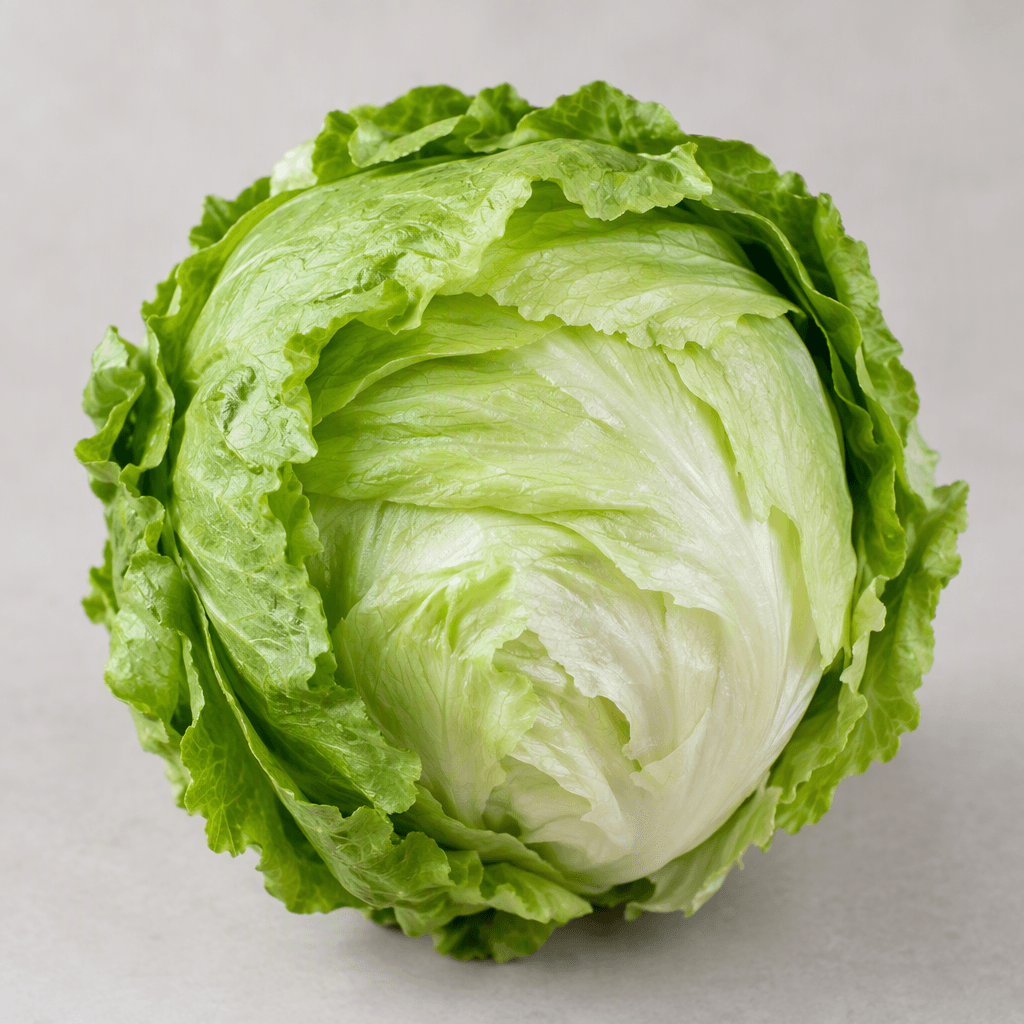
Iceberg lettuce is a compact, round-headed variety of lettuce, with greener outer leaves and a pale, tightly layered, crunchy centre. It is usually eaten raw. Its crisp, mild leaves add freshness to salads, burgers and sandwiches, and work well shredded into wraps or tacos. In the US it is a familiar salad and sandwich staple; elsewhere, it is an easy way to add crunch to everyday meals.
Mostly water and very low in calories, it has a mild flavour that pairs readily with bolder dressings and fillings. A light vinaigrette keeps a salad fresh without weighing it down. Wash and dry the leaves well, then dress them just before serving so they stay crisp.
Iceberg Lettuce Nutrition Facts
Selected: 100 g
14
KCAL / 100G
Carbs
3g
· 1% DV
Protein
0.9g
· 2% DV
Fat
0.1g
· 0% DV
Fiber
1.2g
· 4% DV
DV is the share of the daily value covered, on a 2,000 kcal reference diet.
Calories come from: Carbs 73% · Protein 22% · Fat 5%
Iceberg Lettuce Vitamins & Minerals
Vitamins
Vitamin K
24.1µg · 20% DV
Folate
29µg · 7% DV
Vitamin A
25µg · 3% DV
B1
0.04mg · 3% DV
Minerals
Potassium ⭐
141mg · 4% DV
Phosphorus
20mg · 3% DV
Calcium
18mg · 2% DV
Magnesium
7mg · 2% DV
How Nutritious Is Iceberg Lettuce?
Nutrient density
Low
How many vitamins, minerals and how much fiber this food carries per calorie. A high score means a lot of nutrition for few calories.
Satiety score
Medium
An EatBetter score computed from fiber, protein and calorie density. A high score means staying full longer on the same calories.
Both scores are calculated per 100 g and do not change with the selected portion. The satiety score is EatBetter's own calculation, not a clinical measure.
Iceberg Lettuce Glycemic Index
GLYCEMIC INDEX
GLYCEMIC LOAD
Accounts for portion size — a more realistic measure than GI alone.
How to Burn Off Iceberg Lettuce
To burn the 14 calories in 100 g:
🚶
Walking (5 km/h)
🏃
Running (8 km/h)
🚴
Cycling
🏊
Swimming
Times are calculated with the MET equation for a 70 kg adult. Actual burn varies with your weight, age and pace.
Is Iceberg Lettuce Processed?
NOVA 1
Unprocessed
1. Unprocessed
2. Minimally Processed
3. Processed
4. Ultra-Processed
NOVA classifies foods into 4 groups by industrial processing. NOVA 1 (unprocessed) is the healthiest.
Does Iceberg Lettuce Contain Allergens?
No known major allergens
Which Diets Is Iceberg Lettuce Good For?
Vegan
✓ Suitable
Vegetarian
✓ Suitable
Gluten-Free
✓ Suitable
Dairy-Free
— Not suitable
Mediterranean
✓ Suitable
Paleo
✓ Suitable
Whole30
— Not suitable
DASH
— Not suitable
Keto
✓ Suitable
Low FODMAP
— Not suitable
Iceberg Lettuce Fat Profile
SATURATED
0.02g
MONOUNSATURATED
0.01g
POLYUNSATURATED
0.06g
Omega 6:3 ratio 1.5:1
Below the ideal 4:1 — a good omega balance.
Compare Iceberg Lettuce
Foods Similar to Iceberg Lettuce
Frequently Asked Questions About Iceberg Lettuce
Why is iceberg lettuce called iceberg lettuce?
Iceberg lettuce got its name because, in the early 20th century, heads were shipped covered with crushed ice. Its pale, tightly packed leaves and crisp texture also distinguish it from loose-leaf lettuces.
How do you keep iceberg lettuce crisp?
Keep iceberg lettuce cold and dry, and add dressing only just before serving. After washing, dry the leaves thoroughly; moisture left between them makes them limp faster.
How should you store a head of iceberg lettuce?
Store an unwashed, whole head of iceberg lettuce in the refrigerator, loosely enclosed in a bag or container. Keep it in the crisper drawer and remove any damaged outer leaves before storing.
Can you freeze iceberg lettuce?
You can freeze iceberg lettuce, but it will lose its crisp texture as it thaws and become watery. Use frozen leaves in cooked dishes rather than salads or sandwiches.
How do you wash iceberg lettuce properly?
Separate the iceberg lettuce leaves and rinse them under cool running water, gently rubbing away any soil. Don’t use soap or detergent. Dry the leaves well with a clean towel or salad spinner before eating.
Can you eat the outer leaves of iceberg lettuce?
Yes, you can eat the outer leaves of iceberg lettuce if they are fresh and clean. They may be darker and less tender than the inner leaves; discard any that are slimy, badly damaged, or spoiled.
What is the hard core in iceberg lettuce, and should you remove it?
The hard core is the compact stem at the base of the iceberg lettuce head. Remove it if you want to separate the leaves easily; it is edible, but usually tougher than the leaves.
Why does iceberg lettuce turn brown after cutting?
Iceberg lettuce can turn brown where cut because exposure to air damages the cut tissue. Use a clean knife, keep cut lettuce covered and refrigerated, and discard it if it becomes slimy or develops an off smell.
Can iceberg lettuce be cooked?
Yes, iceberg lettuce can be cooked briefly, although it wilts quickly. Halve and grill it or stir it into a hot dish near the end of cooking to retain some texture.
Can iceberg lettuce be used instead of tortillas for wraps?
Yes, large iceberg lettuce leaves can stand in for tortillas in a fresh, crunchy wrap. Separate intact leaves from the head, trim the thick base if needed, and avoid overfilling so they don’t split.
Have another question about Iceberg Lettuce?
Ask the AI nutrition coach — calories, portions, alternatives and more, answered in seconds in the app.

Scan calories with your camera
Instant AI nutrition analysis

Nutrition data compiled from USDA FoodData Central and scientific sources.