

Ready & Packaged Foods
All →Vegetables & Legumes
All →Desserts & Confectionery
All →Meat & Protein
All →Grains & Bakery
All →Beverages
All →Milk & Dairy
All →

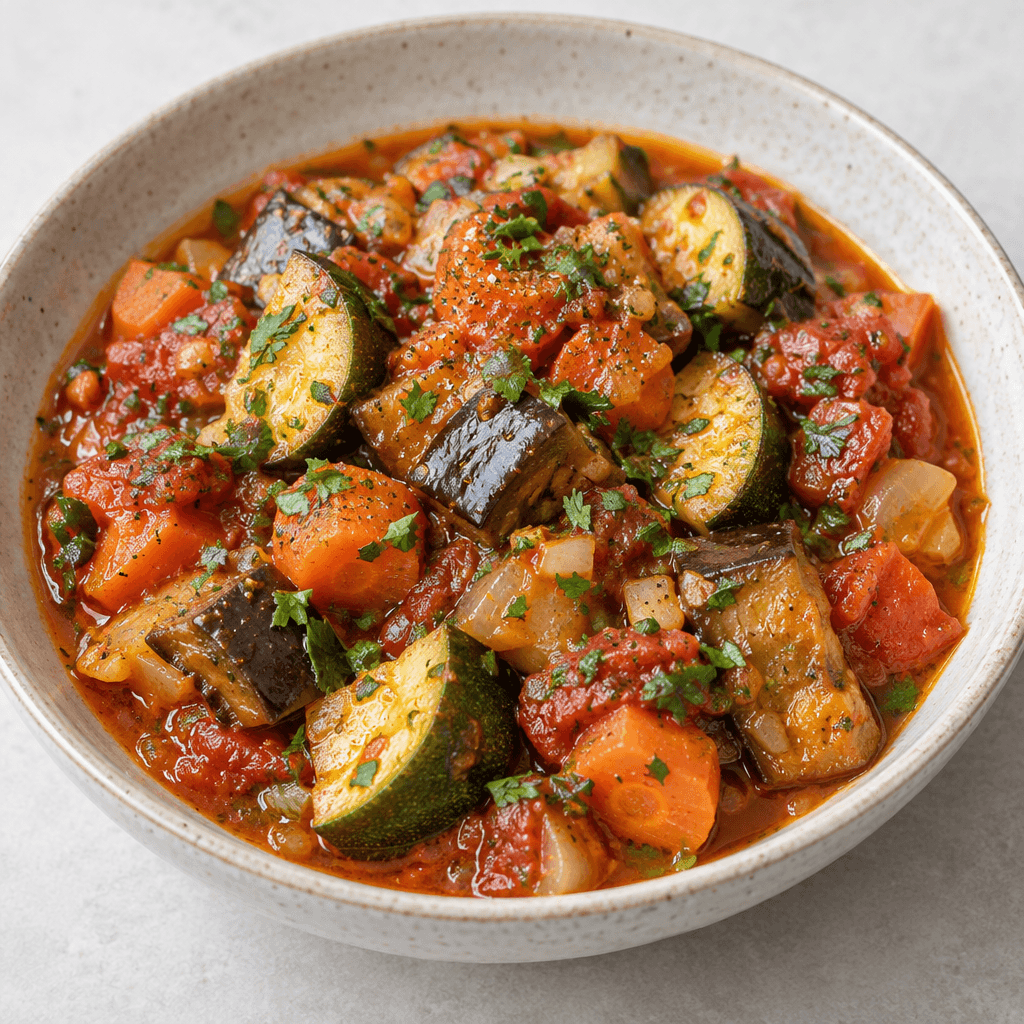
Vegetable Stew with Olive Oil Calories
Olive oil, vegetable-rich, high fiber, Mediterranean cuisine
In season: Spring · Summer · Autumn
CALORIES
GI
POTASSIUM
FIBER
Quick answer
1 serving (medium) of Vegetable Stew with Olive Oil (200 g) has 170 calories. That works out to 85 calories per 100 g. It contains 17 g of carbs, 3.4 g of protein, 9.2 g of fat and 5 g of fiber. Its 640 µg of Vitamin A covers 71% of the Daily Value. Its glycemic index is 35 (low), so it raises blood sugar slowly.
What is Vegetable Stew with Olive Oil?
Vegetable Stew with Olive Oil is a home-style Turkish dish of chunky vegetables—often zucchini, eggplant, tomato, onion and carrot—gently cooked in olive oil, usually with a tomato-based sauce. The exact mix varies with the season and the cook, and the vegetables are generally left in pieces rather than puréed.
It is soft and savoury, with a gentle sweetness and acidity from the tomatoes and a fruity note from the oil. In Turkey, it is commonly served warm or at room temperature, with bread or alongside rice; it also fits naturally into a Mediterranean-style spread of small and shared dishes. The vegetables make it a fibre-containing, plant-focused choice. For a lighter version, measure the oil rather than pouring freely, and serve with plain yogurt if you like.
Vegetable Stew with Olive Oil Nutrition Facts
Selected: 100 g
85
KCAL / 100G
Carbs
8.5g
· 3% DV
Protein
1.7g
· 3% DV
Fat
4.6g
· 6% DV
Fiber
2.5g
· 9% DV
DV is the share of the daily value covered, on a 2,000 kcal reference diet.
Calories come from: Carbs 41% · Protein 8% · Fat 51%
Vegetable Stew with Olive Oil Vitamins & Minerals
Vitamins
Vitamin A
320µg · 36% DV
Vitamin C
13mg · 14% DV
Vitamin K
16µg · 13% DV
Vitamin E
1.7mg · 11% DV
Minerals
Sodium
220mg · 10% DV
Iron
1mg · 6% DV
Potassium ⭐
210mg · 6% DV
Magnesium
17mg · 4% DV
How Nutritious Is Vegetable Stew with Olive Oil?
Nutrient density
High
How many vitamins, minerals and how much fiber this food carries per calorie. A high score means a lot of nutrition for few calories.
Satiety score
Medium
An EatBetter score computed from fiber, protein and calorie density. A high score means staying full longer on the same calories.
Both scores are calculated per 100 g and do not change with the selected portion. The satiety score is EatBetter's own calculation, not a clinical measure.
Vegetable Stew with Olive Oil Glycemic Index
GLYCEMIC INDEX
GLYCEMIC LOAD
Accounts for portion size — a more realistic measure than GI alone.
How to Burn Off Vegetable Stew with Olive Oil
To burn the 85 calories in 100 g:
🚶
Walking (5 km/h)
🏃
Running (8 km/h)
🚴
Cycling
🏊
Swimming
Times are calculated with the MET equation for a 70 kg adult. Actual burn varies with your weight, age and pace.
Is Vegetable Stew with Olive Oil Processed?
NOVA 2
Minimally Processed
1. Unprocessed
2. Minimally Processed
3. Processed
4. Ultra-Processed
NOVA classifies foods into 4 groups by industrial processing. NOVA 1 (unprocessed) is the healthiest.
Does Vegetable Stew with Olive Oil Contain Allergens?
No known major allergens
Which Diets Is Vegetable Stew with Olive Oil Good For?
Vegan
✓ Suitable
Vegetarian
✓ Suitable
Gluten-Free
✓ Suitable
Dairy-Free
— Not suitable
Mediterranean
✓ Suitable
Paleo
✓ Suitable
Whole30
— Not suitable
DASH
— Not suitable
Keto
— Not suitable
Low FODMAP
— Not suitable
Vegetable Stew with Olive Oil Fat Profile
SATURATED
0.7g
MONOUNSATURATED
3.1g
POLYUNSATURATED
0.35g
Omega 6:3 ratio 10.7:1
Above the ideal 4:1 (10.7:1).
Compare Vegetable Stew with Olive Oil
Foods Similar to Vegetable Stew with Olive Oil
Frequently Asked Questions About Vegetable Stew with Olive Oil
What vegetables go in vegetable stew with olive oil?
Vegetable stew with olive oil commonly contains eggplant, zucchini, tomatoes, onions, and peppers; potatoes, carrots, or green beans are also frequent additions. The exact mix changes with the season and the cook, so there is no single required combination.
How do you make vegetable stew with olive oil?
To make vegetable stew with olive oil, soften onion in olive oil, add chopped vegetables and tomatoes, then cook gently until tender. Add only a little water at first, since vegetables release liquid as they cook.
What do you serve with vegetable stew with olive oil?
Serve vegetable stew with olive oil with rice, crusty bread, or another grain to make a more substantial meal. It also works as part of a mezze-style spread, alongside yogurt, olives, or other small dishes.
Is vegetable stew with olive oil served hot or cold?
Vegetable stew with olive oil can be served warm, at room temperature, or chilled. It is often allowed to cool before serving, which suits its olive-oil-based preparation, but reheating it gently is also fine.
How is vegetable stew with olive oil different from ratatouille?
Vegetable stew with olive oil is a Turkish home-style dish, while ratatouille comes from French cuisine. Both use vegetables and olive oil, but their customary seasonings and preparation styles differ, and the names do not refer to the same recipe.
Can you make vegetable stew with olive oil without eggplant?
Yes, you can make vegetable stew with olive oil without eggplant. Replace it with extra zucchini, green beans, potatoes, or another firm vegetable, and cut the pieces evenly so they become tender at roughly the same time.
How do you stop the vegetables in vegetable stew with olive oil from turning mushy?
Cut the vegetables into substantial, even pieces and simmer vegetable stew with olive oil gently rather than boiling it hard. Add quicker-cooking vegetables later, and stop cooking once they are tender; prolonged cooking especially softens zucchini and eggplant.
How long does vegetable stew with olive oil keep in the fridge?
Keep vegetable stew with olive oil in a covered container in the refrigerator for about three days. Cool it promptly after cooking, and reheat only the portion you plan to eat rather than repeatedly warming the whole batch.
Can you freeze vegetable stew with olive oil?
Yes, vegetable stew with olive oil freezes safely, though its texture may be softer after thawing. Cool it first, freeze it in airtight portions, and thaw it in the refrigerator before reheating gently.
Can you make vegetable stew with olive oil in a slow cooker?
Yes, you can make vegetable stew with olive oil in a slow cooker. Use little or no added water because the vegetables release moisture, and add delicate vegetables later if you want them to keep their shape.
Have another question about Vegetable Stew with Olive Oil?
Ask the AI nutrition coach — calories, portions, alternatives and more, answered in seconds in the app.

Scan calories with your camera
Instant AI nutrition analysis

Nutrition data compiled from USDA FoodData Central and scientific sources.