

Ready & Packaged Foods
All →Vegetables & Legumes
All →Desserts & Confectionery
All →Meat & Protein
All →Grains & Bakery
All →Beverages
All →Milk & Dairy
All →

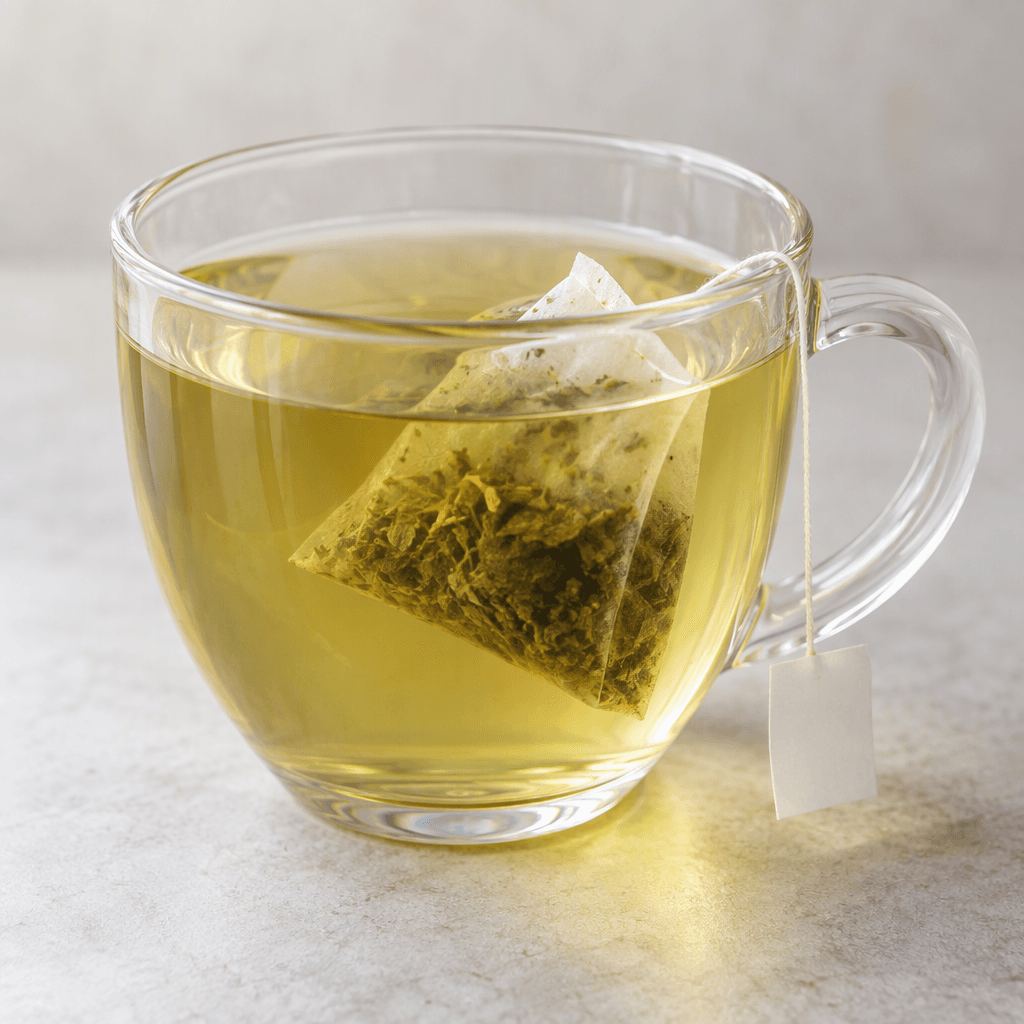
Green tea (bag) Calories
Antioxidant, low calorie, relaxing beverage
In season: Spring · Summer · Autumn · Winter
CALORIES
GI
POTASSIUM
FIBER
Quick answer
1 piece (medium) of Green tea (bag) (2 g) has 0 calories. That works out to 1 calories per 100 g. It contains 0 g of carbs, 0 g of protein, 0 g of fat and 0 g of fiber. Its glycemic index is 0 (low), so it raises blood sugar slowly.
What is Green tea (bag)?
Green tea (bag) is made from tea leaves that are heated to limit oxidation, then portioned into a paper sachet for easy brewing. Green tea has deep roots in China and is widely enjoyed across East Asia and around the world. The infusion is usually pale and has a fresh, grassy flavour that can turn pleasantly astringent if steeped for too long. It is served hot or chilled, often plain, and can accompany meals or a quiet tea break.
Unsweetened, it is mostly water and very low in calories. For a gentler cup, use hot rather than vigorously boiling water and remove the bag once the flavour is to your liking; lemon is an optional, bright pairing.
Green tea (bag) Nutrition Facts
Selected: 100 g
1
KCAL / 100G
Carbs
0.2g
· 0% DV
Protein
0.2g
· 0% DV
Fat
0g
· 0% DV
Fiber
0g
· 0% DV
DV is the share of the daily value covered, on a 2,000 kcal reference diet.
Calories come from: Carbs 50% · Protein 50% · Fat 0%
Green tea (bag) Vitamins & Minerals
Vitamins
B2
0.02mg · 2% DV
B1
0.01mg · 1% DV
B3
0.1mg · 1% DV
B6
0.01mg · 1% DV
Minerals
Calcium
2mg · 0% DV
Iron
0mg · 0% DV
Magnesium
1mg · 0% DV
Zinc
0mg · 0% DV
How Nutritious Is Green tea (bag)?
Nutrient density
Low
How many vitamins, minerals and how much fiber this food carries per calorie. A high score means a lot of nutrition for few calories.
Satiety score
Medium
An EatBetter score computed from fiber, protein and calorie density. A high score means staying full longer on the same calories.
Both scores are calculated per 100 g and do not change with the selected portion. The satiety score is EatBetter's own calculation, not a clinical measure.
Green tea (bag) Glycemic Index
GLYCEMIC INDEX
GLYCEMIC LOAD
Accounts for portion size — a more realistic measure than GI alone.
How to Burn Off Green tea (bag)
To burn the 1 calories in 100 g:
🚶
Walking (5 km/h)
🏃
Running (8 km/h)
🚴
Cycling
🏊
Swimming
Times are calculated with the MET equation for a 70 kg adult. Actual burn varies with your weight, age and pace.
Is Green tea (bag) Processed?
NOVA 2
Minimally Processed
1. Unprocessed
2. Minimally Processed
3. Processed
4. Ultra-Processed
NOVA classifies foods into 4 groups by industrial processing. NOVA 1 (unprocessed) is the healthiest.
Does Green tea (bag) Contain Allergens?
No known major allergens
Which Diets Is Green tea (bag) Good For?
Vegan
✓ Suitable
Vegetarian
✓ Suitable
Gluten-Free
✓ Suitable
Dairy-Free
— Not suitable
Mediterranean
✓ Suitable
Paleo
✓ Suitable
Whole30
— Not suitable
DASH
— Not suitable
Keto
✓ Suitable
Low FODMAP
— Not suitable
Green tea (bag) Fat Profile
SATURATED
0g
MONOUNSATURATED
0g
POLYUNSATURATED
0g
Compare Green tea (bag)
Foods Similar to Green tea (bag)
Frequently Asked Questions About Green tea (bag)
How long should you steep bagged green tea?
Steep bagged green tea for about two to three minutes for a mild, balanced cup. Leaving the bag in much longer can make the tea taste bitter and more astringent; remove it once the flavor suits you.
Does bagged green tea have caffeine?
Yes, bagged green tea contains caffeine. The amount varies with the tea leaves, bag size, water temperature, and steeping time, so a longer brew generally extracts more caffeine.
Can bagged green tea help you lose weight?
Bagged green tea does not cause meaningful weight loss on its own. Unsweetened tea is a low-calorie alternative to sugary drinks, but drinking it is not a substitute for changes to eating habits and activity.
Can you drink bagged green tea before bed?
You can, but its caffeine may make it harder to fall asleep or affect sleep quality. If you are sensitive to caffeine, avoid bagged green tea in the hours before bed and choose a caffeine-free drink instead.
Can you steep bagged green tea in boiling water?
You can, but boiling water often makes bagged green tea taste harsh and bitter. Let freshly boiled water cool briefly before pouring it over the tea bag for a smoother cup.
Can you reuse a bagged green tea tea bag?
Yes, you can steep a green tea bag again, but the second cup will usually be weaker and less flavorful. Reuse it right away rather than leaving a wet tea bag sitting out for hours.
Is bagged green tea okay on an empty stomach?
Yes, but bagged green tea can cause nausea or stomach discomfort for some people when they drink it without food. If that happens to you, have it with or after a meal instead.
Does bagged green tea go bad?
Bagged green tea can lose its flavor over time, especially if exposed to air, heat, light, or moisture. Store it in a sealed container in a cool, dry place, and discard tea bags that are damp or moldy.
Does bagged green tea dehydrate you?
No, a cup of bagged green tea still contributes fluid. Its caffeine can have a mild diuretic effect, especially if you rarely consume caffeine, but ordinary tea drinking does not automatically cause dehydration.
Is bagged green tea as good as loose-leaf green tea?
Bagged green tea is convenient and can make a good cup, while loose-leaf tea often has larger leaves and more room to expand as it steeps. The quality and flavor depend more on the tea itself than on the format alone.
Have another question about Green tea (bag)?
Ask the AI nutrition coach — calories, portions, alternatives and more, answered in seconds in the app.

Scan calories with your camera
Instant AI nutrition analysis

Nutrition data compiled from USDA FoodData Central and scientific sources.