

Ready & Packaged Foods
All →Vegetables & Legumes
All →Desserts & Confectionery
All →Meat & Protein
All →Grains & Bakery
All →Beverages
All →Milk & Dairy
All →

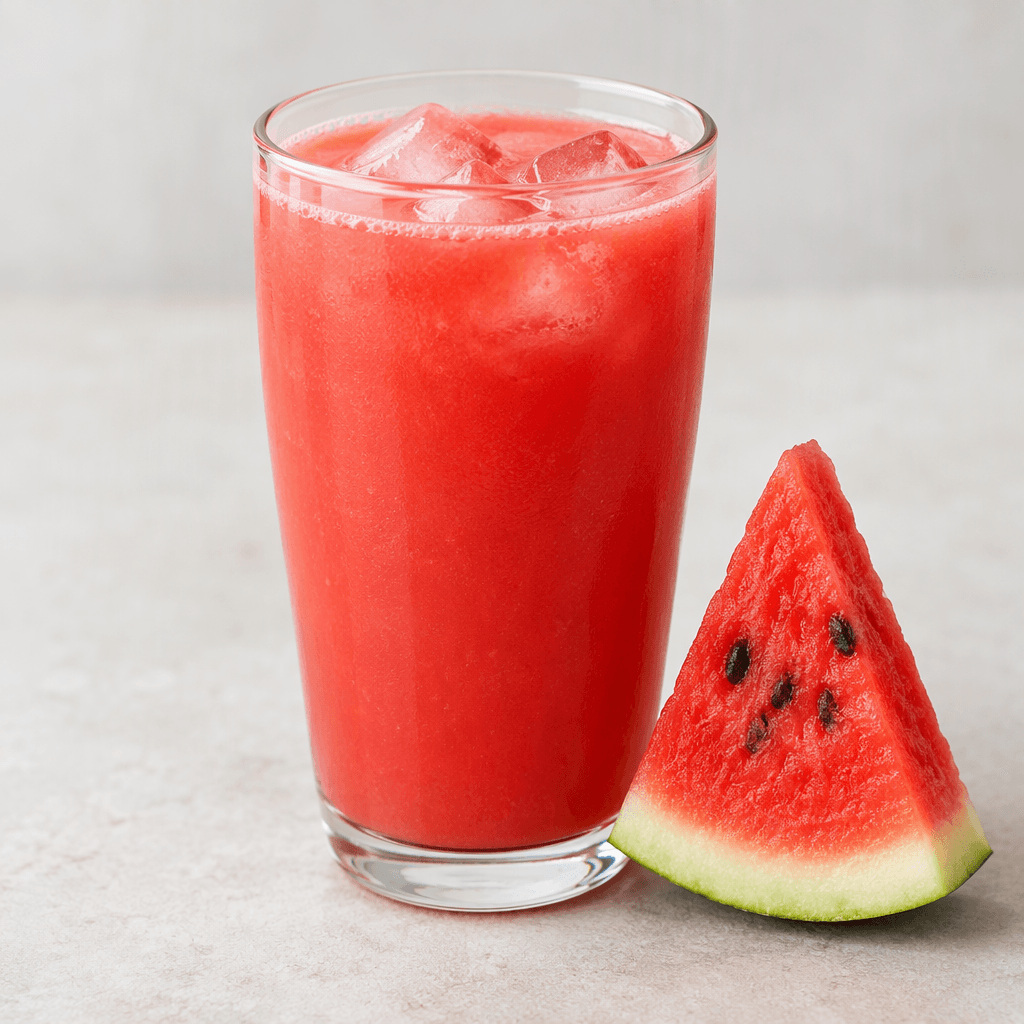
Watermelon juice Calories
Refreshing, low-calorie, source of vitamin C
In season: Summer
CALORIES
GI
POTASSIUM
FIBER
Quick answer
1 cup (medium) of Watermelon juice (240 g) has 72 calories. That works out to 30 calories per 100 g. It contains 18.2 g of carbs, 1.4 g of protein, 0.5 g of fat and 0.5 g of fiber. Its 19.4 mg of Vitamin C covers 22% of the Daily Value. Its glycemic index is 72 (medium), so it raises blood sugar at a moderate pace.
What is Watermelon juice?
Watermelon juice is made by blending or pressing the ripe flesh of a watermelon, then straining it if you prefer a smoother drink. It is a familiar summer refreshment in places where watermelon is grown and enjoyed fresh, and is easy to make at home from chilled fruit.
Its flavour is gently sweet and its texture can be either clear or slightly pulpy. Serve it over ice on a hot day, alongside a light meal, or as a non-alcoholic option at a summer gathering. It is mostly water and carbohydrate, with very little fat; 100 g provides 30 calories. For a less sweet glass, skip added sugar and brighten it with a squeeze of lemon.
Watermelon juice Nutrition Facts
Selected: 100 g
30
KCAL / 100G
Carbs
7.6g
· 3% DV
Protein
0.6g
· 1% DV
Fat
0.2g
· 0% DV
Fiber
0.2g
· 1% DV
DV is the share of the daily value covered, on a 2,000 kcal reference diet.
Calories come from: Carbs 88% · Protein 7% · Fat 5%
Watermelon juice Vitamins & Minerals
Vitamins
Vitamin C
8.1mg · 9% DV
B5
0.2mg · 4% DV
Vitamin A
28µg · 3% DV
B1
0.03mg · 3% DV
Minerals
Potassium ⭐
112mg · 3% DV
Magnesium
10mg · 2% DV
Phosphorus
11mg · 2% DV
Calcium
7mg · 1% DV
How Nutritious Is Watermelon juice?
Nutrient density
Medium
How many vitamins, minerals and how much fiber this food carries per calorie. A high score means a lot of nutrition for few calories.
Satiety score
Medium
An EatBetter score computed from fiber, protein and calorie density. A high score means staying full longer on the same calories.
Both scores are calculated per 100 g and do not change with the selected portion. The satiety score is EatBetter's own calculation, not a clinical measure.
Watermelon juice Glycemic Index
GLYCEMIC INDEX
GLYCEMIC LOAD
Accounts for portion size — a more realistic measure than GI alone.
How to Burn Off Watermelon juice
To burn the 30 calories in 100 g:
🚶
Walking (5 km/h)
🏃
Running (8 km/h)
🚴
Cycling
🏊
Swimming
Times are calculated with the MET equation for a 70 kg adult. Actual burn varies with your weight, age and pace.
Is Watermelon juice Processed?
NOVA 2
Minimally Processed
1. Unprocessed
2. Minimally Processed
3. Processed
4. Ultra-Processed
NOVA classifies foods into 4 groups by industrial processing. NOVA 1 (unprocessed) is the healthiest.
Does Watermelon juice Contain Allergens?
No known major allergens
Which Diets Is Watermelon juice Good For?
Vegan
✓ Suitable
Vegetarian
✓ Suitable
Gluten-Free
✓ Suitable
Dairy-Free
— Not suitable
Mediterranean
✓ Suitable
Paleo
✓ Suitable
Whole30
— Not suitable
DASH
— Not suitable
Keto
— Not suitable
Low FODMAP
— Not suitable
Watermelon juice Fat Profile
SATURATED
0.02g
MONOUNSATURATED
0.03g
POLYUNSATURATED
0.04g
Omega 6:3 ratio 3:1
Below the ideal 4:1 — a good omega balance.
Compare Watermelon juice
Foods Similar to Watermelon juice
Frequently Asked Questions About Watermelon juice
How do you make watermelon juice without a juicer?
Blend seedless watermelon chunks until smooth, then strain only if you prefer a thinner drink. A high-speed blender usually handles the flesh easily; chill the watermelon first for a cold juice without watering it down with ice.
Is watermelon juice good for you?
Yes, watermelon juice provides fluid and vitamin C, and can be a refreshing alternative to sweetened drinks. It contains much less fiber than whole watermelon if strained, so it does not offer the same fullness.
Does watermelon juice hydrate you?
Yes, watermelon juice contributes to fluid intake because it is mostly water. It can be refreshing after time outdoors, but it is not a special replacement for water or a balanced electrolyte drink after heavy sweating.
Can you drink watermelon juice with the seeds?
Yes, small watermelon seeds can be blended and are safe to consume, though they may make the drink less smooth. For a silkier texture, remove the seeds before blending or pour the juice through a fine strainer.
How long does fresh watermelon juice last in the fridge?
Fresh watermelon juice is best consumed the day it is made. Keep it covered and refrigerated, and discard it if it develops a sour smell, fizzing, or an unusual appearance rather than tasting it to check.
Can you freeze watermelon juice?
Yes, freeze watermelon juice in a sealed container or in ice-cube trays, leaving room for expansion. Its texture may separate after thawing, so frozen cubes work especially well in smoothies or as cooling additions to drinks.
Is watermelon juice better before or after a workout?
Watermelon juice can be enjoyed before or after exercise as a source of fluid and carbohydrate. For a long or intense workout with heavy sweating, it does not replace a properly formulated electrolyte drink.
Does watermelon juice have a lot of sugar?
Watermelon juice contains naturally occurring sugars from the fruit, and straining removes much of its fiber. Skip added sugar and keep the serving moderate, especially if you are watching your carbohydrate intake.
Can watermelon juice help with weight loss?
Watermelon juice does not cause weight loss by itself. Unsweetened juice can replace a higher-sugar drink, but it is less filling than eating watermelon because drinking it provides little of the fruit’s fiber.
Why does watermelon juice separate after sitting?
Watermelon juice separates because fine fruit particles settle away from the watery liquid when it stands. Stir or shake it before drinking; separation is normal, but sour odor or fizzing can indicate spoilage.
Have another question about Watermelon juice?
Ask the AI nutrition coach — calories, portions, alternatives and more, answered in seconds in the app.

Scan calories with your camera
Instant AI nutrition analysis

Nutrition data compiled from USDA FoodData Central and scientific sources.