

Ready & Packaged Foods
All →Vegetables & Legumes
All →Desserts & Confectionery
All →Meat & Protein
All →Grains & Bakery
All →Beverages
All →Milk & Dairy
All →

Vegetables Calories
Rich in vitamins and minerals, low calorie
In season: Spring · Summer · Autumn · Winter
CALORIES
GI
POTASSIUM
FIBER
Quick answer
1 cup (medium) of Vegetables (85 g) has 30 calories. That works out to 35 calories per 100 g. It contains 5.5 g of carbs, 1.8 g of protein, 0.3 g of fat and 2.4 g of fiber. Its 323 µg of Vitamin A covers 36% of the Daily Value. Its glycemic index is 15 (low), so it raises blood sugar slowly.
What is Vegetables?
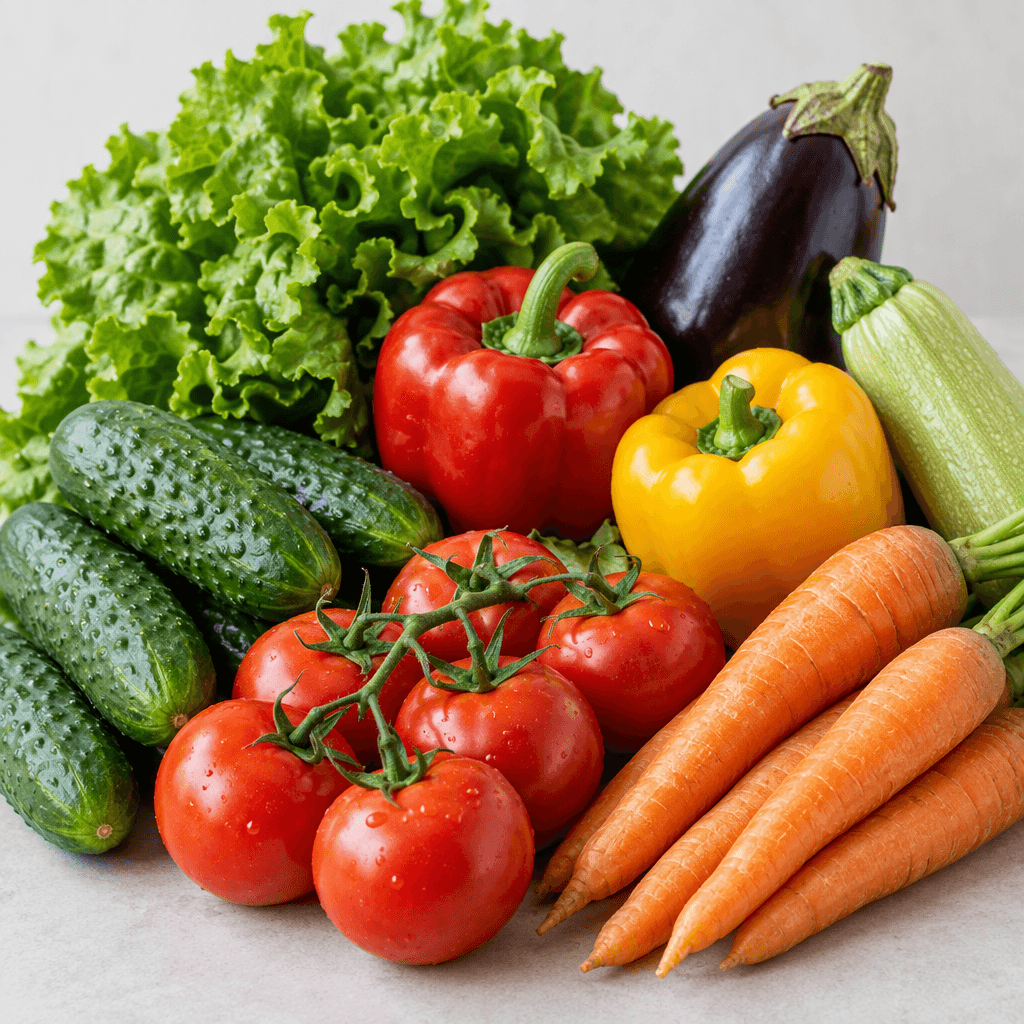
Vegetables are the edible parts of plants, from crisp salad staples such as tomatoes, cucumbers and lettuce to carrots, eggplant, zucchini and peppers. They can be eaten raw, roasted, steamed or cooked into soups and stews. In many parts of the world, they appear in salads and side dishes; in Turkey, fresh vegetables are also common at breakfast and cooked with olive oil for a light meal.
Vegetables are generally low in calories and contribute fibre, vitamins and minerals, though their nutritional profiles vary by type. The mixed profile provided has about 35 calories and 2.8 g of fibre per 100 g. For a more filling plate, pair them with beans, grains or a source of protein, and use a modest amount of oil when cooking.
Vegetables Nutrition Facts
Selected: 100 g
35
KCAL / 100G
Carbs
6.5g
· 2% DV
Protein
2.1g
· 4% DV
Fat
0.3g
· 0% DV
Fiber
2.8g
· 10% DV
DV is the share of the daily value covered, on a 2,000 kcal reference diet.
Calories come from: Carbs 70% · Protein 23% · Fat 7%
Vegetables Vitamins & Minerals
Vitamins
Vitamin A
380µg · 42% DV
Vitamin K
38µg · 32% DV
Vitamin C
22mg · 24% DV
Folate
55µg · 14% DV
Minerals
Potassium ⭐
280mg · 8% DV
Iron
1mg · 6% DV
Phosphorus
32mg · 5% DV
Calcium
38mg · 4% DV
How Nutritious Is Vegetables?
Nutrient density
Very high
How many vitamins, minerals and how much fiber this food carries per calorie. A high score means a lot of nutrition for few calories.
Satiety score
Medium
An EatBetter score computed from fiber, protein and calorie density. A high score means staying full longer on the same calories.
Both scores are calculated per 100 g and do not change with the selected portion. The satiety score is EatBetter's own calculation, not a clinical measure.
Vegetables Glycemic Index
GLYCEMIC INDEX
GLYCEMIC LOAD
Accounts for portion size — a more realistic measure than GI alone.
How to Burn Off Vegetables
To burn the 35 calories in 100 g:
🚶
Walking (5 km/h)
🏃
Running (8 km/h)
🚴
Cycling
🏊
Swimming
Times are calculated with the MET equation for a 70 kg adult. Actual burn varies with your weight, age and pace.
Is Vegetables Processed?
NOVA 1
Unprocessed
1. Unprocessed
2. Minimally Processed
3. Processed
4. Ultra-Processed
NOVA classifies foods into 4 groups by industrial processing. NOVA 1 (unprocessed) is the healthiest.
Does Vegetables Contain Allergens?
No known major allergens
Which Diets Is Vegetables Good For?
Vegan
✓ Suitable
Vegetarian
✓ Suitable
Gluten-Free
✓ Suitable
Dairy-Free
— Not suitable
Mediterranean
✓ Suitable
Paleo
✓ Suitable
Whole30
— Not suitable
DASH
— Not suitable
Keto
— Not suitable
Low FODMAP
— Not suitable
Vegetables Fat Profile
SATURATED
0.05g
MONOUNSATURATED
0.02g
POLYUNSATURATED
0.04g
Omega 6:3 ratio 0.7:1
Below the ideal 4:1 — a good omega balance.
Compare Vegetables
Foods Similar to Vegetables
Frequently Asked Questions About Vegetables
Are frozen vegetables as healthy as fresh vegetables?
Yes, frozen vegetables can be just as nutritious as fresh ones. They are often frozen soon after harvest, which helps preserve nutrients; choose plain vegetables without added sauces or salt when you want to control what goes into a meal.
How do you roast vegetables without making them soggy?
Spread vegetables in a single layer on a hot baking tray and leave space between pieces. Crowding traps steam and makes them soft; cut vegetables into similar-sized pieces, dry them before roasting, and turn them only once or twice.
Which vegetables should be kept out of the refrigerator?
Whole tomatoes, potatoes, and dry onions are usually best stored in a cool, dry place rather than the refrigerator. Cold can affect tomato flavor, while potatoes may develop an undesirable sweet taste; keep potatoes away from light.
Why do vegetables turn brown after they are cut?
Some cut vegetables, especially potatoes and eggplant, brown when exposed flesh reacts with oxygen. To slow browning, cook them soon after cutting or briefly cover the cut pieces with water; drain and dry them before cooking.
Does cooking vegetables destroy their nutrients?
No, cooking does not destroy all the nutrients in vegetables. Heat can reduce some vitamin C, while other nutrients may become easier to absorb. Steaming, microwaving, or briefly stir-frying usually involves less water and shorter cooking than prolonged boiling.
Can you eat vegetables raw?
Yes, many vegetables, including carrots, bell peppers, and cucumbers, can be eaten raw after you wash them under running water. Some vegetables are safer or easier to digest when cooked, so avoid eating wild or unidentified plants raw.
Why do vegetables shrink when you cook them?
Vegetables shrink because heat breaks down their structure and drives off water. Leafy greens such as spinach can reduce dramatically, so start with a large-looking amount and add them in batches if they do not fit in the pan.
How should you store cut vegetables?
Store cut vegetables in a clean, covered container in the refrigerator and use them promptly. Keep wet pieces from sitting in pooled water, and store cut onions separately because their strong smell can transfer to other foods.
Why do some vegetables taste bitter?
Bitterness can be natural in vegetables such as Brussels sprouts, kale, and eggplant, and it may become stronger with age or cooking. Pairing bitter vegetables with a little acidity or roasting them can balance the flavor.
Can wilted vegetables still be used?
Yes, vegetables that are merely limp can often be used in soups, stews, or cooked dishes. Discard them if they are slimy, moldy, or smell unpleasant; wilting is loss of moisture, but those other signs indicate spoilage.
Have another question about Vegetables?
Ask the AI nutrition coach — calories, portions, alternatives and more, answered in seconds in the app.

Scan calories with your camera
Instant AI nutrition analysis

Nutrition data compiled from USDA FoodData Central and scientific sources.