

Ready & Packaged Foods
All →Vegetables & Legumes
All →Desserts & Confectionery
All →Meat & Protein
All →Grains & Bakery
All →Beverages
All →Milk & Dairy
All →

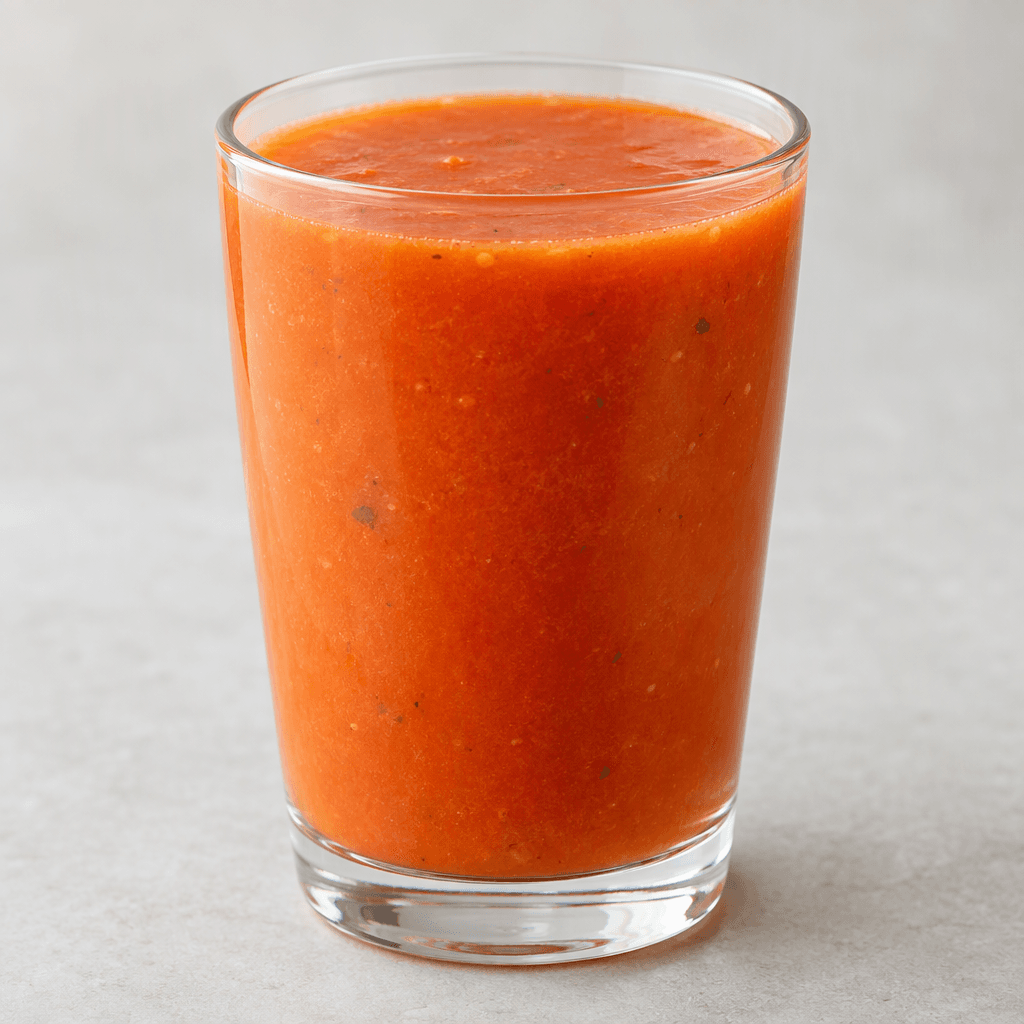
Vegetable Juice Calories
Low-calorie drink rich in vitamins and minerals
In season: Spring · Summer · Autumn · Winter
CALORIES
GI
POTASSIUM
FIBER
Quick answer
1 cup (medium) of Vegetable Juice (240 g) has 48 calories. That works out to 20 calories per 100 g. It contains 10.1 g of carbs, 1.9 g of protein, 0.2 g of fat and 1.7 g of fiber. Its 840 µg of Vitamin A covers 93% of the Daily Value. Its glycemic index is 15 (low), so it raises blood sugar slowly.
What is Vegetable Juice?
Vegetable Juice is made by pressing or blending vegetables such as tomatoes, carrots and celery. It has no single place of origin, and recipes range from smooth, strained drinks to gently pulpy blends; the flavour and colour depend on the vegetables used. It can be freshly made at home or bought ready to drink.
Around the world, people serve it chilled on its own, alongside breakfast or with a light meal. Savoury versions may include herbs or spices, while some blends are naturally sweeter. It is mostly water and generally low in calories, with vitamins and minerals from its vegetables. For a more filling snack, pair it with whole-grain toast or an egg; check the label if you prefer a less salty option.
Vegetable Juice Nutrition Facts
Selected: 100 g
20
KCAL / 100G
Carbs
4.2g
· 2% DV
Protein
0.8g
· 2% DV
Fat
0.1g
· 0% DV
Fiber
0.7g
· 3% DV
DV is the share of the daily value covered, on a 2,000 kcal reference diet.
Calories come from: Carbs 80% · Protein 15% · Fat 5%
Vegetable Juice Vitamins & Minerals
Vitamins
Vitamin A
350µg · 39% DV
Vitamin C
13mg · 14% DV
Vitamin K
15µg · 13% DV
Biotin
1.5µg · 5% DV
Minerals
Potassium ⭐
210mg · 6% DV
Magnesium
13mg · 3% DV
Phosphorus
18mg · 3% DV
Calcium
22mg · 2% DV
How Nutritious Is Vegetable Juice?
Nutrient density
High
How many vitamins, minerals and how much fiber this food carries per calorie. A high score means a lot of nutrition for few calories.
Satiety score
Medium
An EatBetter score computed from fiber, protein and calorie density. A high score means staying full longer on the same calories.
Both scores are calculated per 100 g and do not change with the selected portion. The satiety score is EatBetter's own calculation, not a clinical measure.
Vegetable Juice Glycemic Index
GLYCEMIC INDEX
GLYCEMIC LOAD
Accounts for portion size — a more realistic measure than GI alone.
How to Burn Off Vegetable Juice
To burn the 20 calories in 100 g:
🚶
Walking (5 km/h)
🏃
Running (8 km/h)
🚴
Cycling
🏊
Swimming
Times are calculated with the MET equation for a 70 kg adult. Actual burn varies with your weight, age and pace.
Is Vegetable Juice Processed?
NOVA 2
Minimally Processed
1. Unprocessed
2. Minimally Processed
3. Processed
4. Ultra-Processed
NOVA classifies foods into 4 groups by industrial processing. NOVA 1 (unprocessed) is the healthiest.
Does Vegetable Juice Contain Allergens?
No known major allergens
Which Diets Is Vegetable Juice Good For?
Vegan
✓ Suitable
Vegetarian
✓ Suitable
Gluten-Free
✓ Suitable
Dairy-Free
— Not suitable
Mediterranean
✓ Suitable
Paleo
— Not suitable
Whole30
— Not suitable
DASH
— Not suitable
Keto
— Not suitable
Low FODMAP
— Not suitable
Vegetable Juice Fat Profile
SATURATED
0.02g
MONOUNSATURATED
0.01g
POLYUNSATURATED
0.03g
Omega 6:3 ratio 2:1
Below the ideal 4:1 — a good omega balance.
Compare Vegetable Juice
Foods Similar to Vegetable Juice
Frequently Asked Questions About Vegetable Juice
What vegetables are used in vegetable juice?
Vegetable juice commonly combines tomatoes, carrots, celery, and cucumbers; leafy greens, beets, and herbs are also popular additions. The blend changes the flavor considerably: carrots and beets make it sweeter, while celery and leafy greens add a more savory taste.
How do you make vegetable juice at home?
To make vegetable juice, wash and chop the vegetables, then run them through a juicer. For a blender, add a little water and blend until smooth; strain it for a thinner drink or keep the pulp for more texture and fiber.
Is vegetable juice the same as a smoothie?
No, vegetable juice and a smoothie are prepared differently. A juicer separates liquid from much of the pulp, while a smoothie blends the whole vegetables into the drink. That usually makes a smoothie thicker and keeps more of the original fiber.
How long does fresh vegetable juice last in the fridge?
Fresh vegetable juice is best consumed soon after making it, but it can be kept briefly in the refrigerator in a tightly sealed container. Its flavor and quality decline with storage; discard it if its smell, appearance, or texture changes.
Can vegetable juice replace eating vegetables?
No, vegetable juice should not completely replace whole vegetables. Juicing or straining removes some of the pulp, and drinking is less filling than chewing the same vegetables. Include whole or cooked vegetables as well as juice in your meals.
Should vegetable juice be strained?
Straining vegetable juice is optional: it makes the drink smoother but removes much of the pulp. Leaving the pulp in gives the juice more texture and retains more fiber, while a blender is an easy way to keep the whole mixture.
Is vegetable juice good for weight loss?
Vegetable juice can support weight management when it replaces a sugary drink, but it is not a weight-loss solution on its own. Strained juice may be less filling than whole vegetables, so drinking it instead of a meal can leave you hungry.
Is vegetable juice good for people with diabetes?
Vegetable juice can fit into a diabetes-conscious diet, but ingredients and portions matter. Carrots and beets add carbohydrates, and strained juice is easy to drink quickly; check how your own blood glucose responds, especially with a large serving.
Does vegetable juice have a lot of sodium?
Some vegetable juices are high in sodium, especially savory bottled blends with added salt. Homemade vegetable juice lets you control the salt; herbs, pepper, lemon, or ginger can add flavor without relying on extra salt.
Can you drink vegetable juice on an empty stomach?
Yes, you can drink vegetable juice on an empty stomach; there is no special benefit to having it at that time. If tomato, lemon, or other acidic ingredients bother your stomach, have the juice with food instead.
Have another question about Vegetable Juice?
Ask the AI nutrition coach — calories, portions, alternatives and more, answered in seconds in the app.

Scan calories with your camera
Instant AI nutrition analysis

Nutrition data compiled from USDA FoodData Central and scientific sources.