

Ready & Packaged Foods
All →Vegetables & Legumes
All →Desserts & Confectionery
All →Meat & Protein
All →Grains & Bakery
All →Beverages
All →Milk & Dairy
All →

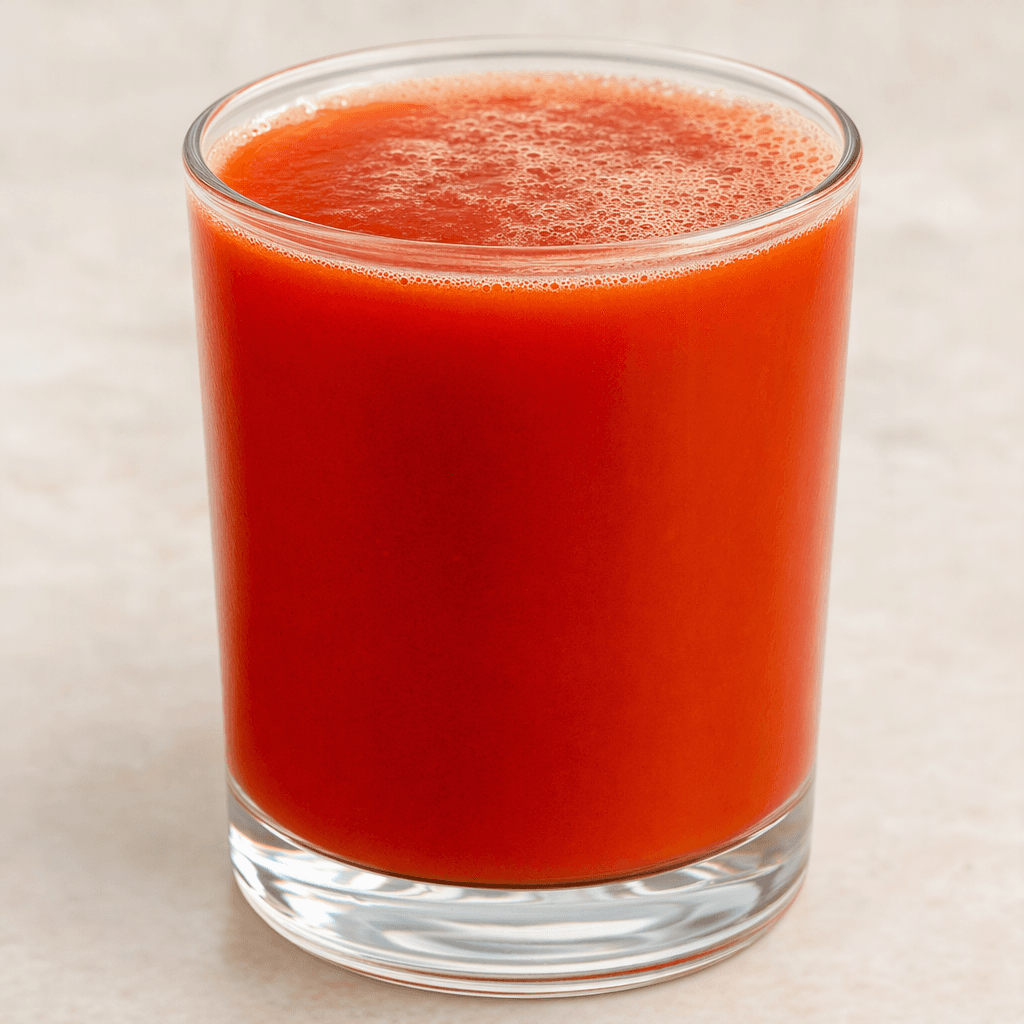
V8 vegetable juice Calories
Low-calorie mixed vegetable juice, high in sodium
CALORIES
GI
POTASSIUM
FIBER
Quick answer
1 cup (medium) of V8 vegetable juice (240 g) has 53 calories. That works out to 22 calories per 100 g. It contains 10.3 g of carbs, 1.9 g of protein, 0.2 g of fat and 1 g of fiber. Its 57.6 mg of Vitamin C covers 64% of the Daily Value. Its glycemic index is 38 (low), so it raises blood sugar slowly.
What is V8 vegetable juice?
V8 vegetable juice is a branded, US-made drink blended from vegetable juices, with tomato providing its familiar deep red colour and savoury base. It is smooth and slightly tangy, and is usually served chilled as a drink on its own or alongside a meal. Some people also use it as a savoury mixer in cocktails or add it to soups and sauces.
It is relatively low in calories and fat, but notably high in sodium compared with many drinks. If you are watching your salt intake, check the label and keep the serving modest. Its bold flavour pairs well with a simple sandwich or savoury snack.
V8 vegetable juice Nutrition Facts
Selected: 100 g
22
KCAL / 100G
Carbs
4.3g
· 2% DV
Protein
0.8g
· 2% DV
Fat
0.1g
· 0% DV
Fiber
0.4g
· 1% DV
DV is the share of the daily value covered, on a 2,000 kcal reference diet.
Calories come from: Carbs 81% · Protein 15% · Fat 4%
V8 vegetable juice Vitamins & Minerals
Vitamins
Vitamin C
24mg · 27% DV
Vitamin A
38µg · 4% DV
B1
0.03mg · 3% DV
B3
0.4mg · 3% DV
Minerals
Sodium
280mg · 12% DV
Potassium ⭐
190mg · 6% DV
Phosphorus
18mg · 3% DV
Magnesium
8mg · 2% DV
How Nutritious Is V8 vegetable juice?
Nutrient density
Medium
How many vitamins, minerals and how much fiber this food carries per calorie. A high score means a lot of nutrition for few calories.
Satiety score
Medium
An EatBetter score computed from fiber, protein and calorie density. A high score means staying full longer on the same calories.
Both scores are calculated per 100 g and do not change with the selected portion. The satiety score is EatBetter's own calculation, not a clinical measure.
V8 vegetable juice Glycemic Index
GLYCEMIC INDEX
GLYCEMIC LOAD
Accounts for portion size — a more realistic measure than GI alone.
How to Burn Off V8 vegetable juice
To burn the 22 calories in 100 g:
🚶
Walking (5 km/h)
🏃
Running (8 km/h)
🚴
Cycling
🏊
Swimming
Times are calculated with the MET equation for a 70 kg adult. Actual burn varies with your weight, age and pace.
Is V8 vegetable juice Processed?
NOVA 3
Processed
1. Unprocessed
2. Minimally Processed
3. Processed
4. Ultra-Processed
NOVA classifies foods into 4 groups by industrial processing. NOVA 1 (unprocessed) is the healthiest.
Does V8 vegetable juice Contain Allergens?
No known major allergens
Which Diets Is V8 vegetable juice Good For?
Vegan
✓ Suitable
Vegetarian
✓ Suitable
Gluten-Free
✓ Suitable
Dairy-Free
— Not suitable
Mediterranean
✓ Suitable
Paleo
— Not suitable
Whole30
— Not suitable
DASH
— Not suitable
Keto
— Not suitable
Low FODMAP
— Not suitable
V8 vegetable juice Fat Profile
SATURATED
0.02g
MONOUNSATURATED
0.01g
POLYUNSATURATED
0.04g
Omega 6:3 ratio 3:1
Below the ideal 4:1 — a good omega balance.
Compare V8 vegetable juice
Foods Similar to V8 vegetable juice
Frequently Asked Questions About V8 vegetable juice
What is V8 vegetable juice made of?
Classic V8 vegetable juice is tomato-based and blends juices from carrots, celery, beets, parsley, lettuce, watercress and spinach. Ingredients can differ among V8 varieties, so the classic recipe does not describe every product in the range.
Is V8 vegetable juice healthy?
V8 vegetable juice can be a convenient way to add some vegetable juice to a meal, but it is not a complete replacement for whole vegetables. Its relatively high sodium content is worth considering, especially if you drink it often.
Does V8 vegetable juice count as a serving of vegetables?
It can contribute vegetable juice to your diet, but it should not replace all your whole-vegetable servings. Juicing reduces the intact fiber and chewing that whole vegetables provide, so include vegetables in their whole form too.
How is V8 vegetable juice different from tomato juice?
V8 vegetable juice combines tomato juice with juices from several other vegetables, while tomato juice is made primarily from tomatoes. That blend gives V8 a more layered vegetable flavor than plain tomato juice.
Can you use V8 vegetable juice in a Bloody Mary?
Yes, V8 vegetable juice works well as the base for a Bloody Mary. Its tomato-and-vegetable blend brings a savory flavor; taste before adding extra salt or seasoning, since the juice may already be salty.
Can you freeze V8 vegetable juice?
Yes, you can freeze V8 vegetable juice in a freezer-safe container, leaving room for it to expand. Thawed juice may separate or change texture, so stir or shake it well and use it in cooking if the texture is less appealing.
How long does V8 vegetable juice last after opening?
Keep opened V8 vegetable juice covered in the refrigerator and aim to use it within about a week. Do not leave it out for extended periods, and discard it if its smell, appearance or container seems unusual.
Why should you shake V8 vegetable juice before drinking it?
Shake V8 vegetable juice because vegetable solids can settle during storage. Mixing it redistributes those ingredients and gives the drink a more even texture and flavor from the first pour to the last.
Can you drink V8 vegetable juice every day?
Yes, many people can drink V8 vegetable juice daily, but regular servings can add a meaningful amount of sodium to the diet. Balance it with lower-sodium foods and vary your vegetables rather than relying on one drink.
Does V8 vegetable juice raise blood pressure?
Its high sodium content can make blood pressure harder to manage, particularly when consumed frequently or in large amounts. If you have high blood pressure, discuss suitable portions and frequency with your healthcare professional.
Have another question about V8 vegetable juice?
Ask the AI nutrition coach — calories, portions, alternatives and more, answered in seconds in the app.

Scan calories with your camera
Instant AI nutrition analysis

Nutrition data compiled from USDA FoodData Central and scientific sources.