

Ready & Packaged Foods
All →Vegetables & Legumes
All →Desserts & Confectionery
All →Meat & Protein
All →Grains & Bakery
All →Beverages
All →Milk & Dairy
All →

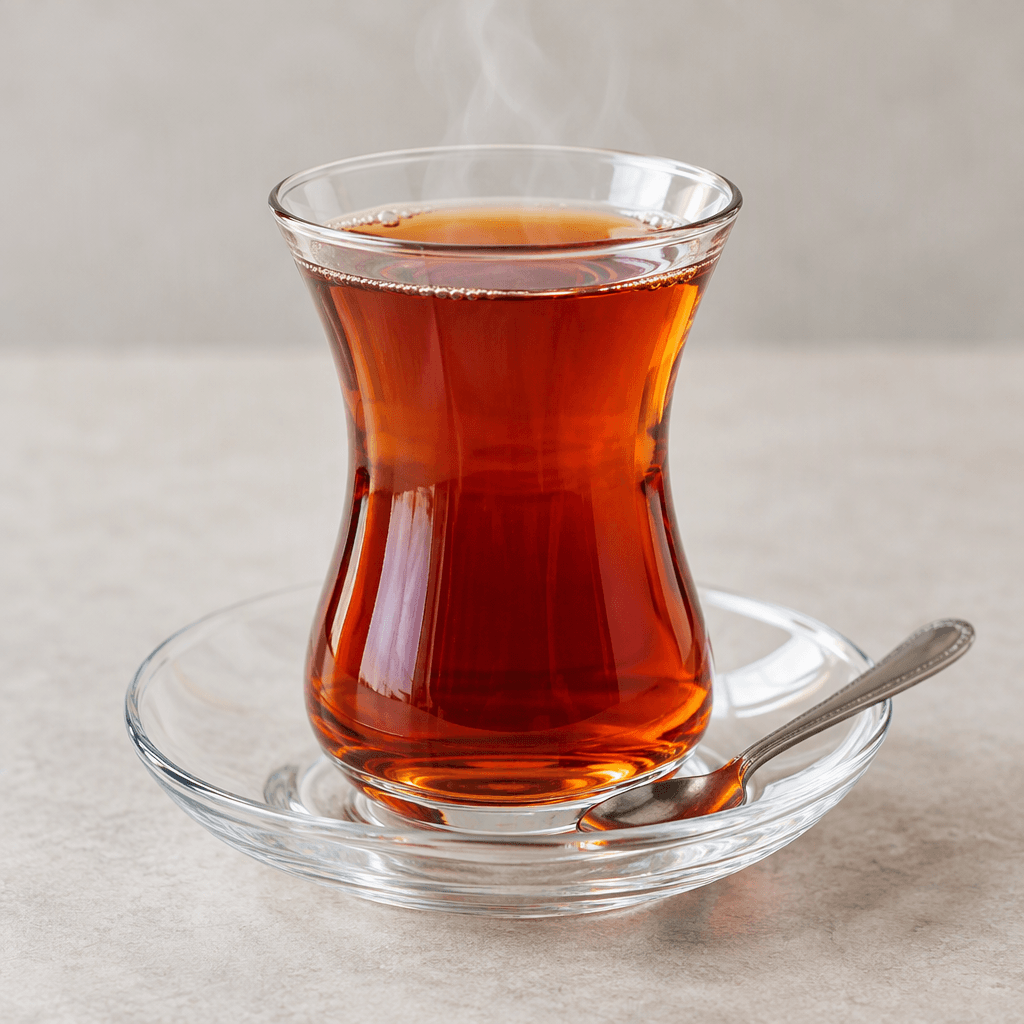
Turkish tea Calories
Traditional black tea, brewed in double teapot, served plain or with sugar.
In season: Spring · Summer · Autumn · Winter
CALORIES
GI
POTASSIUM
FIBER
Quick answer
1 cup (medium) of Turkish tea (120 g) has 1 calories. That works out to 1 calories per 100 g. It contains 0.2 g of carbs, 0.1 g of protein, 0 g of fat and 0 g of fiber. Its 0.4 mg of Manganese covers 16% of the Daily Value. Its glycemic index is 0 (low), so it raises blood sugar slowly.
What is Turkish tea?
Turkish tea is black tea brewed in a double teapot: strong tea steeps in the upper pot while hot water in the lower pot lets each cup be diluted to taste. It is commonly served piping hot in a small, tulip-shaped glass, with sugar offered on the side.
In Turkey, it is part of breakfast and is poured throughout the day for guests, conversations and breaks, often alongside pastries, biscuits or other small bites. Plain brewed tea is mostly water and contributes very little energy—about 1 calorie per 100 g. For a lighter cup, add more hot water and skip the sugar; adjust the strength to suit your taste.
Turkish tea Nutrition Facts
Selected: 100 g
1
KCAL / 100G
Carbs
0.2g
· 0% DV
Protein
0.1g
· 0% DV
Fat
0g
· 0% DV
Fiber
0g
· 0% DV
DV is the share of the daily value covered, on a 2,000 kcal reference diet.
Calories come from: Carbs 67% · Protein 33% · Fat 0%

Log this food in EatBetter
100,000+ people use it
- Get your daily calorie target
- Snap your meal, log it in seconds
- See every vitamin and mineral

📸 Scan the code to get the app free.

Turkish tea Vitamins & Minerals
Vitamins
B2
0.02mg · 2% DV
B1
0.01mg · 1% DV
B3
0.1mg · 1% DV
B6
0.01mg · 1% DV
Minerals
Manganese
0mg · 0% DV
Copper
0mg · 0% DV
Potassium ⭐
12mg · 0% DV
Calcium
3mg · 0% DV
How Nutritious Is Turkish tea?
Nutrient density
Low
How many vitamins, minerals and how much fiber this food carries per calorie. A high score means a lot of nutrition for few calories.
Satiety score
Medium
An EatBetter score computed from fiber, protein and calorie density. A high score means staying full longer on the same calories.
Both scores are calculated per 100 g and do not change with the selected portion. The satiety score is EatBetter's own calculation, not a clinical measure.
Turkish tea Glycemic Index
GLYCEMIC INDEX
GLYCEMIC LOAD
Accounts for portion size — a more realistic measure than GI alone.
How to Burn Off Turkish tea
To burn the 1 calories in 100 g:
🚶
Walking (5 km/h)
🏃
Running (8 km/h)
🚴
Cycling
🏊
Swimming
Times are calculated with the MET equation for a 70 kg adult. Actual burn varies with your weight, age and pace.
Is Turkish tea Processed?
NOVA 2
Minimally Processed
1. Unprocessed
2. Minimally Processed
3. Processed
4. Ultra-Processed
NOVA classifies foods into 4 groups by industrial processing. NOVA 1 (unprocessed) is the healthiest.
Does Turkish tea Contain Allergens?
No known major allergens
Which Diets Is Turkish tea Good For?
Vegan
✓ Suitable
Vegetarian
✓ Suitable
Gluten-Free
✓ Suitable
Dairy-Free
— Not suitable
Mediterranean
✓ Suitable
Paleo
✓ Suitable
Whole30
— Not suitable
DASH
— Not suitable
Keto
— Not suitable
Low FODMAP
— Not suitable
Turkish tea Fat Profile
SATURATED
0g
MONOUNSATURATED
0g
POLYUNSATURATED
0g
Compare Turkish tea
Foods Similar to Turkish tea
Frequently Asked Questions About Turkish tea
What is Turkish tea?
Turkish tea is black tea brewed strong and served hot, usually with hot water added to adjust its strength. It is traditionally made using a double teapot and poured into small, tulip-shaped glasses.
How do you make Turkish tea without a double teapot?
You can make Turkish tea in a regular teapot by steeping loose black tea in hot water, then pouring it through a strainer. Add hot water to the cup to make the tea milder, as you would when serving it from a double teapot.
Does Turkish tea contain caffeine?
Yes, Turkish tea contains caffeine because it is brewed from black tea leaves. The amount varies with the quantity of tea and steeping time, so a stronger, longer-steeped cup generally contains more caffeine.
Why is Turkish tea served in small tulip-shaped glasses?
Turkish tea is traditionally served in small tulip-shaped glasses so its deep amber-red color is visible. The narrow waist also makes the glass easier to hold near the rim while the lower part keeps the tea warm.
Is Turkish tea the same as Turkish apple tea?
No, traditional Turkish tea is brewed black tea, while Turkish apple tea is a fruit-flavored drink that may be made from dried apple or a powdered mix. They differ in ingredients, flavor, and caffeine content.
Why is Turkish tea brewed in a double teapot?
A double teapot lets you brew concentrated tea in the upper pot while keeping water hot in the lower pot. You can then mix them in the glass to choose how strong your Turkish tea tastes.
Is Turkish tea served with milk?
No, Turkish tea is usually served without milk. It is commonly offered plain, with sugar on the side, so you can sweeten it to taste without changing the tea's characteristic flavor.
Can Turkish tea keep you awake at night?
Yes, the caffeine in Turkish tea can make it harder for some people to fall asleep, especially when they drink it late. If evening tea affects your sleep, have your last cup earlier or choose a caffeine-free drink instead.
Why does Turkish tea look so red?
Turkish tea's red-amber color comes from black tea leaves releasing their color as they steep. Brewing a concentrated tea in the upper pot and diluting it with hot water lets you serve it at different strengths while retaining its characteristic hue.
How should you store brewed Turkish tea?
Store leftover Turkish tea covered in the refrigerator and use it within a short time for the best flavor. Avoid leaving brewed tea at room temperature for hours, and make a fresh batch when you want the traditional hot, freshly served taste.
Have another question about Turkish tea?
Ask the AI nutrition coach — calories, portions, alternatives and more, answered in seconds in the app.

Scan calories with your camera
Instant AI nutrition analysis

Nutrition data compiled from USDA FoodData Central and scientific sources.