

Ready & Packaged Foods
All →Vegetables & Legumes
All →Desserts & Confectionery
All →Meat & Protein
All →Grains & Bakery
All →Beverages
All →Milk & Dairy
All →

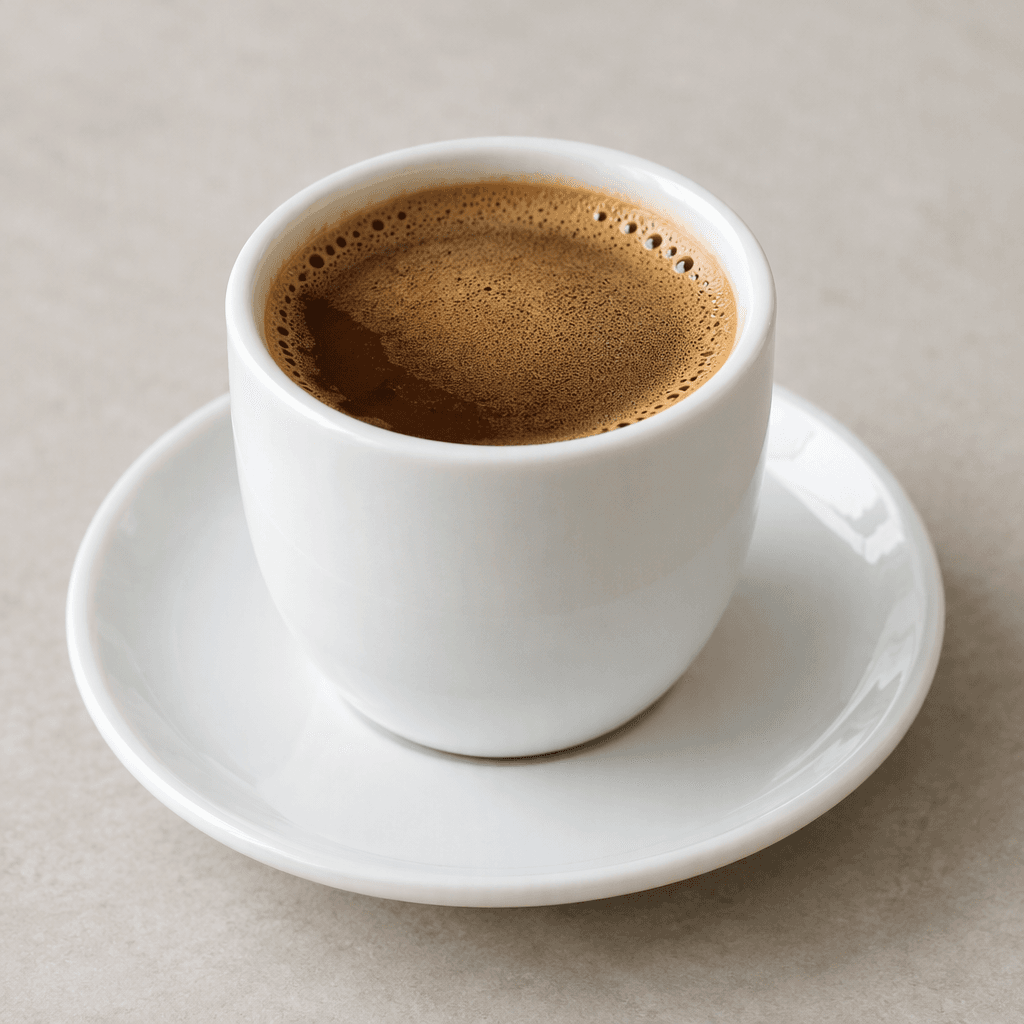
Turkish coffee with medium sugar Calories
Traditional Turkish coffee prepared with medium sugar
CALORIES
GI
POTASSIUM
FIBER
Quick answer
1 cup (small) of Turkish coffee with medium sugar (65 g) has 12 calories. That works out to 18 calories per 100 g. It contains 2.7 g of carbs, 0.2 g of protein, 0.1 g of fat and 0.1 g of fiber. Its glycemic index is 48 (low), so it raises blood sugar slowly.
What is Turkish coffee with medium sugar?
Turkish coffee with medium sugar is made by simmering very finely ground coffee with water and a moderate amount of sugar, traditionally in a small pot called a cezve. It is poured unfiltered into a small cup, so the grounds settle at the bottom; a fine foam on top is a familiar part of the serving.
Its flavour is concentrated, aromatic and gently sweet, and it is meant to be sipped rather than drunk quickly. In Turkey it often follows breakfast or a meal, accompanies conversation, and may be served with a glass of water or a small sweet. The added sugar supplies most of its carbohydrates, while the drink contributes little fat or protein. For a lighter pairing, enjoy it with water instead of an additional sweet.
Turkish coffee with medium sugar Nutrition Facts
Selected: 100 g
18
KCAL / 100G
Carbs
4.1g
· 1% DV
Protein
0.3g
· 1% DV
Fat
0.1g
· 0% DV
Fiber
0.2g
· 1% DV
DV is the share of the daily value covered, on a 2,000 kcal reference diet.
Calories come from: Carbs 89% · Protein 6% · Fat 5%
Turkish coffee with medium sugar Vitamins & Minerals
Vitamins
B2
0.01mg · 1% DV
B3
0.12mg · 1% DV
Vitamin A
0µg · 0% DV
B1
0mg · 0% DV
Minerals
Magnesium
7mg · 2% DV
Potassium ⭐
45mg · 1% DV
Calcium
2mg · 0% DV
Iron
0mg · 0% DV
How Nutritious Is Turkish coffee with medium sugar?
Nutrient density
Low
How many vitamins, minerals and how much fiber this food carries per calorie. A high score means a lot of nutrition for few calories.
Satiety score
Medium
An EatBetter score computed from fiber, protein and calorie density. A high score means staying full longer on the same calories.
Both scores are calculated per 100 g and do not change with the selected portion. The satiety score is EatBetter's own calculation, not a clinical measure.
Turkish coffee with medium sugar Glycemic Index
GLYCEMIC INDEX
GLYCEMIC LOAD
Accounts for portion size — a more realistic measure than GI alone.
How to Burn Off Turkish coffee with medium sugar
To burn the 18 calories in 100 g:
🚶
Walking (5 km/h)
🏃
Running (8 km/h)
🚴
Cycling
🏊
Swimming
Times are calculated with the MET equation for a 70 kg adult. Actual burn varies with your weight, age and pace.
Is Turkish coffee with medium sugar Processed?
NOVA 2
Minimally Processed
1. Unprocessed
2. Minimally Processed
3. Processed
4. Ultra-Processed
NOVA classifies foods into 4 groups by industrial processing. NOVA 1 (unprocessed) is the healthiest.
Does Turkish coffee with medium sugar Contain Allergens?
No known major allergens
Which Diets Is Turkish coffee with medium sugar Good For?
Vegan
✓ Suitable
Vegetarian
✓ Suitable
Gluten-Free
✓ Suitable
Dairy-Free
— Not suitable
Mediterranean
✓ Suitable
Paleo
— Not suitable
Whole30
— Not suitable
DASH
— Not suitable
Keto
— Not suitable
Low FODMAP
— Not suitable
Turkish coffee with medium sugar Fat Profile
SATURATED
0.03g
MONOUNSATURATED
0.01g
POLYUNSATURATED
0.02g
Compare Turkish coffee with medium sugar
Foods Similar to Turkish coffee with medium sugar
Frequently Asked Questions About Turkish coffee with medium sugar
What makes Turkish coffee with medium sugar different from regular coffee?
Turkish coffee with medium sugar is made from very finely ground coffee that is simmered with water and sugar, then served unfiltered. The grounds settle in the cup instead of being removed with a paper filter, giving it a thicker texture than most brewed coffee.
How do you make Turkish coffee with medium sugar in a cezve?
To make Turkish coffee with medium sugar in a cezve, combine finely ground coffee, cold water, and sugar before heating. Warm it slowly over low heat, watching for the foam to rise, then pour into a small cup without letting it boil over.
How much sugar goes into Turkish coffee with medium sugar?
A common measure for Turkish coffee with medium sugar is about one teaspoon of sugar per small cup. The meaning of “medium” varies between households and cafés, so you can adjust the amount to match how sweet you like your coffee.
How do you get foam on Turkish coffee with medium sugar?
For a foamy Turkish coffee with medium sugar, use cold water and finely ground coffee, then heat the cezve gently. Keep an eye on it and pour as the foam rises, before the coffee boils over; vigorous boiling can reduce the foam.
Can you use espresso-ground coffee for Turkish coffee with medium sugar?
Usually not for the traditional result: Turkish coffee with medium sugar needs a powder-fine grind, finer than typical espresso grounds. A coarser grind can make the cup taste different and leave a less settled layer of grounds at the bottom.
Why are there grounds at the bottom of Turkish coffee with medium sugar?
The grounds settle at the bottom of Turkish coffee with medium sugar because the coffee is not filtered after brewing. Let the cup rest briefly after pouring, then sip slowly and leave the final mouthful if you do not want to swallow the sediment.
Is Turkish coffee with medium sugar served with water?
Yes, Turkish coffee with medium sugar is traditionally served with a small glass of water. Sipping the water first clears other flavors from your palate, while lokum or another small sweet is a common accompaniment.
Does Turkish coffee with medium sugar contain caffeine?
Yes, Turkish coffee with medium sugar contains caffeine because the sugar does not remove the caffeine in the coffee. The amount varies with the coffee and preparation, so it can still have a noticeable stimulating effect.
Can you read coffee grounds from Turkish coffee with medium sugar?
Yes, Turkish coffee with medium sugar is often used for tasseography, or fortune-telling from the grounds, as a social tradition. After drinking, people turn the cup onto its saucer and interpret the patterns left behind; this is a custom, not a reliable prediction.
How should you store coffee for Turkish coffee with medium sugar?
Store the finely ground coffee used for Turkish coffee with medium sugar in an airtight container in a cool, dry cupboard, away from heat and sunlight. Add the sugar when you prepare each cup rather than storing a premixed batch, so the coffee stays fresher.
Have another question about Turkish coffee with medium sugar?
Ask the AI nutrition coach — calories, portions, alternatives and more, answered in seconds in the app.

Scan calories with your camera
Instant AI nutrition analysis

Nutrition data compiled from USDA FoodData Central and scientific sources.