

Ready & Packaged Foods
All →Vegetables & Legumes
All →Desserts & Confectionery
All →Meat & Protein
All →Grains & Bakery
All →Beverages
All →Milk & Dairy
All →

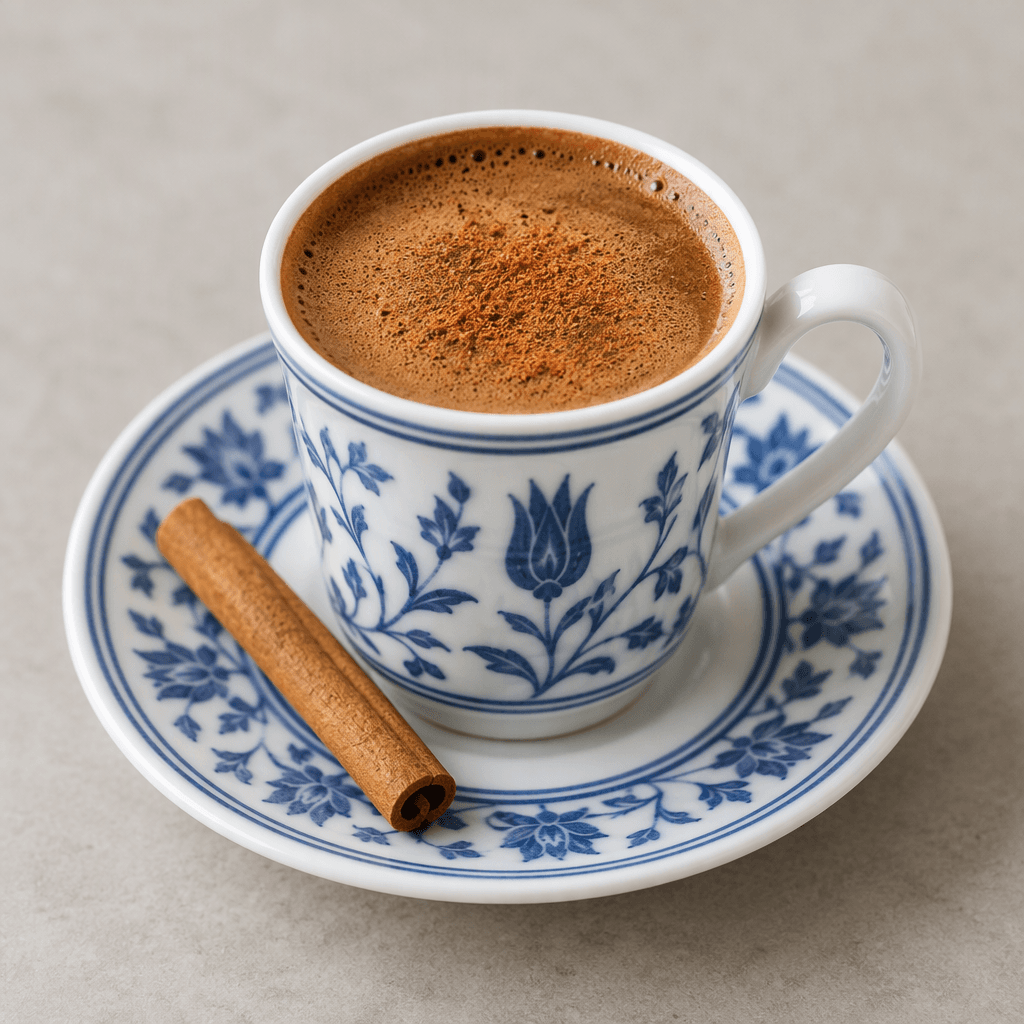
Turkish Coffee (Cinnamon) Calories
Traditional Turkish coffee with cinnamon; antioxidant, low calorie.
In season: Autumn · Winter
CALORIES
GI
POTASSIUM
FIBER
Quick answer
1 cup (small) of Turkish Coffee (Cinnamon) (70 g) has 13 calories. That works out to 18 calories per 100 g. It contains 2.4 g of carbs, 0.2 g of protein, 0.1 g of fat and 0.5 g of fiber. Its 0.1 mg of Manganese covers 6% of the Daily Value. Its glycemic index is 5 (low), so it raises blood sugar slowly.
What is Turkish Coffee (Cinnamon)?
Turkish coffee with cinnamon is made by simmering very finely ground coffee with water in a small pot; cinnamon may be stirred in while brewing or dusted over the top. Sugar is optional. The grounds are not filtered out, so they settle at the bottom of the cup, while a fine layer of foam forms on top.
In Turkey, it is commonly served after a meal or during a visit with friends, often alongside a glass of water and something sweet such as lokum. Its texture is rich and opaque, with cinnamon adding a warm, fragrant spice. Served without sugar, it is a low-calorie drink; it has 18 calories per 100 g. For a lighter cup, leave out the sugar and adjust the cinnamon to taste.
Turkish Coffee (Cinnamon) Nutrition Facts
Selected: 100 g
18
KCAL / 100G
Carbs
3.5g
· 1% DV
Protein
0.3g
· 1% DV
Fat
0.1g
· 0% DV
Fiber
0.7g
· 3% DV
DV is the share of the daily value covered, on a 2,000 kcal reference diet.
Calories come from: Carbs 87% · Protein 7% · Fat 6%
Turkish Coffee (Cinnamon) Vitamins & Minerals
Vitamins
B2
0.02mg · 2% DV
B3
0.3mg · 2% DV
B1
0.01mg · 1% DV
B5
0.05mg · 1% DV
Minerals
Magnesium
12mg · 3% DV
Potassium ⭐
60mg · 2% DV
Calcium
6mg · 1% DV
Phosphorus
8mg · 1% DV
How Nutritious Is Turkish Coffee (Cinnamon)?
Nutrient density
Low
How many vitamins, minerals and how much fiber this food carries per calorie. A high score means a lot of nutrition for few calories.
Satiety score
Medium
An EatBetter score computed from fiber, protein and calorie density. A high score means staying full longer on the same calories.
Both scores are calculated per 100 g and do not change with the selected portion. The satiety score is EatBetter's own calculation, not a clinical measure.
Turkish Coffee (Cinnamon) Glycemic Index
GLYCEMIC INDEX
GLYCEMIC LOAD
Accounts for portion size — a more realistic measure than GI alone.
How to Burn Off Turkish Coffee (Cinnamon)
To burn the 18 calories in 100 g:
🚶
Walking (5 km/h)
🏃
Running (8 km/h)
🚴
Cycling
🏊
Swimming
Times are calculated with the MET equation for a 70 kg adult. Actual burn varies with your weight, age and pace.
Is Turkish Coffee (Cinnamon) Processed?
NOVA 2
Minimally Processed
1. Unprocessed
2. Minimally Processed
3. Processed
4. Ultra-Processed
NOVA classifies foods into 4 groups by industrial processing. NOVA 1 (unprocessed) is the healthiest.
Does Turkish Coffee (Cinnamon) Contain Allergens?
No known major allergens
Which Diets Is Turkish Coffee (Cinnamon) Good For?
Vegan
✓ Suitable
Vegetarian
✓ Suitable
Gluten-Free
✓ Suitable
Dairy-Free
— Not suitable
Mediterranean
✓ Suitable
Paleo
✓ Suitable
Whole30
— Not suitable
DASH
— Not suitable
Keto
— Not suitable
Low FODMAP
— Not suitable
Turkish Coffee (Cinnamon) Fat Profile
SATURATED
0.02g
MONOUNSATURATED
0.03g
POLYUNSATURATED
0.02g
Omega 6:3 ratio 1:1
Below the ideal 4:1 — a good omega balance.
Compare Turkish Coffee (Cinnamon)
Foods Similar to Turkish Coffee (Cinnamon)
Frequently Asked Questions About Turkish Coffee (Cinnamon)
Does Turkish coffee with cinnamon contain caffeine?
Yes. Turkish coffee with cinnamon contains caffeine from the coffee; cinnamon does not remove or reduce it. The amount varies with the coffee and serving, so people who are sensitive to caffeine may prefer a smaller cup or less frequent servings.
How do you make Turkish coffee with cinnamon?
Make Turkish coffee with cinnamon by combining finely ground coffee, cold water, and any desired sugar in a cezve, then heating it gently until the foam rises. Stir in ground cinnamon before heating for a blended flavor, or dust it over the finished cup.
When should you add cinnamon to Turkish coffee?
Add ground cinnamon before brewing Turkish coffee with cinnamon if you want its flavor mixed through the drink. Sprinkling it on top after brewing gives a more noticeable aroma. A cinnamon stick is better used as a serving garnish than stirred into the cezve.
Why does Turkish coffee with cinnamon sometimes have little foam?
Turkish coffee with cinnamon may have little foam if it is heated too quickly, stirred while brewing, or made with stale coffee. Mix the ingredients while cold, then heat slowly without stirring. Adding cinnamon on top after brewing can also help preserve the foam.
Do you drink the grounds in Turkish coffee with cinnamon?
No, you normally leave the grounds at the bottom of Turkish coffee with cinnamon. Sip the coffee slowly and stop before reaching the sediment; the grounds give the drink its traditional texture but are not meant to be swallowed as a serving.
Is Turkish coffee with cinnamon stronger than espresso?
Not necessarily. Turkish coffee with cinnamon tastes concentrated because it is unfiltered and served in a small cup, but caffeine varies with the coffee and serving size. Cinnamon changes the flavor, not the coffee’s caffeine content.
Can you use cinnamon sticks to make Turkish coffee with cinnamon?
You can use a cinnamon stick to flavor Turkish coffee with cinnamon, but ground cinnamon is easier to mix into the brew. A stick can be steeped briefly or served alongside the cup; it will not blend into the coffee as evenly as powder.
Does Turkish coffee with cinnamon help with weight loss?
No, Turkish coffee with cinnamon does not cause weight loss on its own. Cinnamon adds flavor, so it may help some people enjoy coffee without sugar, but it does not burn fat or replace the eating and activity habits that affect body weight.
Why is water served with Turkish coffee with cinnamon?
Water is traditionally served with Turkish coffee with cinnamon to refresh the palate before or after its intense, lingering flavor. A sip beforehand can make the coffee taste clearer; drinking water does not cancel out caffeine.
Can pregnant people drink Turkish coffee with cinnamon?
Pregnant people may be able to include Turkish coffee with cinnamon, but its caffeine counts toward their daily total from all sources. Cinnamon does not make the coffee caffeine-free; ask your healthcare professional about an appropriate amount for your circumstances.
Have another question about Turkish Coffee (Cinnamon)?
Ask the AI nutrition coach — calories, portions, alternatives and more, answered in seconds in the app.

Scan calories with your camera
Instant AI nutrition analysis

Nutrition data compiled from USDA FoodData Central and scientific sources.