

Ready & Packaged Foods
All →Vegetables & Legumes
All →Desserts & Confectionery
All →Meat & Protein
All →Grains & Bakery
All →Beverages
All →Milk & Dairy
All →

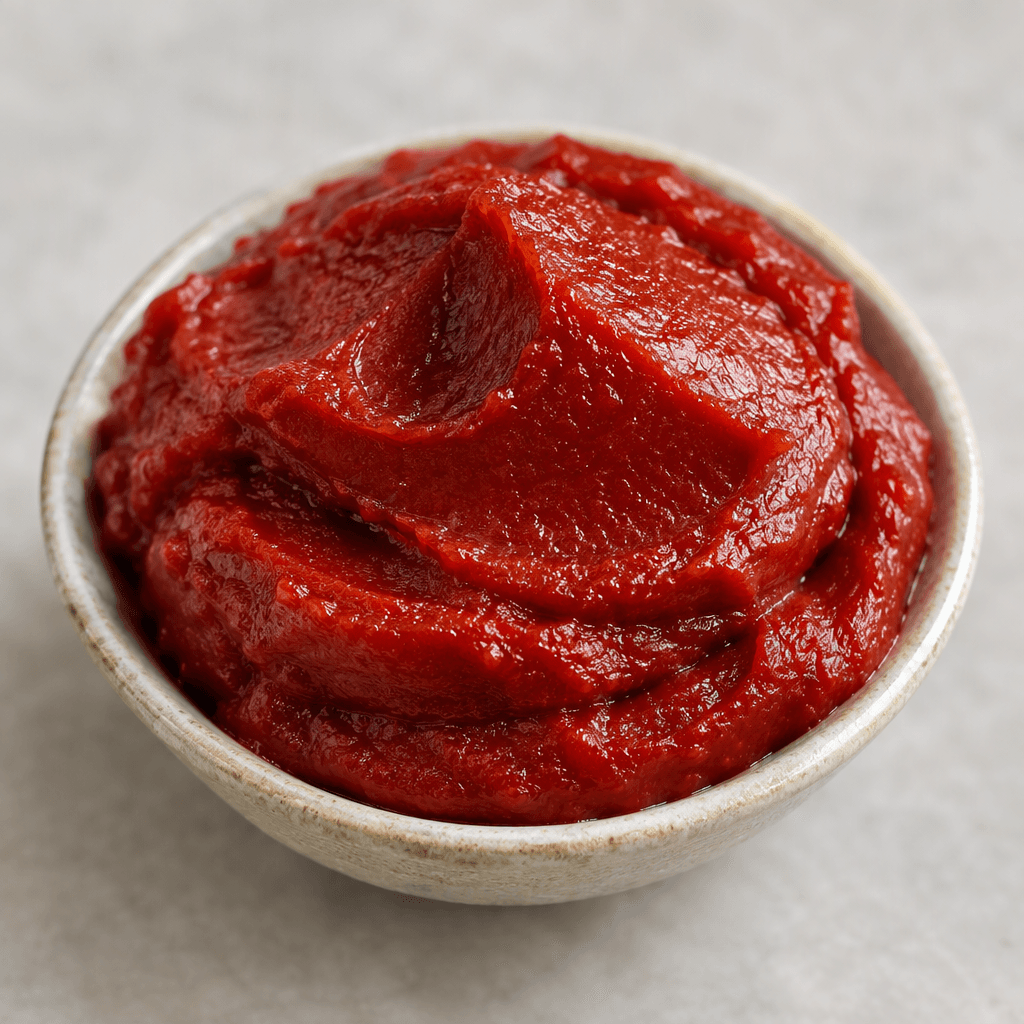
Tomato paste Calories
Rich tomato flavor, source of lycopene, low calorie
In season: Summer · Autumn
CALORIES
GI
POTASSIUM
FIBER
Quick answer
1 tablespoon (medium) of Tomato paste (16 g) has 13 calories. That works out to 82 calories per 100 g. It contains 3 g of carbs, 0.7 g of protein, 0.1 g of fat and 0.7 g of fiber. Its 88 µg of Vitamin A covers 10% of the Daily Value. Its glycemic index is 35 (low), so it raises blood sugar slowly.
What is Tomato paste?
Tomato paste is a thick, smooth concentrate made by cooking ripe tomatoes down until their flavour is rich and pronounced. It is used in cuisines around the world, especially in Mediterranean and Middle Eastern cooking, where a small spoonful can deepen a dish without adding much liquid.
Its sweet-tart, savoury taste works well in soups, stews, pasta sauces and braises. In Turkey, it is often briefly fried with oil and onion at the start of a meal; elsewhere, cooks may stir it into a sauce or broth. Tomato paste contributes concentrated tomato flavour, fibre and lycopene. Use it sparingly when you want a lighter tomato note, or balance its intensity with fresh tomatoes, broth or water.
Tomato paste Nutrition Facts
Selected: 100 g
82
KCAL / 100G
Carbs
18.9g
· 7% DV
Protein
4.3g
· 9% DV
Fat
0.5g
· 1% DV
Fiber
4.1g
· 15% DV
DV is the share of the daily value covered, on a 2,000 kcal reference diet.
Calories come from: Carbs 78% · Protein 18% · Fat 4%
Tomato paste Vitamins & Minerals
Vitamins
Vitamin A
550µg · 61% DV
Vitamin C
21.2mg · 24% DV
Vitamin E
2.8mg · 19% DV
B3
2.2mg · 14% DV
Minerals
Potassium ⭐
1010mg · 30% DV
Phosphorus
83mg · 12% DV
Iron
2mg · 11% DV
Magnesium
42mg · 10% DV
How Nutritious Is Tomato paste?
Nutrient density
High
How many vitamins, minerals and how much fiber this food carries per calorie. A high score means a lot of nutrition for few calories.
Satiety score
Medium
An EatBetter score computed from fiber, protein and calorie density. A high score means staying full longer on the same calories.
Both scores are calculated per 100 g and do not change with the selected portion. The satiety score is EatBetter's own calculation, not a clinical measure.
Tomato paste Glycemic Index
GLYCEMIC INDEX
GLYCEMIC LOAD
Accounts for portion size — a more realistic measure than GI alone.
How to Burn Off Tomato paste
To burn the 82 calories in 100 g:
🚶
Walking (5 km/h)
🏃
Running (8 km/h)
🚴
Cycling
🏊
Swimming
Times are calculated with the MET equation for a 70 kg adult. Actual burn varies with your weight, age and pace.
Is Tomato paste Processed?
NOVA 3
Processed
1. Unprocessed
2. Minimally Processed
3. Processed
4. Ultra-Processed
NOVA classifies foods into 4 groups by industrial processing. NOVA 1 (unprocessed) is the healthiest.
Does Tomato paste Contain Allergens?
No known major allergens
Which Diets Is Tomato paste Good For?
Vegan
✓ Suitable
Vegetarian
✓ Suitable
Gluten-Free
✓ Suitable
Dairy-Free
— Not suitable
Mediterranean
✓ Suitable
Paleo
✓ Suitable
Whole30
— Not suitable
DASH
— Not suitable
Keto
— Not suitable
Low FODMAP
— Not suitable
Tomato paste Fat Profile
SATURATED
0.08g
MONOUNSATURATED
0.09g
POLYUNSATURATED
0.1g
Omega 6:3 ratio 4:1
Below the ideal 4:1 — a good omega balance.
Compare Tomato paste
Foods Similar to Tomato paste
Frequently Asked Questions About Tomato paste
What is tomato paste used for?
Tomato paste adds concentrated tomato flavor and color to soups, stews, sauces, and braises. Stir it into sautéed aromatics or oil before adding liquid so its flavor spreads through the dish rather than remaining as a raw-tasting lump.
What is the difference between tomato paste and tomato sauce?
Tomato paste is much thicker and more concentrated than tomato sauce, which is thinner and usually ready to pour. You can loosen tomato paste with water for a sauce, but the result needs seasoning and cooking to develop its flavor.
Can tomato paste replace tomato sauce?
Yes, tomato paste can replace tomato sauce if you dilute it with water. Add the liquid gradually until you reach the consistency the recipe needs, then adjust the seasoning; paste has a more concentrated flavor than sauce.
Should you cook tomato paste before adding liquid?
Yes, briefly cooking tomato paste in oil or with sautéed vegetables helps soften its sharp, raw flavor and brings out a deeper taste. Stir it constantly and add the recipe’s liquid before it darkens too much or sticks to the pan.
How do you store tomato paste after opening?
Store opened tomato paste in a covered container in the refrigerator. Use a clean utensil each time and keep crumbs or other food out of the container; this helps prevent contamination and keeps the paste in good condition.
Can you freeze tomato paste?
Yes, tomato paste freezes well in small portions. Freeze spoonfuls in a covered container or on a tray, then transfer them to a freezer-safe container; you can add a frozen portion directly to a hot dish.
Why do recipes tell you to use double-concentrated tomato paste?
Double-concentrated tomato paste has less water and a stronger tomato flavor than a less concentrated paste. Use the amount specified in the recipe; if your paste is less concentrated, the dish may need more paste or additional cooking to thicken.
Can you eat tomato paste without cooking it?
Yes, tomato paste is safe to taste without cooking, but it can taste sharp and dense straight from the container. Cooking it briefly with oil or adding it to a simmering dish makes its flavor more rounded and easier to blend.
How do you make tomato paste at home?
Homemade tomato paste is made by crushing tomatoes, straining or cooking off excess liquid, and reducing the pulp until thick. It can be dried in the sun or simmered on the stove; stir regularly during stovetop cooking to prevent scorching.
Can you use tomato paste instead of fresh tomatoes?
Yes, tomato paste can stand in for fresh tomatoes when a dish needs concentrated tomato flavor, but it does not provide their moisture or texture. Use less paste than fresh tomato and add liquid if the recipe needs it.
Have another question about Tomato paste?
Ask the AI nutrition coach — calories, portions, alternatives and more, answered in seconds in the app.

Scan calories with your camera
Instant AI nutrition analysis

Nutrition data compiled from USDA FoodData Central and scientific sources.