

Ready & Packaged Foods
All →Vegetables & Legumes
All →Desserts & Confectionery
All →Meat & Protein
All →Grains & Bakery
All →Beverages
All →Milk & Dairy
All →

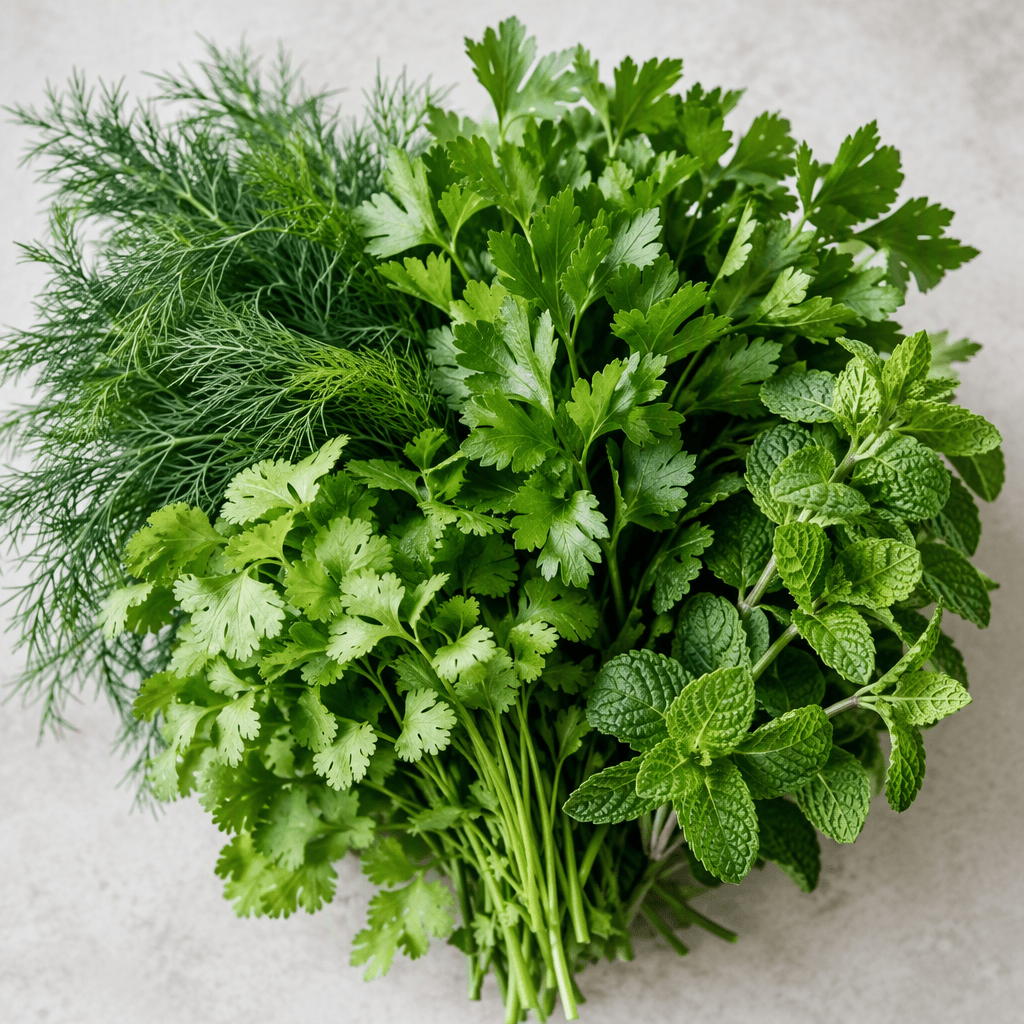
Fresh Herbs Calories
Aromatic fresh herbs, rich in vitamins and minerals, low in calories.
In season: Spring · Summer · Autumn
CALORIES
GI
POTASSIUM
FIBER
Quick answer
1 tablespoon (chopped) of Fresh Herbs (4 g) has 1 calories. That works out to 36 calories per 100 g. It contains 0.3 g of carbs, 0.1 g of protein, 0 g of fat and 0.2 g of fiber. Its 16.4 µg of Vitamin K covers 14% of the Daily Value. Its glycemic index is 5 (low), so it raises blood sugar slowly.
What is Fresh Herbs?
Fresh herbs are the fragrant leaves and tender stems of plants such as parsley, dill, mint and cilantro. They are used across many cuisines, either chopped in raw dishes or stirred in near the end of cooking to preserve their aroma; there is no single place of origin for this mixed category.
They bring a bright, fresh taste and varied textures to salads, soups, sauces and grain dishes. In many kitchens, they are scattered over a finished meal or blended into dressings; parsley and mint also work well with grilled fish, vegetables and yogurt-based dips. Fresh herbs are low in calories and contribute fibre and vitamins and minerals. Wash and dry them well, then chop just before serving, or freeze any extra for cooked dishes.
Fresh Herbs Nutrition Facts
Selected: 100 g
36
KCAL / 100G
Carbs
6.5g
· 2% DV
Protein
3.1g
· 6% DV
Fat
0.6g
· 1% DV
Fiber
4.1g
· 15% DV
DV is the share of the daily value covered, on a 2,000 kcal reference diet.
Calories come from: Carbs 59% · Protein 28% · Fat 13%
Fresh Herbs Vitamins & Minerals
Vitamins
Vitamin K
410µg · 342% DV
Vitamin C
52mg · 58% DV
Vitamin A
420µg · 47% DV
Folate
110µg · 28% DV
Minerals
Manganese
1mg · 43% DV
Iron
6mg · 33% DV
Calcium
170mg · 17% DV
Potassium ⭐
540mg · 16% DV
How Nutritious Is Fresh Herbs?
Nutrient density
Very high
How many vitamins, minerals and how much fiber this food carries per calorie. A high score means a lot of nutrition for few calories.
Satiety score
High
An EatBetter score computed from fiber, protein and calorie density. A high score means staying full longer on the same calories.
Both scores are calculated per 100 g and do not change with the selected portion. The satiety score is EatBetter's own calculation, not a clinical measure.
Fresh Herbs Glycemic Index
GLYCEMIC INDEX
GLYCEMIC LOAD
Accounts for portion size — a more realistic measure than GI alone.
How to Burn Off Fresh Herbs
To burn the 36 calories in 100 g:
🚶
Walking (5 km/h)
🏃
Running (8 km/h)
🚴
Cycling
🏊
Swimming
Times are calculated with the MET equation for a 70 kg adult. Actual burn varies with your weight, age and pace.
Is Fresh Herbs Processed?
NOVA 1
Unprocessed
1. Unprocessed
2. Minimally Processed
3. Processed
4. Ultra-Processed
NOVA classifies foods into 4 groups by industrial processing. NOVA 1 (unprocessed) is the healthiest.
Does Fresh Herbs Contain Allergens?
No known major allergens
Which Diets Is Fresh Herbs Good For?
Vegan
✓ Suitable
Vegetarian
✓ Suitable
Gluten-Free
✓ Suitable
Dairy-Free
— Not suitable
Mediterranean
✓ Suitable
Paleo
✓ Suitable
Whole30
— Not suitable
DASH
— Not suitable
Keto
✓ Suitable
Low FODMAP
— Not suitable
Fresh Herbs Fat Profile
SATURATED
0.09g
MONOUNSATURATED
0.04g
POLYUNSATURATED
0.17g
Omega 6:3 ratio 0.3:1
Below the ideal 4:1 — a good omega balance.
Compare Fresh Herbs
Foods Similar to Fresh Herbs
Frequently Asked Questions About Fresh Herbs
How do you store fresh herbs so they stay fresh?
Store fresh herbs according to how sturdy they are. Trim the stems of parsley, cilantro, and dill and stand them in a jar of water, loosely covered in the fridge; keep basil at room temperature, since cold can darken its leaves.
How should you wash fresh herbs?
Wash fresh herbs just before using them by swishing them gently in a bowl of cold water. Lift them out so grit stays behind, repeat if needed, and dry them thoroughly in a clean towel or salad spinner before chopping.
Can you freeze fresh herbs?
Yes, you can freeze fresh herbs, but thawed leaves usually lose their crisp texture. Wash and dry them well, chop them, and freeze in small portions for cooked dishes; dill and parsley work especially well stirred into soups and sauces.
When should you add fresh herbs to a recipe?
Add most fresh herbs near the end of cooking to preserve their aroma and bright flavor. Stir parsley, cilantro, or dill into a hot dish just before serving; tougher herbs may handle more cooking, but delicate leaves are best added late.
Can you eat the stems of fresh herbs?
Yes, the tender stems of fresh herbs are edible and flavorful. Finely chop parsley and cilantro stems for salads, sauces, and soups, but discard any thick, woody lower stems that would make the dish unpleasantly fibrous.
Which fresh herbs go well together?
Fresh herbs with compatible flavors can be combined, but start with a small mix so one does not overpower the others. Parsley, dill, and mint work well in bright salads, while cilantro and mint suit many fresh, citrusy sauces.
How do you dry fresh herbs at home?
You can air-dry fresh herbs by hanging small bunches in a warm, dry, shaded, well-ventilated place. Once the leaves crumble easily, remove them from the stems and keep them in an airtight container away from heat and light.
How do you revive wilted fresh herbs?
Slightly wilted fresh herbs may perk up if you trim the stem ends and place them in cold water for a short time. Discard herbs with slimy leaves, extensive dark patches, or an unpleasant smell rather than trying to revive them.
Should you remove fresh herb leaves from their stems before chopping?
No, you do not need to strip every fresh herb leaf from its stem. Tender stems of parsley and cilantro can be chopped with the leaves, while thick or woody stems are better removed for a smoother texture.
How can you use fresh herbs in homemade herb butter?
Fresh herbs make a flavorful herb butter when finely chopped and mixed into softened butter. Parsley, dill, or chives work well; chill the mixture before serving it with vegetables, bread, fish, or potatoes.
Have another question about Fresh Herbs?
Ask the AI nutrition coach — calories, portions, alternatives and more, answered in seconds in the app.

Scan calories with your camera
Instant AI nutrition analysis

Nutrition data compiled from USDA FoodData Central and scientific sources.