

Ready & Packaged Foods
All →Vegetables & Legumes
All →Desserts & Confectionery
All →Meat & Protein
All →Grains & Bakery
All →Beverages
All →Milk & Dairy
All →

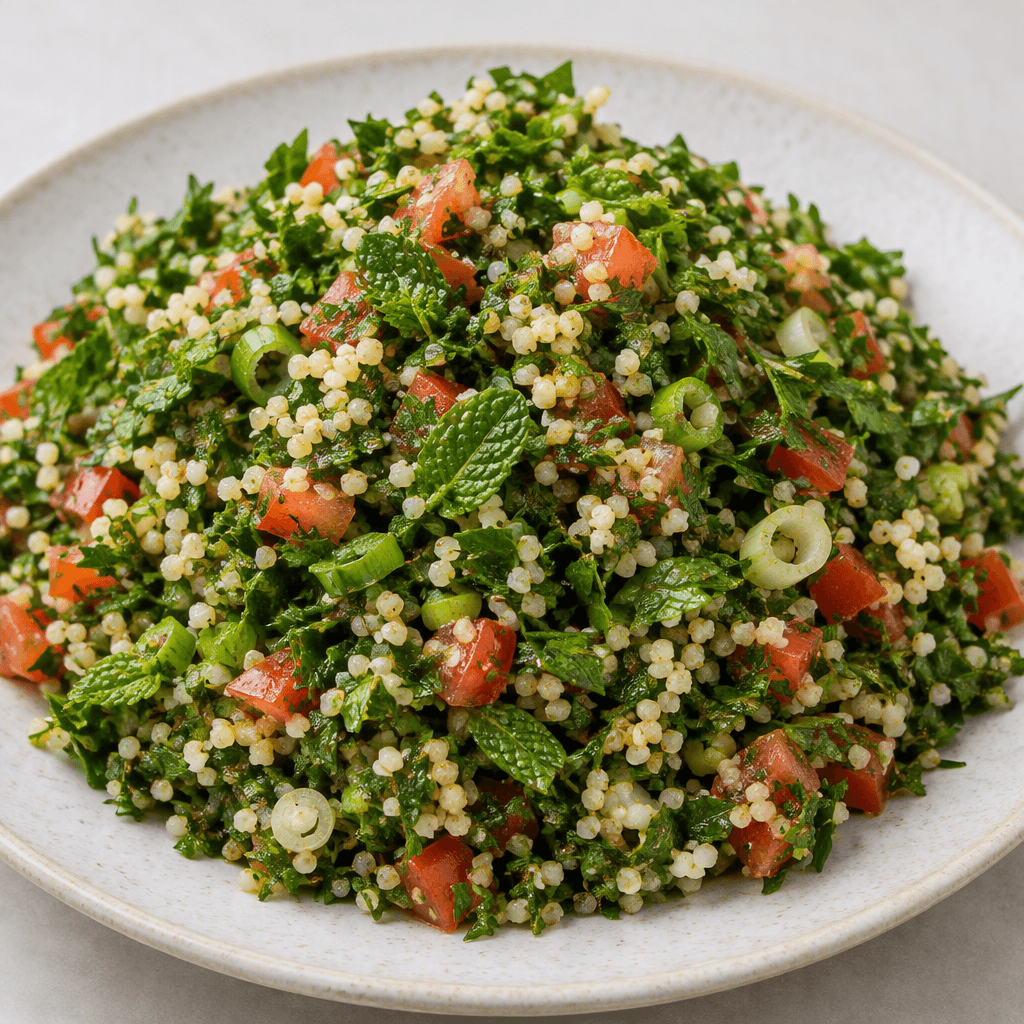
Tabbouleh Calories
Mediterranean salad made with bulgur, parsley, tomato, lemon, olive oil
In season: Spring · Summer · Autumn
CALORIES
GI
POTASSIUM
FIBER
Quick answer
1 serving (medium) of Tabbouleh (150 g) has 165 calories. That works out to 110 calories per 100 g. It contains 26.3 g of carbs, 3.9 g of protein, 4.8 g of fat and 4.7 g of fiber. Its 240 µg of Vitamin K covers 200% of the Daily Value. Its glycemic index is 55 (medium), so it raises blood sugar at a moderate pace.
What is Tabbouleh?
Kısır is a Turkish bulgur salad, made by softening fine bulgur and mixing it with tomato or pepper paste, parsley, spring onion, tomato, lemon and olive oil. Recipes vary by household, and may include mint or pomegranate molasses. The grains are tender but distinct, with a fresh, tangy flavour from the herbs and citrus. It is related to, but different from, the parsley-led Levantine salad often called tabbouleh.
In Turkey, kısır is a familiar dish for tea gatherings, a light lunch or a meze spread, and it is sometimes scooped up with lettuce leaves. Bulgur gives it substance, while the vegetables and herbs contribute fibre; a 100 g portion has 3.1 g. For a lighter serving, keep the oil modest and pair it with plain yoghurt or another fresh salad.
Tabbouleh Nutrition Facts
Selected: 100 g
110
KCAL / 100G
Carbs
17.5g
· 6% DV
Protein
2.6g
· 5% DV
Fat
3.2g
· 4% DV
Fiber
3.1g
· 11% DV
DV is the share of the daily value covered, on a 2,000 kcal reference diet.
Calories come from: Carbs 64% · Protein 10% · Fat 26%
Tabbouleh Vitamins & Minerals
Vitamins
Vitamin K
160µg · 133% DV
Vitamin A
220µg · 24% DV
Folate
60µg · 15% DV
Vitamin C
13mg · 14% DV
Minerals
Zinc
1mg · 9% DV
Magnesium
28mg · 7% DV
Calcium
55mg · 6% DV
Iron
1mg · 6% DV
How Nutritious Is Tabbouleh?
Nutrient density
High
How many vitamins, minerals and how much fiber this food carries per calorie. A high score means a lot of nutrition for few calories.
Satiety score
Medium
An EatBetter score computed from fiber, protein and calorie density. A high score means staying full longer on the same calories.
Both scores are calculated per 100 g and do not change with the selected portion. The satiety score is EatBetter's own calculation, not a clinical measure.
Tabbouleh Glycemic Index
GLYCEMIC INDEX
GLYCEMIC LOAD
Accounts for portion size — a more realistic measure than GI alone.
How to Burn Off Tabbouleh
To burn the 110 calories in 100 g:
🚶
Walking (5 km/h)
🏃
Running (8 km/h)
🚴
Cycling
🏊
Swimming
Times are calculated with the MET equation for a 70 kg adult. Actual burn varies with your weight, age and pace.
Is Tabbouleh Processed?
NOVA 2
Minimally Processed
1. Unprocessed
2. Minimally Processed
3. Processed
4. Ultra-Processed
NOVA classifies foods into 4 groups by industrial processing. NOVA 1 (unprocessed) is the healthiest.
Does Tabbouleh Contain Allergens?
No known major allergens
Which Diets Is Tabbouleh Good For?
Vegan
✓ Suitable
Vegetarian
✓ Suitable
Gluten-Free
— Not suitable
Dairy-Free
— Not suitable
Mediterranean
✓ Suitable
Paleo
— Not suitable
Whole30
— Not suitable
DASH
— Not suitable
Keto
— Not suitable
Low FODMAP
— Not suitable
Tabbouleh Fat Profile
SATURATED
0.5g
MONOUNSATURATED
2g
POLYUNSATURATED
0.6g
Omega 6:3 ratio 11.3:1
Above the ideal 4:1 (11.3:1).
Compare Tabbouleh
Foods Similar to Tabbouleh
Frequently Asked Questions About Tabbouleh
What is kısır?
Kısır is a Turkish bulgur salad, not the parsley-heavy Levantine dish usually called tabbouleh in English. It typically combines fine bulgur with tomato or pepper paste, herbs, lemon, olive oil, and often pomegranate molasses.
How do you make kısır?
Kısır is made by softening fine bulgur with hot water, then mixing it with tomato or pepper paste, olive oil, lemon, and seasonings. Let the bulgur cool before folding in chopped parsley, scallions, and tomato.
What is the difference between kısır and tabbouleh?
Kısır has a more prominent bulgur base and is commonly seasoned with pepper paste, chili, and pomegranate molasses. Tabbouleh is usually parsley-forward, with a smaller amount of bulgur and a lighter lemon dressing.
What kind of bulgur do you use for kısır?
Fine bulgur, often sold as fine or köftelik bulgur, is used for kısır. Coarse pilaf bulgur stays too firm for the traditional texture. Add hot water gradually so the grains soften without becoming waterlogged.
Why does kısır turn mushy?
Kısır turns mushy when the bulgur absorbs too much water or sits covered for too long. Use only enough hot water to soften it, fluff it once tender, and add juicy tomatoes and fresh herbs after the bulgur has cooled.
Can you make kısır ahead of time?
Yes, you can prepare kısır ahead, but it tastes freshest when the herbs and tomato are added closer to serving. If making it in advance, refrigerate it covered and stir in a little lemon juice before serving if the bulgur has absorbed the dressing.
What do you serve with kısır?
Kısır is often served with lettuce leaves, pickles, cucumber, or ayran. It also works as part of a Turkish tea spread alongside pastries, or as a light meal with extra fresh vegetables.
Can you freeze kısır?
Freezing kısır is possible, but it is not ideal: thawed tomato and herbs release water and lose their fresh texture. For the best result, freeze only the seasoned bulgur base and add fresh vegetables and herbs after thawing.
Do you eat kısır with lettuce?
Yes, kısır is often scooped into crisp lettuce leaves and eaten by hand. Wash and thoroughly dry the leaves first so they stay crisp; serving kısır on a plate with a fork is just as common.
Is kısır healthy?
Kısır can be part of a balanced meal, especially when made with plenty of herbs and vegetables. Its bulgur provides whole-grain fiber, while the amount of oil and the size of the serving affect how filling the meal is.
Have another question about Tabbouleh?
Ask the AI nutrition coach — calories, portions, alternatives and more, answered in seconds in the app.

Scan calories with your camera
Instant AI nutrition analysis

Nutrition data compiled from USDA FoodData Central and scientific sources.