

Ready & Packaged Foods
All →Vegetables & Legumes
All →Desserts & Confectionery
All →Meat & Protein
All →Grains & Bakery
All →Beverages
All →Milk & Dairy
All →

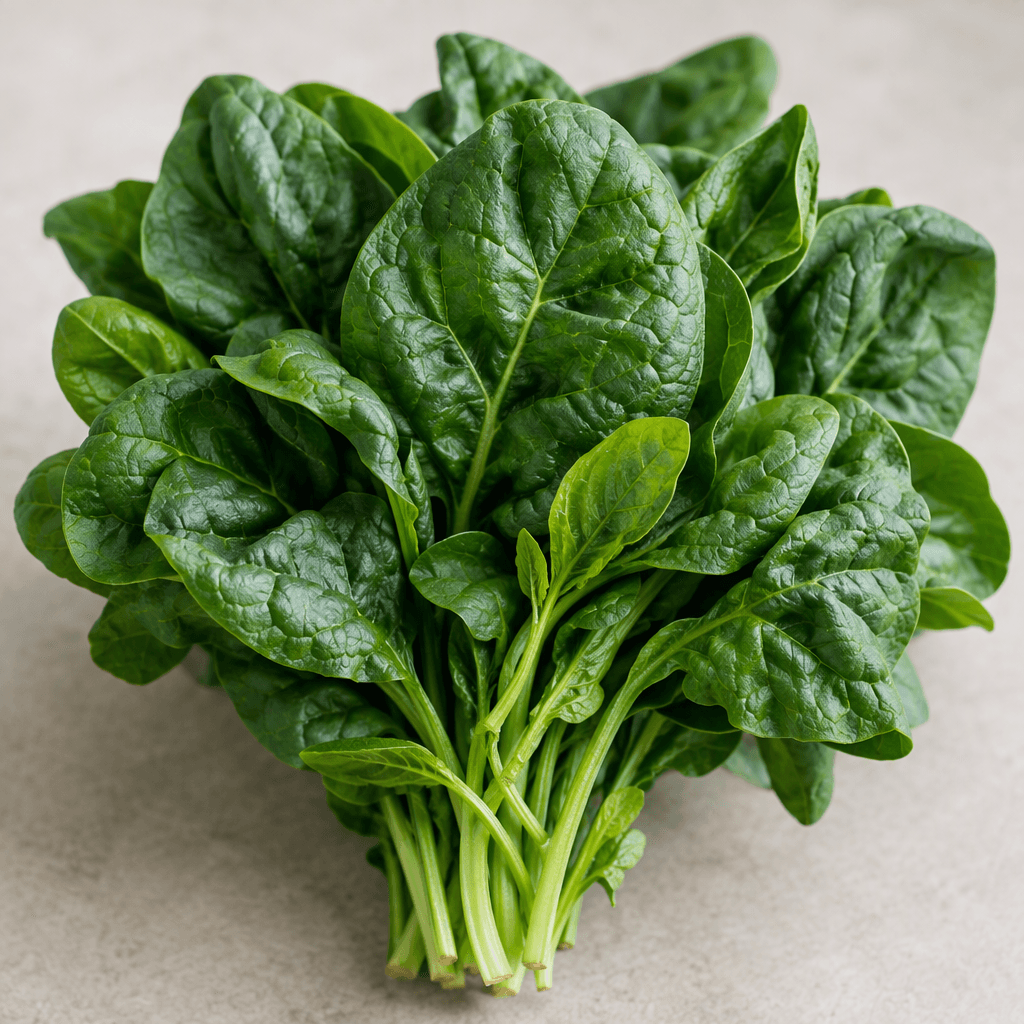
Spinach (Fresh) Calories
Rich in iron and folate, low calorie, high fiber
In season: Spring · Autumn · Winter
CALORIES
GI
POTASSIUM
FIBER
Quick answer
1 cup (medium) of Spinach (Fresh) (30 g) has 7 calories. That works out to 23 calories per 100 g. It contains 1.1 g of carbs, 0.9 g of protein, 0.1 g of fat and 0.7 g of fiber. Its 144.9 µg of Vitamin K covers 121% of the Daily Value. Its glycemic index is 15 (low), so it raises blood sugar slowly.
What is Spinach (Fresh)?
Fresh spinach is a leafy green vegetable, sold in bunches with tender leaves and slim stems. The smaller leaves are pleasant raw, while larger leaves soften quickly and shrink considerably when cooked. It has a mild, earthy flavour that works well in both simple meals and more seasoned dishes.
Across the English-speaking world, fresh spinach is often tossed into salads, wilted into pasta or soups, or cooked with eggs for breakfast. It contributes fibre and folate while remaining low in calories, so it fits easily into a range of meals. Add tender leaves at the end of cooking, or pair them with beans, eggs, or grains for a more substantial plate.
Spinach (Fresh) Nutrition Facts
Selected: 100 g
23
KCAL / 100G
Carbs
3.6g
· 1% DV
Protein
2.9g
· 6% DV
Fat
0.4g
· 1% DV
Fiber
2.2g
· 8% DV
DV is the share of the daily value covered, on a 2,000 kcal reference diet.
Calories come from: Carbs 49% · Protein 39% · Fat 12%

Log this food in EatBetter
100,000+ people use it
- Get your daily calorie target
- Snap your meal, log it in seconds
- See every vitamin and mineral

📸 Scan the code to get the app free.

Spinach (Fresh) Vitamins & Minerals
Vitamins
Vitamin K
482.9µg · 402% DV
Vitamin A
469µg · 52% DV
Folate
194µg · 49% DV
Vitamin C
28.1mg · 31% DV
Minerals
Manganese
1mg · 43% DV
Magnesium
79mg · 19% DV
Iron
3mg · 17% DV
Potassium ⭐
558mg · 16% DV
How Nutritious Is Spinach (Fresh)?
Nutrient density
Very high
How many vitamins, minerals and how much fiber this food carries per calorie. A high score means a lot of nutrition for few calories.
Satiety score
Medium
An EatBetter score computed from fiber, protein and calorie density. A high score means staying full longer on the same calories.
Both scores are calculated per 100 g and do not change with the selected portion. The satiety score is EatBetter's own calculation, not a clinical measure.
Spinach (Fresh) Glycemic Index
GLYCEMIC INDEX
GLYCEMIC LOAD
Accounts for portion size — a more realistic measure than GI alone.
How to Burn Off Spinach (Fresh)
To burn the 23 calories in 100 g:
🚶
Walking (5 km/h)
🏃
Running (8 km/h)
🚴
Cycling
🏊
Swimming
Times are calculated with the MET equation for a 70 kg adult. Actual burn varies with your weight, age and pace.
Is Spinach (Fresh) Processed?
NOVA 1
Unprocessed
1. Unprocessed
2. Minimally Processed
3. Processed
4. Ultra-Processed
NOVA classifies foods into 4 groups by industrial processing. NOVA 1 (unprocessed) is the healthiest.
Does Spinach (Fresh) Contain Allergens?
No known major allergens
Which Diets Is Spinach (Fresh) Good For?
Vegan
✓ Suitable
Vegetarian
✓ Suitable
Gluten-Free
✓ Suitable
Dairy-Free
— Not suitable
Mediterranean
✓ Suitable
Paleo
✓ Suitable
Whole30
— Not suitable
DASH
— Not suitable
Keto
✓ Suitable
Low FODMAP
— Not suitable
Spinach (Fresh) Fat Profile
SATURATED
0.06g
MONOUNSATURATED
0.01g
POLYUNSATURATED
0.17g
Omega 6:3 ratio 0.2:1
Below the ideal 4:1 — a good omega balance.
Compare Spinach (Fresh)
Foods Similar to Spinach (Fresh)
Frequently Asked Questions About Spinach (Fresh)
How do you keep fresh spinach from going slimy in the fridge?
Keep fresh spinach dry and unwashed in a breathable bag or container lined with a paper towel. Remove damaged leaves and wash it just before use; trapped moisture is a common reason spinach turns slimy quickly.
Can you eat fresh spinach raw?
Yes, fresh spinach can be eaten raw in salads, sandwiches, and smoothies. Rinse the leaves thoroughly to remove grit, and dry them before adding them to a salad so the dressing clings better.
Can you freeze fresh spinach?
Yes, fresh spinach freezes well for cooked dishes. Wash the leaves, briefly blanch them, cool them, and squeeze out excess water before freezing in portions; thawed spinach becomes soft and is less suitable for salads.
Do you need to remove the stems from fresh spinach?
No, you do not need to remove tender spinach stems; they are edible. If the stems are thick, chop them and start cooking them before the leaves so they have time to soften.
Does cooking spinach destroy its iron?
No, cooking spinach does not destroy its iron. Spinach contains non-heme iron, which is less readily absorbed than iron from meat; having it with a vitamin C-rich food, such as citrus or tomatoes, can improve absorption.
Why does fresh spinach shrink so much when cooked?
Fresh spinach shrinks because its leaves contain a lot of water and collapse as they heat. The change is mainly in volume, so add the leaves in batches if they do not all fit in the pan at first.
Can you reheat cooked spinach safely?
Yes, you can reheat cooked spinach if it was refrigerated promptly after cooking. Reheat only the portion you plan to eat until it is steaming hot, and avoid leaving cooked spinach at room temperature for a long time.
Does spinach cause kidney stones?
Spinach does not cause kidney stones in everyone, but it is high in oxalates, which can contribute to calcium oxalate stones in people prone to them. If you have a history of these stones, ask your clinician about your diet.
Is raw or cooked spinach better for nutrient absorption?
Neither form is best for every nutrient: cooking can make some compounds, including carotenoids, easier to absorb, while raw spinach retains more heat-sensitive vitamin C. Eating spinach both ways provides variety.
How can you tell if fresh spinach has gone bad?
Fresh spinach that is slimy, foul-smelling, or extensively yellowed has spoiled and should be discarded. Leaves that are merely a little wilted may still be usable if they have no slime or unpleasant odor.
Have another question about Spinach (Fresh)?
Ask the AI nutrition coach — calories, portions, alternatives and more, answered in seconds in the app.

Scan calories with your camera
Instant AI nutrition analysis

Nutrition data compiled from USDA FoodData Central and scientific sources.