

Ready & Packaged Foods
All →Vegetables & Legumes
All →Desserts & Confectionery
All →Meat & Protein
All →Grains & Bakery
All →Beverages
All →Milk & Dairy
All →

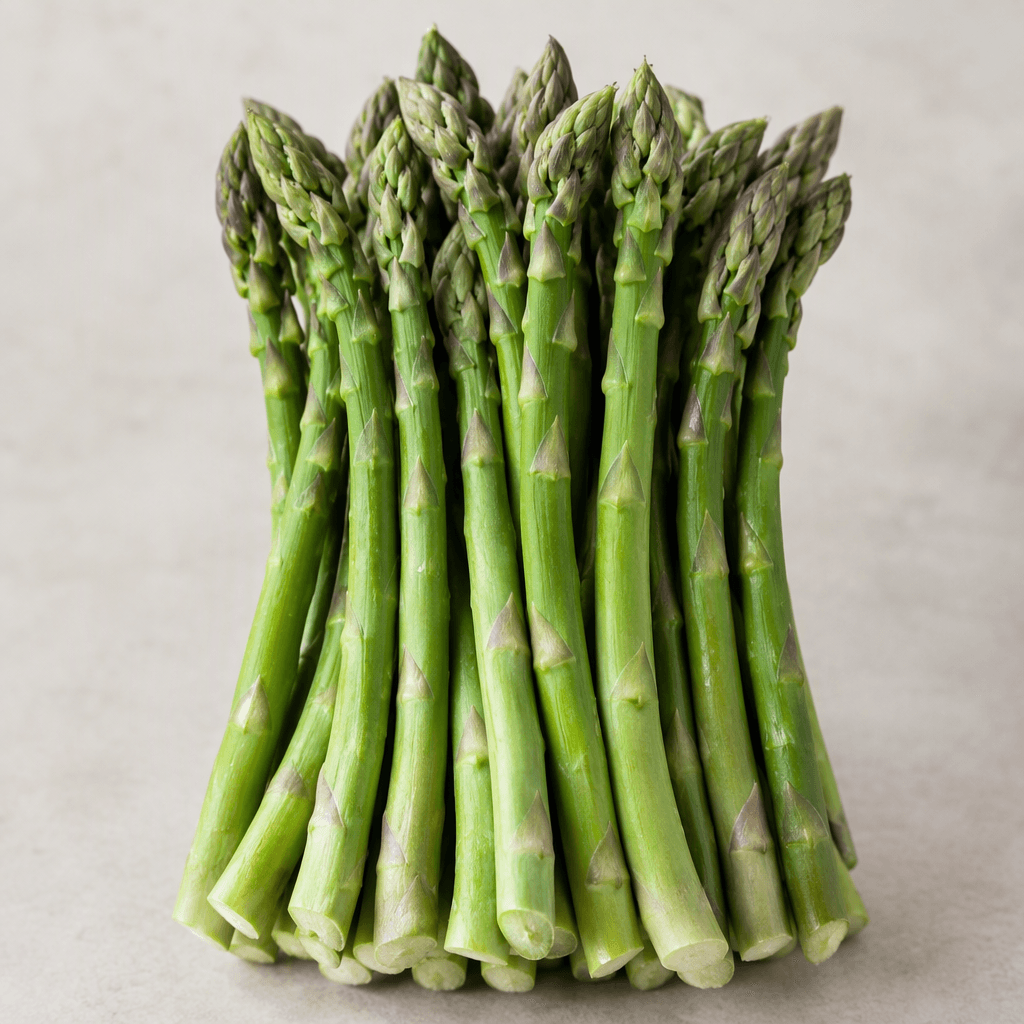
Asparagus Calories
Low calorie, high fiber, rich in folate and vitamin K
In season: Spring
CALORIES · 100 G
GI
POTASSIUM · 100 G
FIBER · 100 G
Quick answer
5 piece (medium) of Asparagus (80 g) has 16 calories. That works out to 20 calories per 100 g. It contains 3.1 g of carbs, 1.8 g of protein, 0.2 g of fat and 1.7 g of fiber. Its 119.2 µg of Folate covers 30% of the Daily Value. Its glycemic index is 15 (low), so it raises blood sugar slowly.
Asparagus Nutrition Facts
Selected: 5 piece (medium) · 80 g
16
KCAL / 80G
Carbs
3.1g
· 1% DV
Protein
1.8g
· 4% DV
Fat
0.2g
· 0% DV
Fiber
1.7g
· 6% DV
DV is the share of the daily value covered, on a 2,000 kcal reference diet.
Calories come from: Carbs 58% · Protein 34% · Fat 8%
Asparagus nutrition facts table · 5 piece (medium) (80 g)
| Nutrient | Amount | % DV |
|---|---|---|
| Calories | 16 kcal | |
| Total fat | 0.2 g | 0% |
| Saturated fat | 0.03 g | 0% |
| Trans fat | 0 g | |
| Sodium | 1.6 mg | 0% |
| Total carbohydrate | 3.1 g | 1% |
| Fiber | 1.7 g | 6% |
| Protein | 1.8 g | 4% |
Calories: Calories measure energy. Average daily need is 2,000 kcal. Excess calories are stored as fat, too few cause weight loss.
Carbs: Your body's primary energy source. The brain runs exclusively on carbs. Daily need: 275g.
Protein: Essential for muscle repair and cell growth. Daily need: 50g. Keeps you full and boosts metabolism.
Fat: Needed for hormone production and vitamin absorption. Daily need: 78g. Limit saturated fats, choose unsaturated.
Fiber: Critical for digestive health and satiety. Daily need: 28g. Stabilizes blood sugar, lowers cholesterol.

Log this food in EatBetter
100,000+ people use it
- Get your daily calorie target
- Snap your meal, log it in seconds
- See every vitamin and mineral

📸 Scan the code to get the app free.

How Many Calories in 5 Pieces of Asparagus?
| Serving | Amount | Calories |
|---|---|---|
| 5 piece (medium) | 80 g | 16 kcal |
| 1 piece (extra small) | 16 g | 3 kcal |
| 3 piece (small) | 50 g | 10 kcal |
| 100 g | 100 g | 20 kcal |
| 1 serving (medium) | 100 g | 20 kcal |
| 8 piece (large) | 130 g | 26 kcal |
| 1 cup (chopped) | 134 g | 27 kcal |
| 10 piece (jumbo) | 160 g | 32 kcal |
| 1 bottle (whole) | 250 g | 50 kcal |
| 1 pack (whole) | 250 g | 50 kcal |
Calculated from 20 calories per 100 g.
Frequently Asked Questions About Asparagus
How do you cook asparagus?
Roasting, pan-frying, steaming, and grilling all work well for asparagus. Wash the spears, remove the tough ends, and cook until the stalks are tender but still hold their shape. Overcooking can make the tips mushy and the stalks limp.
Why does asparagus make your urine smell?
Asparagus contains sulfur-containing compounds that produce distinctive-smelling by-products when digested. These pass into the urine, so the smell can change for a short time after eating asparagus. It is a normal effect and is not harmful by itself.
Can you eat asparagus raw?
Yes, asparagus can be eaten raw. Rinse it well, cut off the woody ends, and shave or slice the stalks thinly for salads or dips. Thin pieces are easier to chew than whole, thick raw spears.
How do you store fresh asparagus?
Keep fresh asparagus in the refrigerator with the cut ends wrapped in a damp paper towel, or stand the stalks in a little water in a jar. Cover loosely and use it soon; the tips and stalks lose their freshness over time.
How do you trim asparagus?
Cut or snap off the dry, tough base of each asparagus spear before cooking. The natural break can vary from spear to spear, so check that the remaining end is tender rather than woody. You can peel the lower part of especially thick stalks.
Does asparagus need to be peeled?
No, thin asparagus usually does not need peeling. Thick stalks can have a fibrous outer layer near the base, so peel just the lower portion with a vegetable peeler. Leave the tender tips unpeeled.
Can you freeze asparagus?
Yes, asparagus freezes well after brief blanching. Wash and trim the spears, blanch them briefly in boiling water, cool them quickly in cold water, then drain and pack them airtight. Frozen asparagus softens after thawing, so it works best in cooked dishes.
What is the difference between green and white asparagus?
White asparagus is grown without exposure to light, while green asparagus grows in sunlight and develops its color. White spears are often thicker and have a tougher outer layer, so they are usually peeled before cooking.
When is asparagus in season?
Fresh asparagus is a spring vegetable in many growing regions, though the exact season varies with local climate. Look for firm stalks and tightly closed tips when it is in season; imported asparagus may be available at other times of year.
Can asparagus cause gas or bloating?
Yes, asparagus can cause gas or bloating in some people. Certain carbohydrates in the spears are fermented by gut bacteria, which can produce gas. If it bothers you, try a smaller serving or well-cooked asparagus and see whether that is easier to tolerate.
Asparagus Vitamins & Minerals
Vitamins
Folate
119.2µg · 30% DV
Vitamin K
33.28µg · 28% DV
B1
0.11mg · 9% DV
B2
0.11mg · 8% DV
Minerals
Copper
0.15mg · 17% DV
Iron
1.71mg · 10% DV
Phosphorus
42mg · 6% DV
Manganese
0.13mg · 6% DV
Potassium ⭐
162mg · 5% DV
Sodium
1.6mg · 0% DV
Asparagus Glycemic Index
GLYCEMIC INDEX
GLYCEMIC LOAD
Accounts for portion size — a more realistic measure than GI alone.
How to Burn Off Asparagus
To burn the 16 calories in 5 piece (medium) (80 g):
🚶
Walking (5 km/h)
🏃
Running (8 km/h)
🚴
Cycling
🏊
Swimming
Times are calculated with the MET equation for a 70 kg adult. Actual burn varies with your weight, age and pace.
What is Asparagus?
Asparagus is the tender young shoot of a perennial plant, traditionally associated with the Mediterranean and now grown in many parts of the world. Its slim stalks have a mild, grassy flavour; when cooked, the stems turn tender while the pointed tips stay delicate. It is often enjoyed in spring, though availability varies by region.
Roast, grill, steam or briefly sauté the spears, then serve them as a side with olive oil and lemon. They also work well in omelettes, pasta, salads and soups; thinly shaved raw asparagus can add a crisp bite. It is low in calories and provides fibre, folate and vitamin K. For a lighter meal, cook it with just a little oil and pair it with eggs, grains or other seasonal vegetables.
How Nutritious Is Asparagus?
Nutrient density
Very high
How many vitamins, minerals and how much fiber this food carries per calorie. A high score means a lot of nutrition for few calories.
Satiety score
Medium
An EatBetter score computed from fiber, protein and calorie density. A high score means staying full longer on the same calories.
Both scores are calculated per 100 g and do not change with the selected portion. The satiety score is EatBetter's own calculation, not a clinical measure.
Is Asparagus Processed?
NOVA 1
Unprocessed
1. Unprocessed
2. Minimally Processed
3. Processed
4. Ultra-Processed
NOVA classifies foods into 4 groups by industrial processing. NOVA 1 (unprocessed) is the healthiest.
Does Asparagus Contain Allergens?
No known major allergens
Which Diets Is Asparagus Good For?
Vegan
✓ Suitable
Vegetarian
✓ Suitable
Gluten-Free
✓ Suitable
Dairy-Free
— Not suitable
Mediterranean
✓ Suitable
Paleo
✓ Suitable
Whole30
— Not suitable
DASH
— Not suitable
Keto
✓ Suitable
Low FODMAP
— Not suitable
Asparagus Fat Profile
SATURATED
0.03g
MONOUNSATURATED
0.01g
POLYUNSATURATED
0.03g
Omega 6:3 ratio 1:1
Below the ideal 4:1 — a good omega balance.
Compare Asparagus
Foods Similar to Asparagus
Have another question about Asparagus?
Ask the AI nutrition coach — calories, portions, alternatives and more, answered in seconds in the app.

Scan calories with your camera
Instant AI nutrition analysis

Nutrition data compiled from USDA FoodData Central and scientific sources.