

Ready & Packaged Foods
All →Vegetables & Legumes
All →Desserts & Confectionery
All →Meat & Protein
All →Grains & Bakery
All →Beverages
All →Milk & Dairy
All →

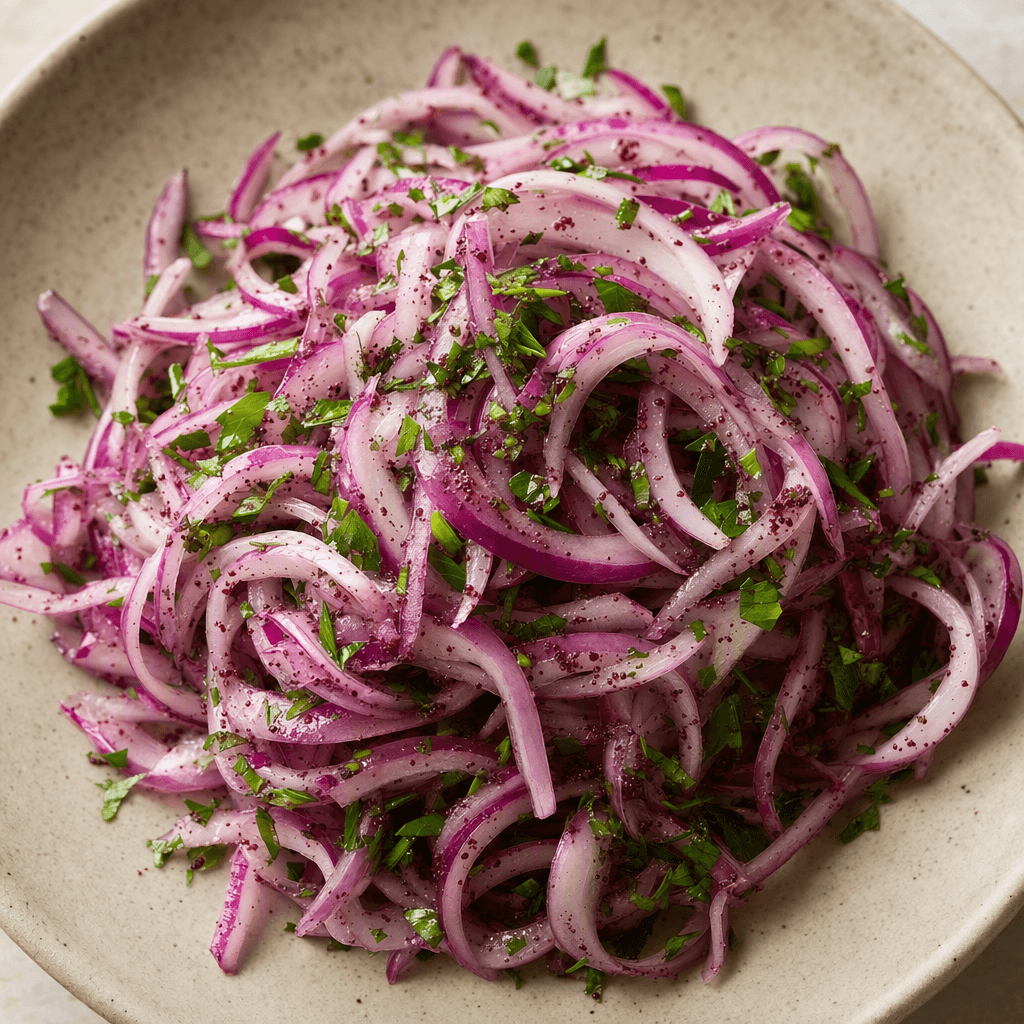
Onion Sumac Salad Calories
Refreshing, low calorie, antioxidant-rich
In season: Spring · Summer · Autumn · Winter
CALORIES · 100 G
GI
POTASSIUM · 100 G
FIBER · 100 G
Quick answer
1 serving (medium) of Onion Sumac Salad (80 g) has 30 calories. That works out to 38 calories per 100 g. It contains 6.6 g of carbs, 1 g of protein, 0.2 g of fat and 1.7 g of fiber. Its 5.9 mg of Vitamin C covers 7% of the Daily Value. Its glycemic index is 20 (low), so it raises blood sugar slowly.
Onion Sumac Salad Nutrition Facts
Selected: 1 serving (medium) · 80 g
30
KCAL / 80G
Carbs
6.6g
· 2% DV
Protein
1g
· 2% DV
Fat
0.2g
· 0% DV
Fiber
1.7g
· 6% DV
DV is the share of the daily value covered, on a 2,000 kcal reference diet.
Calories come from: Carbs 82% · Protein 12% · Fat 6%
Onion Sumac Salad nutrition facts table · 1 serving (medium) (80 g)
| Nutrient | Amount | % DV |
|---|---|---|
| Calories | 30 kcal | |
| Total fat | 0.2 g | 0% |
| Saturated fat | 0.04 g | 0% |
| Trans fat | 0 g | |
| Sodium | 5.6 mg | 0% |
| Total carbohydrate | 6.6 g | 2% |
| Fiber | 1.7 g | 6% |
| Protein | 1 g | 2% |
Calories: Calories measure energy. Average daily need is 2,000 kcal. Excess calories are stored as fat, too few cause weight loss.
Carbs: Your body's primary energy source. The brain runs exclusively on carbs. Daily need: 275g.
Protein: Essential for muscle repair and cell growth. Daily need: 50g. Keeps you full and boosts metabolism.
Fat: Needed for hormone production and vitamin absorption. Daily need: 78g. Limit saturated fats, choose unsaturated.
Fiber: Critical for digestive health and satiety. Daily need: 28g. Stabilizes blood sugar, lowers cholesterol.

Log this food in EatBetter
100,000+ people use it
- Get your daily calorie target
- Snap your meal, log it in seconds
- See every vitamin and mineral

📸 Scan the code to get the app free.

How Many Calories in 1 Serving of Onion Sumac Salad?
| Serving | Amount | Calories |
|---|---|---|
| 1 serving (medium) | 80 g | 30 kcal |
| 2 tablespoon (chopped) | 30 g | 11 kcal |
| 1 serving (small) | 50 g | 19 kcal |
| 1 piece (small) | 60 g | 23 kcal |
| 1 cup (medium) | 90 g | 34 kcal |
| 100 g | 100 g | 38 kcal |
| 1 piece (large) | 100 g | 38 kcal |
| 1 serving (large) | 120 g | 46 kcal |
| 1 pack (jumbo) | 150 g | 57 kcal |
Calculated from 38 calories per 100 g.
Frequently Asked Questions About Onion Sumac Salad
What is Onion Sumac Salad made of?
Onion Sumac Salad is made mainly with thinly sliced onions, sumac, and salt. Parsley is a common addition, and some versions include olive oil or lemon. The simple combination is traditionally served as a tangy accompaniment to grilled foods.
How do you make Onion Sumac Salad?
To make Onion Sumac Salad, thinly slice the onions, toss them with sumac and salt, then gently mix in chopped parsley. Let the flavors mingle briefly before serving. Add olive oil or lemon only if you want a richer or sharper finish.
Why are the onions rubbed with sumac in Onion Sumac Salad?
Rubbing the onions with sumac and salt helps coat each slice and spread the seasoning through Onion Sumac Salad. Do it gently rather than crushing the onions, which can make them release excess liquid and lose their crisp texture.
What kind of onion is best for Onion Sumac Salad?
Red onion is a popular choice for Onion Sumac Salad because its color and mild sweetness work well with tangy sumac. White onion also works, especially if you prefer a sharper flavor; soaking it briefly in cold water can soften its bite.
What do you serve with Onion Sumac Salad?
Onion Sumac Salad is commonly served with kebabs, grilled meats, and kofta. Its tart, fresh flavor cuts through rich or smoky dishes, and it also works tucked into wraps or served alongside flatbread.
Can you make Onion Sumac Salad ahead of time?
Yes, you can make Onion Sumac Salad a little ahead, but it is crispest when freshly prepared. If you need to hold it, refrigerate it in a covered container and add the parsley close to serving so it stays fresher.
How do you make Onion Sumac Salad less sharp?
To make Onion Sumac Salad less sharp, soak the sliced onions briefly in cold water, then drain and dry them well before adding sumac. Avoid a long soak, which can wash away the onion’s flavor as well as its bite.
Does Onion Sumac Salad need lemon juice?
No, Onion Sumac Salad does not need lemon juice because sumac already gives it a tart flavor. Taste it first, then add a small squeeze of lemon only if you want extra acidity; too much can overwhelm the sumac.
What does sumac add to Onion Sumac Salad?
Sumac gives Onion Sumac Salad a tangy, slightly fruity taste and its characteristic reddish color. It complements the onion without requiring a heavy dressing, so the salad remains a bright, simple side dish.
How long does Onion Sumac Salad last in the fridge?
Onion Sumac Salad keeps covered in the refrigerator for about two days, though the onions soften and release liquid as it sits. For the best crunch and flavor, eat it freshly made and do not leave it at room temperature for long.
Onion Sumac Salad Vitamins & Minerals
Vitamins
Vitamin C
5.92mg · 7% DV
B6
0.1mg · 6% DV
Folate
15.2µg · 4% DV
B1
0.03mg · 3% DV
Minerals
Copper
0.03mg · 3% DV
Manganese
0.08mg · 3% DV
Potassium ⭐
117mg · 3% DV
Phosphorus
23mg · 3% DV
Sodium
5.6mg · 0% DV
Onion Sumac Salad Glycemic Index
GLYCEMIC INDEX
GLYCEMIC LOAD
Accounts for portion size — a more realistic measure than GI alone.
How to Burn Off Onion Sumac Salad
To burn the 30 calories in 1 serving (medium) (80 g):
🚶
Walking (5 km/h)
🏃
Running (8 km/h)
🚴
Cycling
🏊
Swimming
Times are calculated with the MET equation for a 70 kg adult. Actual burn varies with your weight, age and pace.
What is Onion Sumac Salad?
Onion Sumac Salad brings thinly sliced onion together with tangy sumac, often with parsley and lemon. It is a familiar Turkish side, especially alongside kebabs and other grilled foods. The onion stays pleasantly crisp, while sumac adds a tart, citrus-like note that softens its sharpness. Serve it with grilled meat, tuck it into a wrap, or add it to a mezze spread; it also works well as a bright contrast to rich dishes. For a gentler bite, rub the sliced onion with a little salt and let it stand briefly before mixing in the sumac and herbs. It is naturally light and plant-based, with 38 calories per 100 g.
How Nutritious Is Onion Sumac Salad?
Nutrient density
High
How many vitamins, minerals and how much fiber this food carries per calorie. A high score means a lot of nutrition for few calories.
Satiety score
Medium
An EatBetter score computed from fiber, protein and calorie density. A high score means staying full longer on the same calories.
Both scores are calculated per 100 g and do not change with the selected portion. The satiety score is EatBetter's own calculation, not a clinical measure.
Is Onion Sumac Salad Processed?
NOVA 2
Minimally Processed
1. Unprocessed
2. Minimally Processed
3. Processed
4. Ultra-Processed
NOVA classifies foods into 4 groups by industrial processing. NOVA 1 (unprocessed) is the healthiest.
Does Onion Sumac Salad Contain Allergens?
No known major allergens
Which Diets Is Onion Sumac Salad Good For?
Vegan
✓ Suitable
Vegetarian
✓ Suitable
Gluten-Free
✓ Suitable
Dairy-Free
— Not suitable
Mediterranean
✓ Suitable
Paleo
✓ Suitable
Whole30
— Not suitable
DASH
— Not suitable
Keto
— Not suitable
Low FODMAP
— Not suitable
Onion Sumac Salad Fat Profile
SATURATED
0.04g
MONOUNSATURATED
0.06g
POLYUNSATURATED
0.07g
Omega 6:3 ratio 2:1
Below the ideal 4:1 — a good omega balance.
Compare Onion Sumac Salad
Foods Similar to Onion Sumac Salad
Have another question about Onion Sumac Salad?
Ask the AI nutrition coach — calories, portions, alternatives and more, answered in seconds in the app.

Scan calories with your camera
Instant AI nutrition analysis

Nutrition data compiled from USDA FoodData Central and scientific sources.