

Ready & Packaged Foods
All →Vegetables & Legumes
All →Desserts & Confectionery
All →Meat & Protein
All →Grains & Bakery
All →Beverages
All →Milk & Dairy
All →

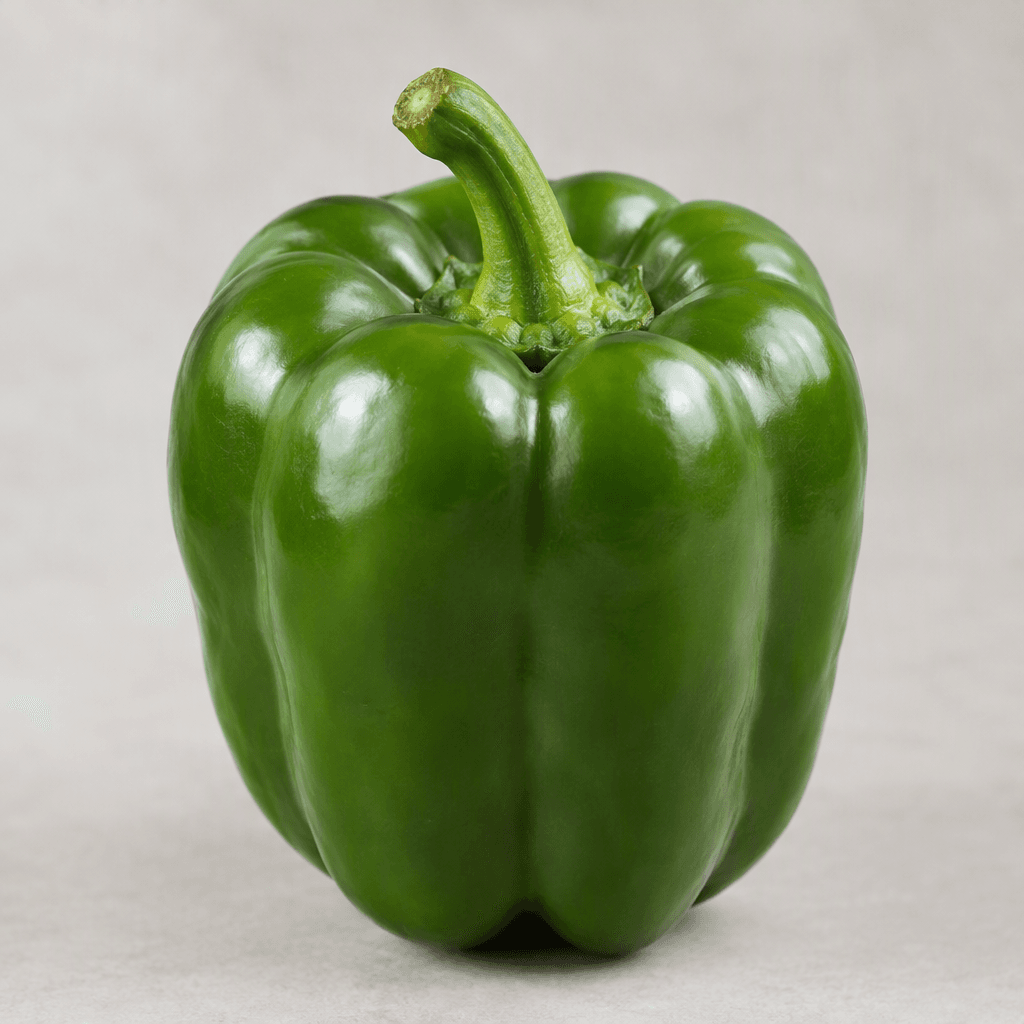
Green pepper Calories
Rich in vitamin C and fiber, low calorie
In season: Spring · Summer · Autumn
CALORIES · 100 G
GI
POTASSIUM · 100 G
FIBER · 100 G
Quick answer
1 piece (medium) of Green pepper (45 g) has 9 calories. That works out to 20 calories per 100 g. It contains 2.1 g of carbs, 0.4 g of protein, 0.1 g of fat and 0.8 g of fiber. Its 36 mg of Vitamin C covers 40% of the Daily Value. Its glycemic index is 15 (low), so it raises blood sugar slowly.
Green pepper Nutrition Facts
Selected: 1 piece (medium) · 45 g
9
KCAL / 45G
Carbs
2.1g
· 1% DV
Protein
0.4g
· 1% DV
Fat
0.1g
· 0% DV
Fiber
0.8g
· 3% DV
DV is the share of the daily value covered, on a 2,000 kcal reference diet.
Calories come from: Carbs 77% · Protein 15% · Fat 8%
Green pepper nutrition facts table · 1 piece (medium) (45 g)
| Nutrient | Amount | % DV |
|---|---|---|
| Calories | 9 kcal | |
| Total fat | 0.1 g | 0% |
| Saturated fat | 0.01 g | 0% |
| Trans fat | 0 g | |
| Sodium | 0.9 mg | 0% |
| Total carbohydrate | 2.1 g | 1% |
| Fiber | 0.8 g | 3% |
| Protein | 0.4 g | 1% |
Calories: Calories measure energy. Average daily need is 2,000 kcal. Excess calories are stored as fat, too few cause weight loss.
Carbs: Your body's primary energy source. The brain runs exclusively on carbs. Daily need: 275g.
Protein: Essential for muscle repair and cell growth. Daily need: 50g. Keeps you full and boosts metabolism.
Fat: Needed for hormone production and vitamin absorption. Daily need: 78g. Limit saturated fats, choose unsaturated.
Fiber: Critical for digestive health and satiety. Daily need: 28g. Stabilizes blood sugar, lowers cholesterol.

Log this food in EatBetter
100,000+ people use it
- Get your daily calorie target
- Snap your meal, log it in seconds
- See every vitamin and mineral

📸 Scan the code to get the app free.

How Many Calories in 1 Medium Green pepper?
| Serving | Amount | Calories |
|---|---|---|
| 1 piece (medium) | 45 g | 9 kcal |
| 1 slice (thin) | 8 g | 2 kcal |
| 1 tablespoon (chopped) | 10 g | 2 kcal |
| 1 slice (thick) | 15 g | 3 kcal |
| 1 piece (small) | 25 g | 5 kcal |
| 1 piece (large) | 80 g | 16 kcal |
| 2 piece (medium) | 90 g | 18 kcal |
| 1 cup (chopped) | 92 g | 18 kcal |
| 100 g | 100 g | 20 kcal |
| 1 serving (large) | 100 g | 20 kcal |
Calculated from 20 calories per 100 g.
Frequently Asked Questions About Green pepper
Is green pepper spicy?
Sometimes. The green pepper on this page is the long, slender Turkish sivri biber, not necessarily the mild bell pepper many English speakers picture. Sivri peppers range from mild to quite hot, so taste a small piece if you are unsure.
Is Turkish green pepper the same as a green bell pepper?
No. Turkish sivri biber is a long, narrow, pointed pepper, while a green bell pepper is broad and block-shaped. The English name “green pepper” can mean either, so look for the slender shape when buying this variety.
How can you tell if green pepper is fresh?
Choose green peppers that are firm, glossy, and free of wrinkles, soft spots, or bruises. A fresh-looking stem is another useful sign. Sivri peppers vary in heat, so appearance alone cannot tell you whether one will taste hot.
How should you store green pepper?
Keep green peppers unwashed and dry in the refrigerator’s vegetable drawer, preferably in a ventilated bag or container. Moisture encourages spoilage. Wash and dry each pepper just before using it rather than storing it wet.
Can you freeze green pepper?
Yes. Wash and dry green peppers thoroughly, remove the stems, then freeze them whole or chopped in a freezer-safe bag. Thawed peppers become softer, so they work better in cooked dishes than in salads or other crisp preparations.
Can you eat the seeds of green pepper?
Yes, green pepper seeds are edible and do not need to be removed. In hot sivri peppers, the white inner ribs usually contribute more of the burning sensation than the seeds themselves; remove both if you want a milder result.
Can you eat green pepper raw?
Yes, green pepper can be eaten raw after washing and removing the stem. Add it to salads, sandwiches, or a snack plate. Since sivri peppers can be hot, taste a small piece first if you are sensitive to chilli heat.
How do you roast green pepper?
Roast green peppers under a hot grill, over a flame, or in a hot oven, turning them until the skin blisters and chars. Let them cool in a covered bowl, then peel off the loose skin if desired and remove the stem and seeds.
Why does green pepper sometimes taste bitter?
Green pepper can taste bitter when it is underripe, old, or cooked until its skin chars heavily. Choose firm, fresh peppers and remove badly blackened skin after roasting. Sivri peppers can also seem harsh simply because their heat is stronger than expected.
Does green pepper cause indigestion?
It can for some people, particularly when the sivri pepper is hot or eaten raw. The heat may aggravate reflux or cause stomach discomfort. If you notice a connection, try a milder pepper, remove the inner ribs, or eat it cooked instead.
Green pepper Vitamins & Minerals
Vitamins
Vitamin C
36mg · 40% DV
B6
0.1mg · 6% DV
Vitamin K
3.33µg · 3% DV
B1
0.02mg · 2% DV
Minerals
Manganese
0.06mg · 3% DV
Copper
0.02mg · 2% DV
Potassium ⭐
79mg · 2% DV
Phosphorus
9mg · 1% DV
Sodium
0.9mg · 0% DV
Green pepper Glycemic Index
GLYCEMIC INDEX
GLYCEMIC LOAD
Accounts for portion size — a more realistic measure than GI alone.
How to Burn Off Green pepper
To burn the 9 calories in 1 piece (medium) (45 g):
🚶
Walking (5 km/h)
🏃
Running (8 km/h)
🚴
Cycling
🏊
Swimming
Times are calculated with the MET equation for a 70 kg adult. Actual burn varies with your weight, age and pace.
What is Green pepper?
Green pepper here refers to the long, slender Turkish sivri biber, rather than the blocky bell pepper common in many English-speaking countries. It may be gently sweet or quite hot, depending on the variety. In Turkey, it is eaten raw alongside cheese and tomatoes at breakfast, sliced into salads, or cooked in a pan or over a flame; it also turns up in stews and stuffed dishes.
It is a light vegetable, with fibre and vitamin C and around 20 calories per 100 g. For a milder dish, remove the seeds and serve the pepper lightly cooked with eggs, yogurt or grilled foods.
How Nutritious Is Green pepper?
Nutrient density
High
How many vitamins, minerals and how much fiber this food carries per calorie. A high score means a lot of nutrition for few calories.
Satiety score
Medium
An EatBetter score computed from fiber, protein and calorie density. A high score means staying full longer on the same calories.
Both scores are calculated per 100 g and do not change with the selected portion. The satiety score is EatBetter's own calculation, not a clinical measure.
Is Green pepper Processed?
NOVA 1
Unprocessed
1. Unprocessed
2. Minimally Processed
3. Processed
4. Ultra-Processed
NOVA classifies foods into 4 groups by industrial processing. NOVA 1 (unprocessed) is the healthiest.
Does Green pepper Contain Allergens?
No known major allergens
Which Diets Is Green pepper Good For?
Vegan
✓ Suitable
Vegetarian
✓ Suitable
Gluten-Free
✓ Suitable
Dairy-Free
— Not suitable
Mediterranean
✓ Suitable
Paleo
✓ Suitable
Whole30
— Not suitable
DASH
— Not suitable
Keto
✓ Suitable
Low FODMAP
— Not suitable
Green pepper Fat Profile
SATURATED
0.01g
MONOUNSATURATED
0.01g
POLYUNSATURATED
0.02g
Compare Green pepper
Foods Similar to Green pepper
Have another question about Green pepper?
Ask the AI nutrition coach — calories, portions, alternatives and more, answered in seconds in the app.

Scan calories with your camera
Instant AI nutrition analysis

Nutrition data compiled from USDA FoodData Central and scientific sources.