

Ready & Packaged Foods
All →Vegetables & Legumes
All →Desserts & Confectionery
All →Meat & Protein
All →Grains & Bakery
All →Beverages
All →Milk & Dairy
All →

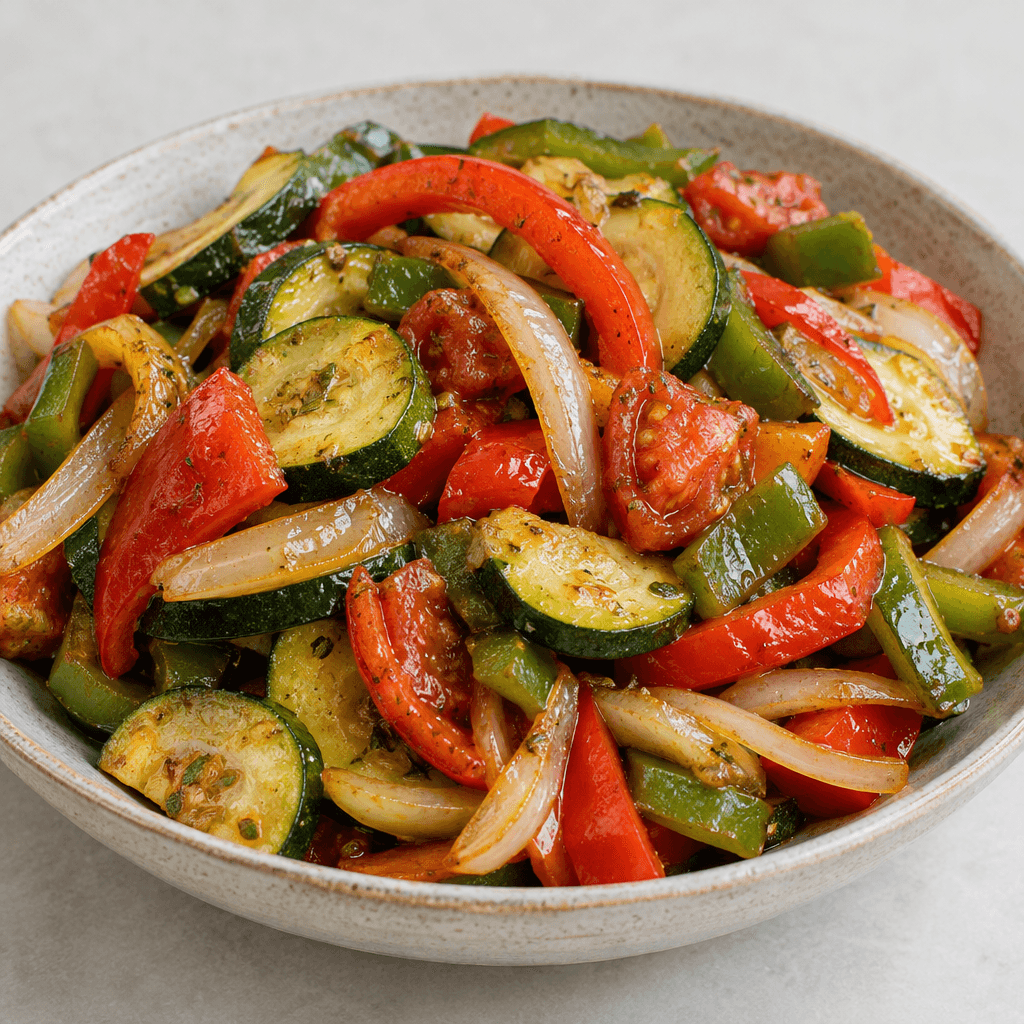
Vegetable Sauté Calories
Light sauté of mixed vegetables, rich in fiber and vitamins.
In season: Spring · Summer · Autumn · Winter
CALORIES
GI
POTASSIUM
FIBER
Quick answer
1 serving (medium) of Vegetable Sauté (150 g) has 98 calories. That works out to 65 calories per 100 g. It contains 14.7 g of carbs, 3.2 g of protein, 3.3 g of fat and 4.8 g of fiber. Its 630 µg of Vitamin A covers 70% of the Daily Value. Its glycemic index is 35 (low), so it raises blood sugar slowly.
What is Vegetable Sauté?
Vegetable Sauté is a simple pan-cooked dish of mixed vegetables, often including zucchini, red and green bell peppers, onion and tomato. It is a flexible home-style preparation rather than a recipe tied to one particular region, and the mix can change with the season or what is on hand.
The vegetables turn tender while keeping some bite; tomato adds juiciness, and the peppers and onion bring gentle sweetness. It works as a side with grains, fish or other mains, or as a light meal with bread. With plenty of fibre and a modest amount of fat, it is an easy way to add vegetables to a meal. Use just enough oil to coat the pan, and add beans or chickpeas if you want it to be more filling.
Vegetable Sauté Nutrition Facts
Selected: 100 g
65
KCAL / 100G
Carbs
9.8g
· 4% DV
Protein
2.1g
· 4% DV
Fat
2.2g
· 3% DV
Fiber
3.2g
· 11% DV
DV is the share of the daily value covered, on a 2,000 kcal reference diet.
Calories come from: Carbs 58% · Protein 12% · Fat 30%
Vegetable Sauté Vitamins & Minerals
Vitamins
Vitamin A
420µg · 47% DV
Vitamin K
28µg · 23% DV
Vitamin C
18mg · 20% DV
Folate
38µg · 10% DV
Minerals
Iron
1mg · 6% DV
Potassium ⭐
220mg · 6% DV
Magnesium
19mg · 5% DV
Sodium
120mg · 5% DV
How Nutritious Is Vegetable Sauté?
Nutrient density
Very high
How many vitamins, minerals and how much fiber this food carries per calorie. A high score means a lot of nutrition for few calories.
Satiety score
Medium
An EatBetter score computed from fiber, protein and calorie density. A high score means staying full longer on the same calories.
Both scores are calculated per 100 g and do not change with the selected portion. The satiety score is EatBetter's own calculation, not a clinical measure.
Vegetable Sauté Glycemic Index
GLYCEMIC INDEX
GLYCEMIC LOAD
Accounts for portion size — a more realistic measure than GI alone.
How to Burn Off Vegetable Sauté
To burn the 65 calories in 100 g:
🚶
Walking (5 km/h)
🏃
Running (8 km/h)
🚴
Cycling
🏊
Swimming
Times are calculated with the MET equation for a 70 kg adult. Actual burn varies with your weight, age and pace.
Is Vegetable Sauté Processed?
NOVA 2
Minimally Processed
1. Unprocessed
2. Minimally Processed
3. Processed
4. Ultra-Processed
NOVA classifies foods into 4 groups by industrial processing. NOVA 1 (unprocessed) is the healthiest.
Does Vegetable Sauté Contain Allergens?
No known major allergens
Which Diets Is Vegetable Sauté Good For?
Vegan
✓ Suitable
Vegetarian
✓ Suitable
Gluten-Free
✓ Suitable
Dairy-Free
— Not suitable
Mediterranean
✓ Suitable
Paleo
— Not suitable
Whole30
— Not suitable
DASH
— Not suitable
Keto
— Not suitable
Low FODMAP
— Not suitable
Vegetable Sauté Fat Profile
SATURATED
0.3g
MONOUNSATURATED
0.7g
POLYUNSATURATED
0.5g
Omega 6:3 ratio 3:1
Below the ideal 4:1 — a good omega balance.
Compare Vegetable Sauté
Foods Similar to Vegetable Sauté
Frequently Asked Questions About Vegetable Sauté
What vegetables are used in Vegetable Sauté?
Vegetable Sauté commonly combines zucchini, red and green bell peppers, onion, and tomatoes. You can add mushrooms, eggplant, or carrots, too; add firmer vegetables earlier so they have time to soften without overcooking the rest.
How do you keep Vegetable Sauté from getting soggy?
Cook Vegetable Sauté in a hot, uncrowded pan, and dry the vegetables before adding them. Work in batches if needed, and add juicy tomatoes and salt near the end so the vegetables brown instead of steaming in released liquid.
What is the best way to cook Vegetable Sauté?
The best way to cook Vegetable Sauté is in a wide skillet over fairly high heat. Stir occasionally rather than constantly, and add ingredients according to how quickly they cook: onion and peppers first, zucchini next, and tomatoes last.
What herbs and spices go well in Vegetable Sauté?
Black pepper, oregano, thyme, garlic, and a little chili pair well with Vegetable Sauté. Finish it with fresh parsley or basil for a brighter flavor, adding delicate fresh herbs after the pan comes off the heat.
Can you add chickpeas or tofu to Vegetable Sauté?
Yes, chickpeas or tofu can make Vegetable Sauté more filling. Add drained chickpeas toward the end to warm through; brown firm tofu separately first, then fold it in so it keeps its shape and does not crowd the vegetables.
Can Vegetable Sauté be made with frozen vegetables?
Yes, Vegetable Sauté can be made with frozen vegetables. Add them straight to a hot pan without thawing, and cook uncovered so excess moisture can evaporate. The vegetables may turn softer than fresh ones, especially after freezing and reheating.
What should you serve with Vegetable Sauté?
Vegetable Sauté goes well with rice, couscous, pasta, or crusty bread. For a more substantial meal, serve it alongside grilled fish or chicken, or spoon it over grains and top with a fried egg.
How long does Vegetable Sauté keep in the fridge?
Vegetable Sauté keeps for a few days in a covered container in the refrigerator. Cool it and refrigerate it promptly rather than leaving it out for an extended period, and discard it if its smell or appearance changes.
Can you freeze Vegetable Sauté?
Yes, you can freeze Vegetable Sauté, although zucchini and tomatoes may become softer when thawed. Cool it first, pack it in a sealed freezer-safe container, and thaw it in the refrigerator before reheating in a skillet.
Do you need to peel the zucchini for Vegetable Sauté?
No, you usually do not need to peel zucchini for Vegetable Sauté. Its skin softens during cooking and helps the slices hold their shape; just rinse the zucchini under running water and trim off the ends before cutting.
Have another question about Vegetable Sauté?
Ask the AI nutrition coach — calories, portions, alternatives and more, answered in seconds in the app.

Scan calories with your camera
Instant AI nutrition analysis

Nutrition data compiled from USDA FoodData Central and scientific sources.