

Ready & Packaged Foods
All →Vegetables & Legumes
All →Desserts & Confectionery
All →Meat & Protein
All →Grains & Bakery
All →Beverages
All →Milk & Dairy
All →

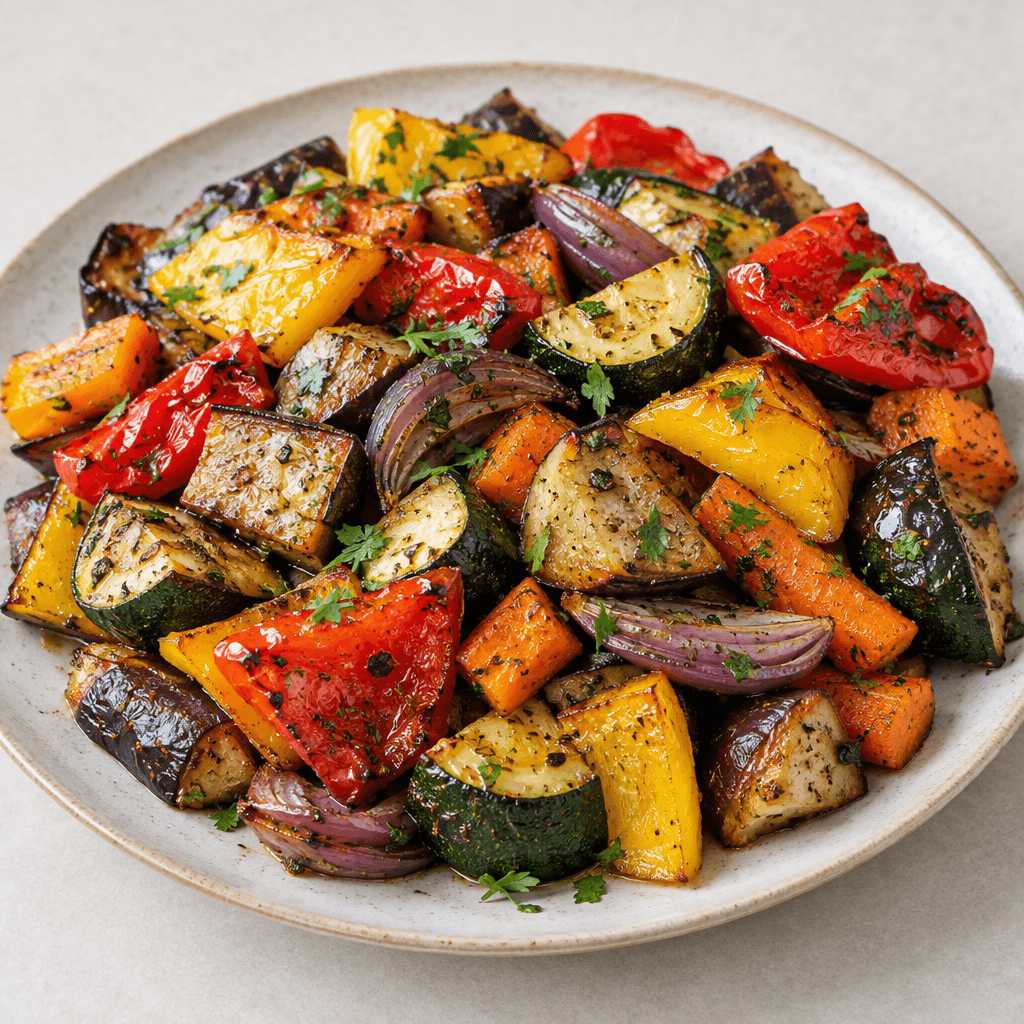
Roasted vegetables Calories
Oven-roasted mixed vegetables, rich in fiber and vitamins
In season: Spring · Summer · Autumn · Winter
CALORIES
GI
POTASSIUM
FIBER
Quick answer
1 serving (medium) of Roasted vegetables (150 g) has 113 calories. That works out to 75 calories per 100 g. It contains 18.8 g of carbs, 3.2 g of protein, 3.3 g of fat and 4.8 g of fiber. Its 630 µg of Vitamin A covers 70% of the Daily Value. Its glycemic index is 45 (low), so it raises blood sugar slowly.
What is Roasted vegetables?
Roasted vegetables are a simple oven dish made by cooking vegetables until tender, with browned edges. The mix can include peppers, courgette or zucchini, aubergine or eggplant, carrots and red onion; the exact selection often changes with the season. Roasting is common across Mediterranean cooking, where olive oil and herbs are often used to bring out the vegetables’ natural sweetness.
Serve them warm or at room temperature as a side, pile them into a grain bowl, or add leftovers to a sandwich or salad. Their soft, glossy centres and lightly charred edges pair well with grains, beans, or a tangy yogurt or tahini sauce. They provide fibre and vitamins, with 3.2g of fibre per 100g. For a lighter tray, use just enough oil to coat the vegetables and season generously with herbs.
Roasted vegetables Nutrition Facts
Selected: 100 g
75
KCAL / 100G
Carbs
12.5g
· 5% DV
Protein
2.1g
· 4% DV
Fat
2.2g
· 3% DV
Fiber
3.2g
· 11% DV
DV is the share of the daily value covered, on a 2,000 kcal reference diet.
Calories come from: Carbs 64% · Protein 11% · Fat 25%
Roasted vegetables Vitamins & Minerals
Vitamins
Vitamin A
420µg · 47% DV
Vitamin C
15mg · 17% DV
Vitamin K
18µg · 15% DV
B6
0.13mg · 8% DV
Minerals
Potassium ⭐
260mg · 8% DV
Iron
1mg · 6% DV
Sodium
120mg · 5% DV
Phosphorus
38mg · 5% DV
How Nutritious Is Roasted vegetables?
Nutrient density
High
How many vitamins, minerals and how much fiber this food carries per calorie. A high score means a lot of nutrition for few calories.
Satiety score
Medium
An EatBetter score computed from fiber, protein and calorie density. A high score means staying full longer on the same calories.
Both scores are calculated per 100 g and do not change with the selected portion. The satiety score is EatBetter's own calculation, not a clinical measure.
Roasted vegetables Glycemic Index
GLYCEMIC INDEX
GLYCEMIC LOAD
Accounts for portion size — a more realistic measure than GI alone.
How to Burn Off Roasted vegetables
To burn the 75 calories in 100 g:
🚶
Walking (5 km/h)
🏃
Running (8 km/h)
🚴
Cycling
🏊
Swimming
Times are calculated with the MET equation for a 70 kg adult. Actual burn varies with your weight, age and pace.
Is Roasted vegetables Processed?
NOVA 2
Minimally Processed
1. Unprocessed
2. Minimally Processed
3. Processed
4. Ultra-Processed
NOVA classifies foods into 4 groups by industrial processing. NOVA 1 (unprocessed) is the healthiest.
Does Roasted vegetables Contain Allergens?
No known major allergens
Which Diets Is Roasted vegetables Good For?
Vegan
✓ Suitable
Vegetarian
✓ Suitable
Gluten-Free
✓ Suitable
Dairy-Free
— Not suitable
Mediterranean
✓ Suitable
Paleo
✓ Suitable
Whole30
— Not suitable
DASH
— Not suitable
Keto
— Not suitable
Low FODMAP
— Not suitable
Roasted vegetables Fat Profile
SATURATED
0.3g
MONOUNSATURATED
1g
POLYUNSATURATED
0.18g
Omega 6:3 ratio 3.3:1
Below the ideal 4:1 — a good omega balance.
Compare Roasted vegetables
Foods Similar to Roasted vegetables
Frequently Asked Questions About Roasted vegetables
How do you make roasted vegetables?
To make roasted vegetables, cut them into similar-sized pieces, toss with a little oil and seasoning, and spread them in a single layer on a baking tray. Roast in a preheated oven until browned at the edges and tender inside.
What vegetables work best for roasted vegetables?
Bell peppers, zucchini, eggplant, carrots, and red onion make a colorful roasted vegetable mix. Carrots are firmer than zucchini and peppers, so cut them smaller or give them a head start in the oven.
Can you roast different vegetables together?
Yes, you can roast mixed vegetables together, but cut denser ones, such as carrots, smaller than quick-cooking zucchini or peppers. Leave space between the pieces so moisture can escape and the vegetables brown rather than steam.
How long do roasted vegetables take in the oven?
Roasted vegetables usually take about 25–40 minutes at 400°F (200°C), depending on their size and type. Turn them once during cooking and check that the firmest pieces are tender before taking the tray out.
Why do roasted vegetables turn soggy?
Roasted vegetables turn soggy when the tray is crowded, the oven is not hot enough, or the vegetables go in wet. Dry them well after washing, spread them out in one layer, and use a second tray if needed.
What seasoning is good for roasted vegetables?
Roasted vegetables pair well with olive oil, black pepper, garlic, and herbs such as thyme or oregano. Add fresh herbs after roasting for a brighter flavor, or use paprika and chili flakes for more warmth.
Can you roast frozen vegetables?
Yes, frozen vegetables can be roasted without thawing, but they release more moisture than fresh ones. Spread them out while still frozen, use a hot oven, and expect softer results than with fresh vegetables.
How should you store roasted vegetables?
Store roasted vegetables in a covered container in the refrigerator once they have cooled. They keep for about 3–4 days; refrigerate leftovers promptly and reheat only the portion you plan to eat.
How do you reheat roasted vegetables without making them mushy?
Reheat roasted vegetables in a hot oven, spread out on a tray, until warmed through. This helps restore some browning; a microwave is quicker but usually makes the vegetables softer.
What can you serve with roasted vegetables?
Roasted vegetables go well with grilled chicken or fish, grains such as rice or quinoa, and beans or lentils. Add a yogurt-based sauce or a squeeze of lemon at the table to balance their browned, savory flavor.
Have another question about Roasted vegetables?
Ask the AI nutrition coach — calories, portions, alternatives and more, answered in seconds in the app.

Scan calories with your camera
Instant AI nutrition analysis

Nutrition data compiled from USDA FoodData Central and scientific sources.