

Ready & Packaged Foods
All →Vegetables & Legumes
All →Desserts & Confectionery
All →Meat & Protein
All →Grains & Bakery
All →Beverages
All →Milk & Dairy
All →

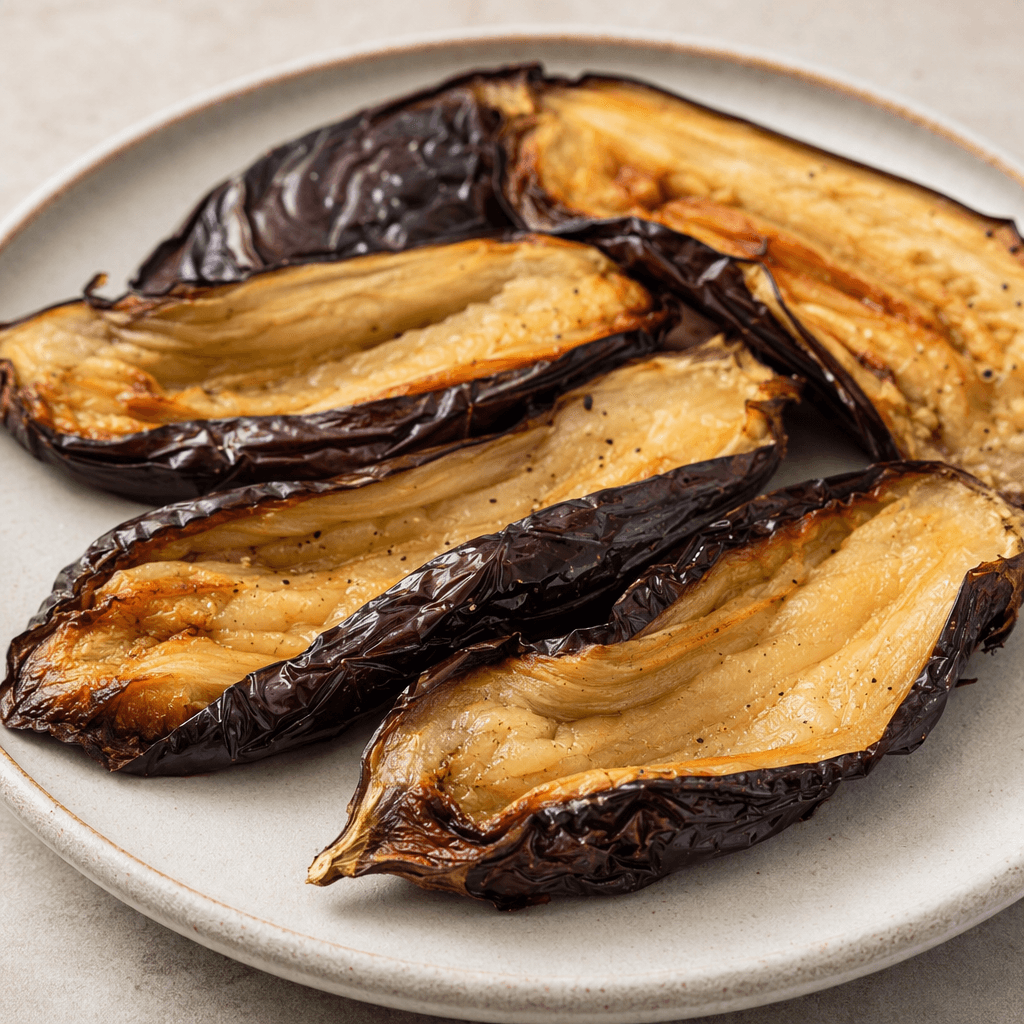
Roasted eggplant Calories
Fiber source, low calorie, antioxidants
In season: Summer · Autumn
CALORIES
GI
POTASSIUM
FIBER
Quick answer
1 piece (medium) of Roasted eggplant (120 g) has 42 calories. That works out to 35 calories per 100 g. It contains 9.6 g of carbs, 1.2 g of protein, 0.2 g of fat and 3 g of fiber. Its 0.3 mg of Manganese covers 12% of the Daily Value. Its glycemic index is 15 (low), so it raises blood sugar slowly.
What is Roasted eggplant?
Roasted eggplant is made by baking whole eggplants or halved pieces until the flesh turns soft and the skin wrinkles and blisters. It is enjoyed across Mediterranean and Middle Eastern cuisines, with each household seasoning it in its own way.
The flesh becomes creamy and mild, while browned edges bring a little sweetness. Serve it as a side, mash it into a dip with olive oil, lemon and garlic, or pair it with yoghurt, herbs and grilled foods. It is low in calories and provides fibre; a 100 g portion has 35 calories. For a lighter preparation, use just a little oil and let the eggplant’s soft texture carry the dish.
Roasted eggplant Nutrition Facts
Selected: 100 g
35
KCAL / 100G
Carbs
8g
· 3% DV
Protein
1g
· 2% DV
Fat
0.2g
· 0% DV
Fiber
2.5g
· 9% DV
DV is the share of the daily value covered, on a 2,000 kcal reference diet.
Calories come from: Carbs 85% · Protein 11% · Fat 4%

Log this food in EatBetter
100,000+ people use it
- Get your daily calorie target
- Snap your meal, log it in seconds
- See every vitamin and mineral

📸 Scan the code to get the app free.

Roasted eggplant Vitamins & Minerals
Vitamins
B5
0.28mg · 6% DV
Folate
22µg · 6% DV
B6
0.08mg · 5% DV
B3
0.6mg · 4% DV
Minerals
Potassium ⭐
230mg · 7% DV
Phosphorus
24mg · 3% DV
Manganese
0mg · 0% DV
Copper
0mg · 0% DV
How Nutritious Is Roasted eggplant?
Nutrient density
High
How many vitamins, minerals and how much fiber this food carries per calorie. A high score means a lot of nutrition for few calories.
Satiety score
Medium
An EatBetter score computed from fiber, protein and calorie density. A high score means staying full longer on the same calories.
Both scores are calculated per 100 g and do not change with the selected portion. The satiety score is EatBetter's own calculation, not a clinical measure.
Roasted eggplant Glycemic Index
GLYCEMIC INDEX
GLYCEMIC LOAD
Accounts for portion size — a more realistic measure than GI alone.
How to Burn Off Roasted eggplant
To burn the 35 calories in 100 g:
🚶
Walking (5 km/h)
🏃
Running (8 km/h)
🚴
Cycling
🏊
Swimming
Times are calculated with the MET equation for a 70 kg adult. Actual burn varies with your weight, age and pace.
Is Roasted eggplant Processed?
NOVA 2
Minimally Processed
1. Unprocessed
2. Minimally Processed
3. Processed
4. Ultra-Processed
NOVA classifies foods into 4 groups by industrial processing. NOVA 1 (unprocessed) is the healthiest.
Does Roasted eggplant Contain Allergens?
No known major allergens
Which Diets Is Roasted eggplant Good For?
Vegan
✓ Suitable
Vegetarian
✓ Suitable
Gluten-Free
✓ Suitable
Dairy-Free
— Not suitable
Mediterranean
✓ Suitable
Paleo
✓ Suitable
Whole30
— Not suitable
DASH
— Not suitable
Keto
— Not suitable
Low FODMAP
— Not suitable
Roasted eggplant Fat Profile
SATURATED
0.03g
MONOUNSATURATED
0.02g
POLYUNSATURATED
0.03g
Omega 6:3 ratio 2:1
Below the ideal 4:1 — a good omega balance.
Compare Roasted eggplant
Foods Similar to Roasted eggplant
Frequently Asked Questions About Roasted eggplant
How do you make roasted eggplant in the oven?
To make roasted eggplant, halve it lengthwise, brush the cut sides lightly with oil, and bake at 400°F (200°C) until the flesh is very tender and the surface is browned. Larger pieces take longer, so test the center with a fork.
Do you peel eggplant before roasting it?
No, you do not need to peel eggplant before roasting. The skin helps the halves hold their shape and becomes softer in the oven; scoop out the flesh after cooking if you want a smooth dip or purée.
How can you tell when roasted eggplant is done?
Roasted eggplant is done when a fork slides easily through the center and the flesh looks soft and creamy. Wrinkled, browned skin is a useful sign, but check the flesh too because the outside can darken before the middle is tender.
Can you eat the skin of roasted eggplant?
Yes, roasted eggplant skin is edible and softens during cooking. If you are making a silky dip, scoop out the flesh and discard the skin; for a simple side dish, you can serve and eat the roasted halves with the skin on.
Should you roast eggplant whole or cut in half?
Either works, but halving eggplant helps it cook faster and makes it easier to check for tenderness. If roasting it whole, prick the skin in several places first so steam can escape, and expect it to take longer to soften.
How do you keep roasted eggplant from turning watery?
To keep roasted eggplant from turning watery, dry it after washing and leave space between pieces on the baking sheet. Crowding traps steam, so the eggplant softens without browning; placing the cut sides against the hot pan encourages better color.
What should you season roasted eggplant with?
Olive oil, salt, and black pepper are a simple seasoning for roasted eggplant. Garlic, lemon, cumin, paprika, or fresh herbs also work well; add delicate herbs and lemon after roasting so their flavors stay fresh.
How do you store leftover roasted eggplant?
Store leftover roasted eggplant in a sealed container in the refrigerator for about three to four days. Let it cool before storing, and reheat it in an oven or skillet; adding it to pasta, grain bowls, or a sandwich also works.
Can you freeze roasted eggplant?
Yes, roasted eggplant freezes well, though it may be softer after thawing. Cool it completely, portion it into airtight freezer containers, and use the thawed pieces in dips, soups, sauces, or other dishes where a tender texture is welcome.
Why is my roasted eggplant bitter?
Roasted eggplant can taste bitter if the fruit is old or naturally bitter, though bitterness is not inevitable. Choose firm eggplants with smooth, glossy skin; if sliced pieces taste bitter, salting them briefly and then rinsing and drying can help.
Have another question about Roasted eggplant?
Ask the AI nutrition coach — calories, portions, alternatives and more, answered in seconds in the app.

Scan calories with your camera
Instant AI nutrition analysis

Nutrition data compiled from USDA FoodData Central and scientific sources.