

Ready & Packaged Foods
All →Vegetables & Legumes
All →Desserts & Confectionery
All →Meat & Protein
All →Grains & Bakery
All →Beverages
All →Milk & Dairy
All →

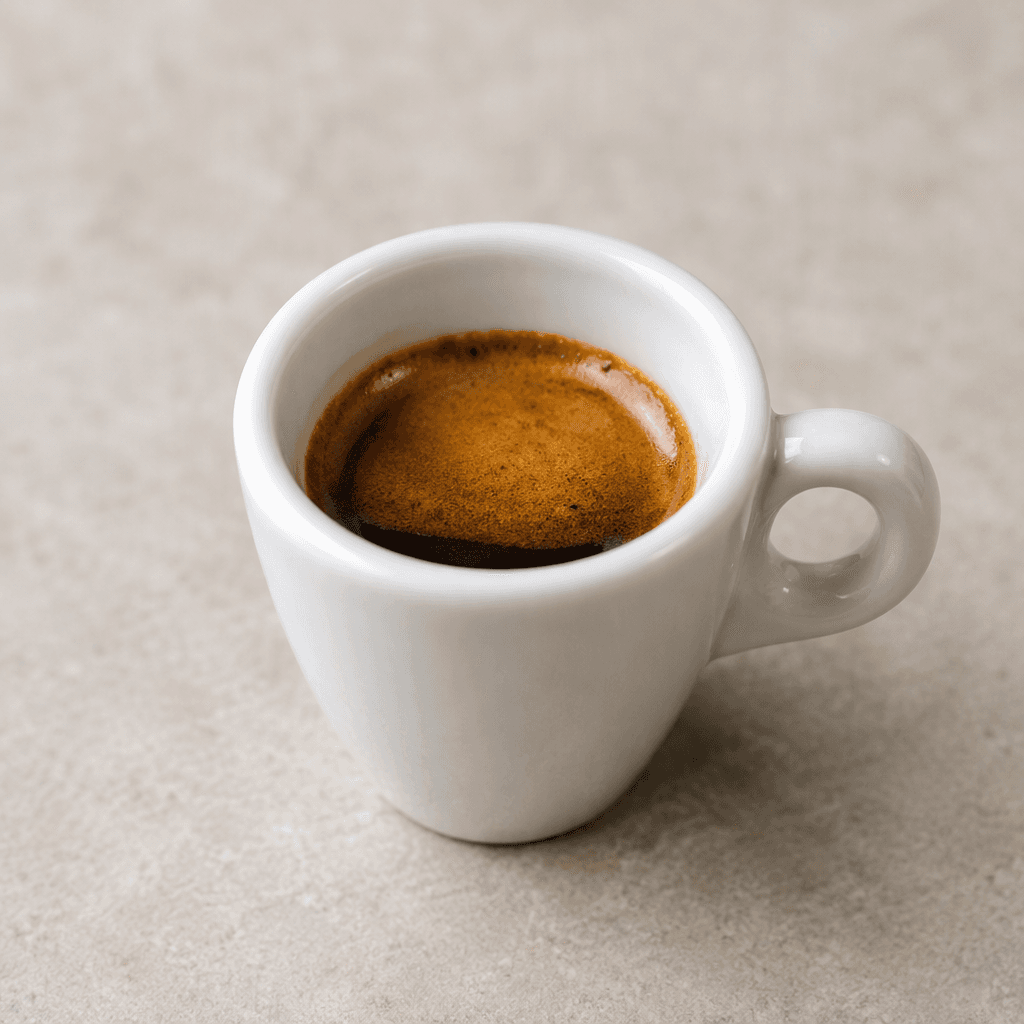
Ristretto Calories
Intense short espresso, less water
In season: Spring · Summer · Autumn · Winter
CALORIES
GI
POTASSIUM
FIBER
Quick answer
1 cup (small) of Ristretto (20 g) has 0 calories. That works out to 1 calories per 100 g. It contains 0 g of carbs, 0 g of protein, 0 g of fat and 0 g of fiber. Its glycemic index is 0 (low), so it raises blood sugar slowly.
What is Ristretto?
Ristretto comes from Italy’s espresso tradition. It is made with the same kind of finely ground coffee as espresso but less water, yielding a very short, concentrated shot, usually served in a small cup beneath a thin layer of crema.
Its flavour is intense and full-bodied, so it is meant to be sipped in a few small mouthfuls rather than lingered over like a larger coffee. In Italy it may be enjoyed at a café counter or after a meal; elsewhere, it also works well as a small coffee break, often with water alongside. With no sugar or additions, it contributes very little energy. Choose it when you want a bold coffee taste in a compact serving.
Ristretto Nutrition Facts
Selected: 100 g
1
KCAL / 100G
Carbs
0.2g
· 0% DV
Protein
0.1g
· 0% DV
Fat
0g
· 0% DV
Fiber
0g
· 0% DV
DV is the share of the daily value covered, on a 2,000 kcal reference diet.
Calories come from: Carbs 67% · Protein 33% · Fat 0%
Ristretto Vitamins & Minerals
Vitamins
B2
0.02mg · 2% DV
B1
0.01mg · 1% DV
B3
0.1mg · 1% DV
B5
0.03mg · 1% DV
Minerals
Magnesium
3mg · 1% DV
Phosphorus
7mg · 1% DV
Potassium ⭐
50mg · 1% DV
Calcium
2mg · 0% DV
How Nutritious Is Ristretto?
Nutrient density
Low
How many vitamins, minerals and how much fiber this food carries per calorie. A high score means a lot of nutrition for few calories.
Satiety score
Medium
An EatBetter score computed from fiber, protein and calorie density. A high score means staying full longer on the same calories.
Both scores are calculated per 100 g and do not change with the selected portion. The satiety score is EatBetter's own calculation, not a clinical measure.
Ristretto Glycemic Index
GLYCEMIC INDEX
GLYCEMIC LOAD
Accounts for portion size — a more realistic measure than GI alone.
How to Burn Off Ristretto
To burn the 1 calories in 100 g:
🚶
Walking (5 km/h)
🏃
Running (8 km/h)
🚴
Cycling
🏊
Swimming
Times are calculated with the MET equation for a 70 kg adult. Actual burn varies with your weight, age and pace.
Is Ristretto Processed?
NOVA 2
Minimally Processed
1. Unprocessed
2. Minimally Processed
3. Processed
4. Ultra-Processed
NOVA classifies foods into 4 groups by industrial processing. NOVA 1 (unprocessed) is the healthiest.
Does Ristretto Contain Allergens?
No known major allergens
Which Diets Is Ristretto Good For?
Vegan
✓ Suitable
Vegetarian
✓ Suitable
Gluten-Free
✓ Suitable
Dairy-Free
— Not suitable
Mediterranean
✓ Suitable
Paleo
✓ Suitable
Whole30
— Not suitable
DASH
— Not suitable
Keto
✓ Suitable
Low FODMAP
— Not suitable
Ristretto Fat Profile
SATURATED
0g
MONOUNSATURATED
0g
POLYUNSATURATED
0g
Compare Ristretto
Foods Similar to Ristretto
Frequently Asked Questions About Ristretto
What is a ristretto?
A ristretto is a short espresso made by passing less water through the same dose of coffee. It is served in a small cup and has a concentrated flavor, but it is not simply espresso with extra coffee added.
What is the difference between ristretto and espresso?
A ristretto is extracted for a shorter time and yields less coffee in the cup than an espresso made with a similar dose. The smaller amount of water makes its flavor more concentrated, while espresso has a longer extraction.
Does a ristretto have more caffeine than an espresso?
Not necessarily. A ristretto can taste more concentrated because it contains less water, but that does not mean it has more caffeine. The caffeine in the cup depends largely on the coffee dose and how the shot is prepared.
How do you make a ristretto?
Make a ristretto with an espresso machine by using a normal espresso dose and stopping the extraction earlier. Less water passes through the coffee, so the shot is shorter and produces a smaller amount in the cup.
Why does ristretto taste sweeter than espresso?
Ristretto can taste sweeter and less bitter because its shorter extraction changes which flavors reach the cup. The result depends on the beans and preparation, but its concentrated taste does not mean it contains more sugar.
What is the difference between ristretto and lungo?
A ristretto uses less water and has a shorter extraction, while a lungo is pulled with more water. A lungo produces a larger drink; a ristretto is served as a small, concentrated shot.
Is ristretto stronger than espresso?
Ristretto often tastes more intense and concentrated than espresso because less water dilutes the extracted coffee. However, “stronger” describes flavor here, not necessarily higher caffeine content or a more bitter taste.
Can you add milk to a ristretto?
Yes, you can add milk to a ristretto or use it as the coffee base in a milk drink. It is traditionally served on its own in a small cup, while milk softens its concentrated flavor.
What coffee beans are used for ristretto?
Ristretto does not require a special kind of bean. Coffee sold for espresso works well, and the bean variety and roast affect the shot’s flavor; the defining feature is the shorter extraction, not a particular origin.
Can you make a ristretto without an espresso machine?
Not quite. A ristretto is made by extracting coffee under espresso-machine pressure and stopping the shot early. A moka pot or another brewing method can make strong coffee, but it will not produce a true ristretto.
Have another question about Ristretto?
Ask the AI nutrition coach — calories, portions, alternatives and more, answered in seconds in the app.

Scan calories with your camera
Instant AI nutrition analysis

Nutrition data compiled from USDA FoodData Central and scientific sources.