

Ready & Packaged Foods
All →Vegetables & Legumes
All →Desserts & Confectionery
All →Meat & Protein
All →Grains & Bakery
All →Beverages
All →Milk & Dairy
All →

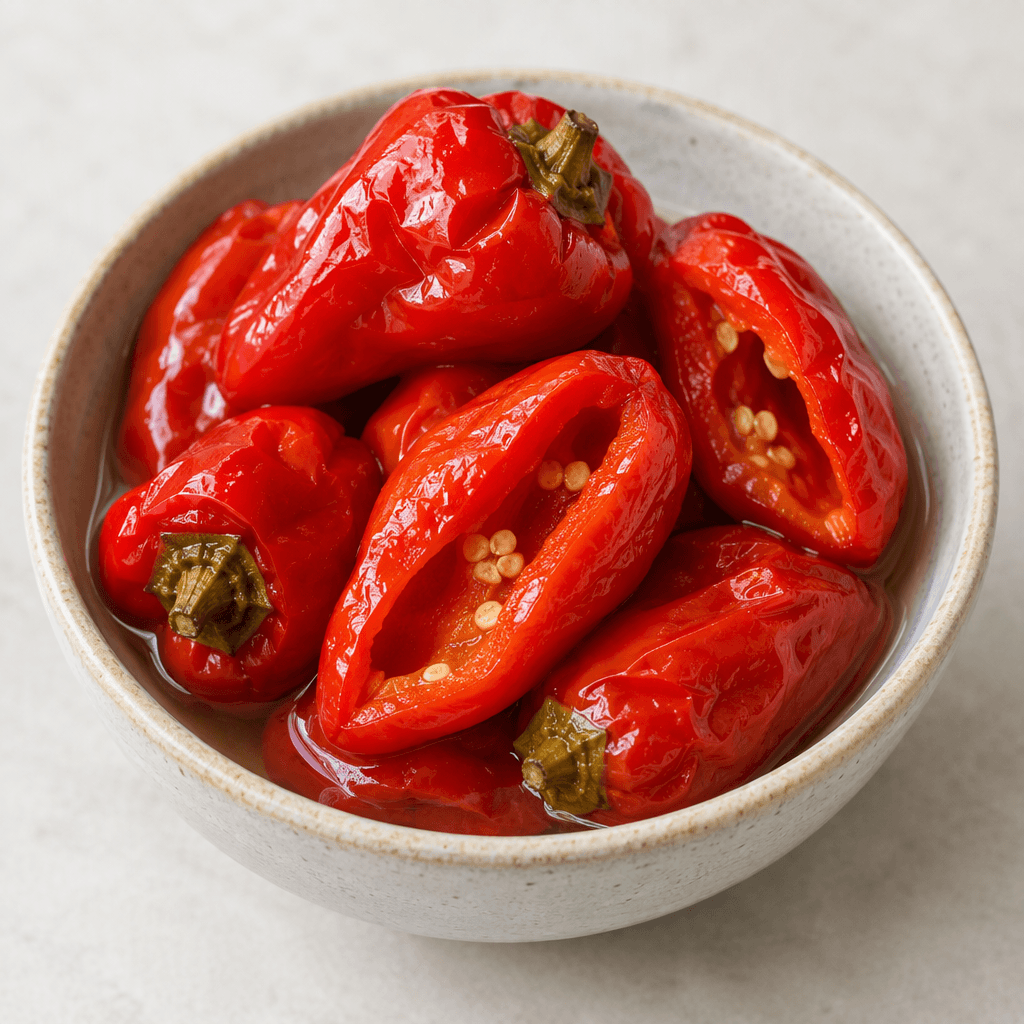
Red pepper pickles Calories
Vitamin C and antioxidant source, low calorie, fermented or vinegar-based
In season: Summer · Autumn
CALORIES
GI
POTASSIUM
FIBER
Quick answer
1 serving (medium) of Red pepper pickles (50 g) has 16 calories. That works out to 32 calories per 100 g. It contains 3.1 g of carbs, 0.6 g of protein, 0.2 g of fat and 1.1 g of fiber. Its 41 mg of Vitamin C covers 46% of the Daily Value. Its glycemic index is 15 (low), so it raises blood sugar slowly.
What is Red pepper pickles?
Red pepper pickles are pieces or whole peppers preserved in a tangy brine or vinegar mixture, often with garlic. The peppers stay pleasantly firm beneath their smooth skins, while the liquid gives them a sharp, salty edge; the exact flavour depends on the pepper and the style of pickle.
In Turkey, they’re served alongside everyday meals, added to a meze spread, or brought out with breakfast. For cooks elsewhere, they make an easy bright, tangy accompaniment to beans, grilled foods, sandwiches or a cheese board. They’re low in calories and provide some fibre, but can be salty, so drain them well or rinse briefly if you prefer a milder taste.
Red pepper pickles Nutrition Facts
Selected: 100 g
32
KCAL / 100G
Carbs
6.2g
· 2% DV
Protein
1.1g
· 2% DV
Fat
0.3g
· 0% DV
Fiber
2.1g
· 8% DV
DV is the share of the daily value covered, on a 2,000 kcal reference diet.
Calories come from: Carbs 78% · Protein 14% · Fat 8%
Red pepper pickles Vitamins & Minerals
Vitamins
Vitamin C
82mg · 91% DV
Vitamin A
157µg · 17% DV
B6
0.29mg · 17% DV
Vitamin E
1.6mg · 11% DV
Minerals
Sodium
620mg · 27% DV
Iron
1mg · 6% DV
Potassium ⭐
180mg · 5% DV
Magnesium
13mg · 3% DV
How Nutritious Is Red pepper pickles?
Nutrient density
High
How many vitamins, minerals and how much fiber this food carries per calorie. A high score means a lot of nutrition for few calories.
Satiety score
Medium
An EatBetter score computed from fiber, protein and calorie density. A high score means staying full longer on the same calories.
Both scores are calculated per 100 g and do not change with the selected portion. The satiety score is EatBetter's own calculation, not a clinical measure.
Red pepper pickles Glycemic Index
GLYCEMIC INDEX
GLYCEMIC LOAD
Accounts for portion size — a more realistic measure than GI alone.
How to Burn Off Red pepper pickles
To burn the 32 calories in 100 g:
🚶
Walking (5 km/h)
🏃
Running (8 km/h)
🚴
Cycling
🏊
Swimming
Times are calculated with the MET equation for a 70 kg adult. Actual burn varies with your weight, age and pace.
Is Red pepper pickles Processed?
NOVA 3
Processed
1. Unprocessed
2. Minimally Processed
3. Processed
4. Ultra-Processed
NOVA classifies foods into 4 groups by industrial processing. NOVA 1 (unprocessed) is the healthiest.
Does Red pepper pickles Contain Allergens?
No known major allergens
Which Diets Is Red pepper pickles Good For?
Vegan
✓ Suitable
Vegetarian
✓ Suitable
Gluten-Free
✓ Suitable
Dairy-Free
— Not suitable
Mediterranean
✓ Suitable
Paleo
✓ Suitable
Whole30
— Not suitable
DASH
— Not suitable
Keto
— Not suitable
Low FODMAP
— Not suitable
Red pepper pickles Fat Profile
SATURATED
0.04g
MONOUNSATURATED
0.03g
POLYUNSATURATED
0.09g
Omega 6:3 ratio 4:1
Below the ideal 4:1 — a good omega balance.
Compare Red pepper pickles
Foods Similar to Red pepper pickles
Frequently Asked Questions About Red pepper pickles
How do you make red pepper pickles?
Red pepper pickles are made by packing clean peppers into a jar and covering them with vinegar brine or saltwater. Garlic and herbs are common additions. Vinegar pickles get their tang from the brine, while saltwater pickles develop acidity through fermentation.
What kind of peppers are best for red pepper pickles?
Firm, fresh, thick-fleshed red peppers work best for red pepper pickles because they hold their shape in the brine. Sweet bell peppers are a mild option; smaller hot peppers give the finished pickles more heat. Avoid peppers with bruises or soft spots.
Are red pepper pickles spicy?
Red pepper pickles are not necessarily spicy; their heat depends on the pepper variety. Pickles made with sweet red bell peppers are usually mild, while hot peppers or a mix of hot and sweet varieties make a much spicier jar.
How long do red pepper pickles take to ferment?
Red pepper pickles can begin tasting tangy after several days, but naturally fermented batches usually need longer to develop their full flavor. The timing varies with room temperature, pepper size, and brine strength; vinegar-based pickles do not rely on fermentation to become sour.
Why did my red pepper pickles turn soft?
Red pepper pickles often turn soft when the peppers were already old or bruised, the brine was unsuitable, or the jar was not kept clean. Start with firm peppers and keep them submerged in brine to help them retain their texture.
How should you store red pepper pickles after opening?
Store opened red pepper pickles in the refrigerator with the lid tightly closed. Keep the peppers covered by brine and use a clean fork to remove them; introducing food or dirty utensils into the jar can encourage spoilage.
How can you tell if red pepper pickles have gone bad?
Discard red pepper pickles if you see mold, notice an unpleasant or unusual smell, or find a slimy texture or unexpected discoloration. A bulging or leaking jar is also a warning sign. Do not taste questionable pickles to check whether they are safe.
What can you eat with red pepper pickles?
Red pepper pickles pair well with grilled meats, sandwiches, burgers, beans, and grain bowls. Their sharp, tangy flavor can cut through rich foods, and chopped pickled peppers also add a bright, savory accent to salads and wraps.
Are red pepper pickles the same as roasted red peppers?
No, red pepper pickles are peppers preserved in an acidic or fermented brine, while roasted red peppers are cooked over heat and may be packed in oil. Pickling gives the peppers a tangy, salty taste; roasting brings out a sweeter, smoky flavor.
Can you use red pepper pickles in recipes?
Yes, red pepper pickles can be chopped into sandwiches, salads, pasta salads, or sauces. Drain them first if you want to avoid making a dish too wet, and add them near the end of cooking so their sharp flavor stays noticeable.
Have another question about Red pepper pickles?
Ask the AI nutrition coach — calories, portions, alternatives and more, answered in seconds in the app.

Scan calories with your camera
Instant AI nutrition analysis

Nutrition data compiled from USDA FoodData Central and scientific sources.