

Ready & Packaged Foods
All →Vegetables & Legumes
All →Desserts & Confectionery
All →Meat & Protein
All →Grains & Bakery
All →Beverages
All →Milk & Dairy
All →

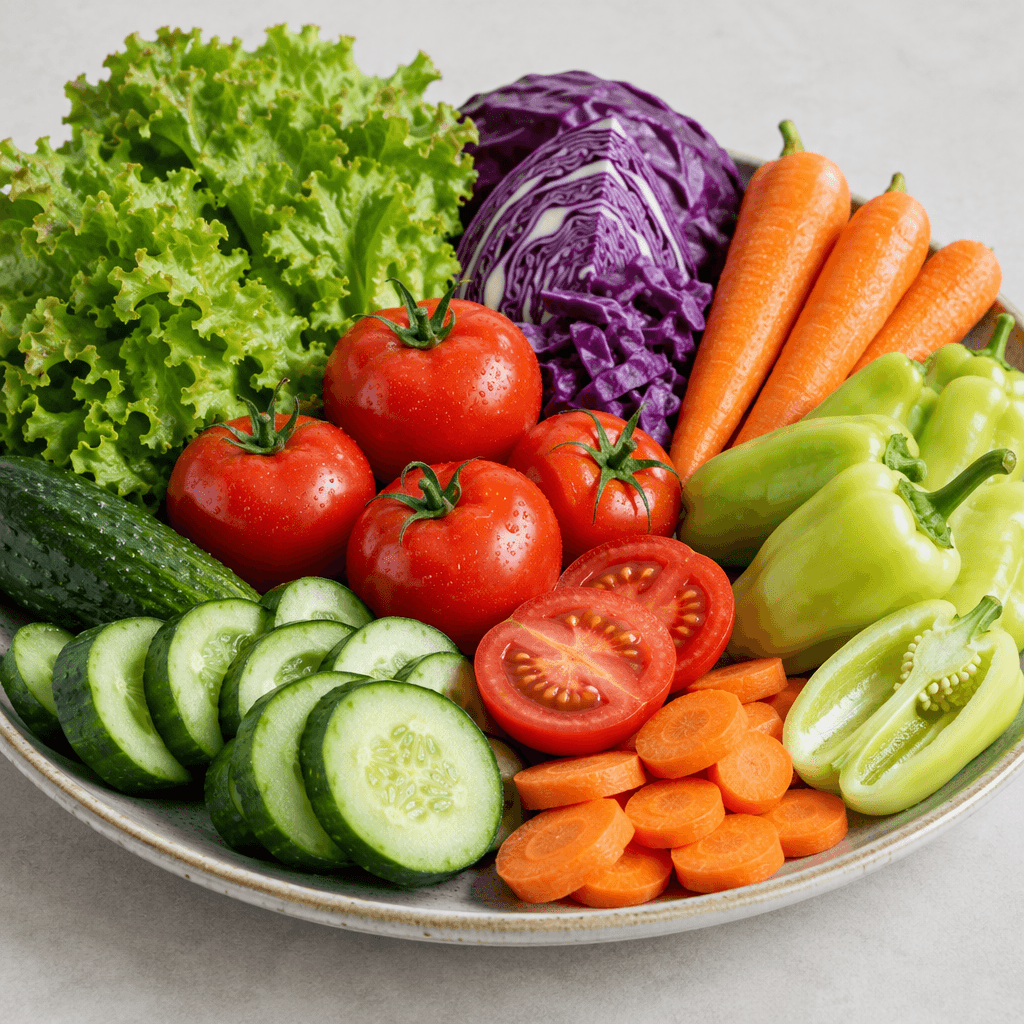
Raw vegetables Calories
Low-calorie mixed raw vegetables rich in fiber and vitamins
In season: Spring · Summer · Autumn · Winter
CALORIES
GI
POTASSIUM
FIBER
Quick answer
100 g of Raw vegetables has 30 calories. It contains 6 g of carbs, 1.4 g of protein, 0.2 g of fat and 2.3 g of fiber. Its 320 µg of Vitamin A covers 36% of the Daily Value. Its glycemic index is 15 (low), so it raises blood sugar slowly.
What is Raw vegetables?
Raw vegetables are vegetables eaten uncooked, whole or cut up—often tomatoes, cucumbers, carrots, lettuce and peppers. They are enjoyed around the world as a simple snack, tossed into salads or arranged on a platter; in many places, they are served with a dip or alongside a meal.
Their flavours range from juicy and mild to peppery, while crisp pieces contrast nicely with tender leaves. A squeeze of lemon or a light dressing can bring the assortment together without masking its freshness. Raw vegetables are generally low in calories and provide fibre; this mix has about 30 calories per 100 g. For a more filling snack, pair them with hummus or another protein-rich dip.
Raw vegetables Nutrition Facts
Selected: 100 g
30
KCAL / 100G
Carbs
6g
· 2% DV
Protein
1.4g
· 3% DV
Fat
0.2g
· 0% DV
Fiber
2.3g
· 8% DV
DV is the share of the daily value covered, on a 2,000 kcal reference diet.
Calories come from: Carbs 76% · Protein 18% · Fat 6%
Raw vegetables Vitamins & Minerals
Vitamins
Vitamin A
320µg · 36% DV
Vitamin C
18mg · 20% DV
Vitamin K
22µg · 18% DV
Folate
28µg · 7% DV
Minerals
Potassium ⭐
240mg · 7% DV
Iron
1mg · 6% DV
Phosphorus
34mg · 5% DV
Magnesium
15mg · 4% DV
How Nutritious Is Raw vegetables?
Nutrient density
Very high
How many vitamins, minerals and how much fiber this food carries per calorie. A high score means a lot of nutrition for few calories.
Satiety score
Medium
An EatBetter score computed from fiber, protein and calorie density. A high score means staying full longer on the same calories.
Both scores are calculated per 100 g and do not change with the selected portion. The satiety score is EatBetter's own calculation, not a clinical measure.
Raw vegetables Glycemic Index
GLYCEMIC INDEX
GLYCEMIC LOAD
Accounts for portion size — a more realistic measure than GI alone.
How to Burn Off Raw vegetables
To burn the 30 calories in 100 g:
🚶
Walking (5 km/h)
🏃
Running (8 km/h)
🚴
Cycling
🏊
Swimming
Times are calculated with the MET equation for a 70 kg adult. Actual burn varies with your weight, age and pace.
Is Raw vegetables Processed?
NOVA 1
Unprocessed
1. Unprocessed
2. Minimally Processed
3. Processed
4. Ultra-Processed
NOVA classifies foods into 4 groups by industrial processing. NOVA 1 (unprocessed) is the healthiest.
Does Raw vegetables Contain Allergens?
No known major allergens
Which Diets Is Raw vegetables Good For?
Vegan
✓ Suitable
Vegetarian
✓ Suitable
Gluten-Free
✓ Suitable
Dairy-Free
— Not suitable
Mediterranean
✓ Suitable
Paleo
✓ Suitable
Whole30
— Not suitable
DASH
— Not suitable
Keto
✓ Suitable
Low FODMAP
— Not suitable
Raw vegetables Fat Profile
SATURATED
0.03g
MONOUNSATURATED
0.01g
POLYUNSATURATED
0.09g
Omega 6:3 ratio 2:1
Below the ideal 4:1 — a good omega balance.
Compare Raw vegetables
Foods Similar to Raw vegetables
Frequently Asked Questions About Raw vegetables
Which raw vegetables are best to eat?
Good choices for eating raw include carrots, cucumbers, bell peppers, tomatoes, lettuce, and cabbage. Choose firm vegetables without bruises or mold, and mix colors and textures for variety. Wash them under running water before cutting or serving.
How should you wash raw vegetables?
Rinse raw vegetables under clean running water and rub their surfaces with your hands; do not use soap or detergent. Separate and rinse leafy greens leaf by leaf. Wash vegetables before cutting so a knife does not transfer surface dirt into the flesh.
How long do raw vegetables last in the fridge?
Whole raw vegetables generally keep longer than cut ones, but their shelf life varies by type and freshness. Refrigerate cut vegetables promptly in a clean, covered container, and discard them if they become slimy, moldy, or develop an off smell.
Can raw vegetables be frozen?
Yes, but thawed raw vegetables often turn soft and watery, so they are usually unsuitable for salads. For better quality, blanch most vegetables briefly before freezing, then use them in cooked dishes. Cucumbers and lettuce do not freeze well for fresh use.
Are raw vegetables healthier than cooked vegetables?
Neither is always healthier; the effect depends on the vegetable and how it is cooked. Cooking tomatoes can make lycopene easier for the body to use, while heat can reduce some vitamin C. Eating both raw and cooked vegetables offers variety.
Why do raw vegetables cause bloating?
Some raw vegetables, especially cabbage, cauliflower, and broccoli, contain carbohydrates that gut bacteria ferment and that can cause gas. Smaller portions, thorough chewing, or cooking the vegetables may make them easier to tolerate. Persistent or severe symptoms deserve medical attention.
Can you eat raw vegetables every day?
Yes, most people can include raw vegetables every day as part of varied meals. Wash them well and rotate the types you eat rather than relying on only one vegetable. If raw vegetables repeatedly upset your stomach, try cooked versions instead.
Do raw vegetables lose nutrients after being cut?
Yes, some nutrients can gradually decline after cutting, especially when vegetables are exposed to air, light, and heat. For the best quality, cut raw vegetables shortly before eating and refrigerate any prepared portions in a covered container.
Should you eat raw vegetables before a meal?
Yes, eating raw vegetables before or alongside a meal can add crunch and fiber and help make the meal more filling. Pair them with a protein-rich food or a dip containing protein or healthy fats rather than treating vegetables as the whole meal.
Are raw vegetables safe during pregnancy?
Yes, raw vegetables can be eaten during pregnancy if they are washed thoroughly under running water and prepared with clean utensils. Keep cut vegetables refrigerated and avoid produce that is visibly spoiled or has been left out for a long time.
Have another question about Raw vegetables?
Ask the AI nutrition coach — calories, portions, alternatives and more, answered in seconds in the app.

Scan calories with your camera
Instant AI nutrition analysis

Nutrition data compiled from USDA FoodData Central and scientific sources.