

Ready & Packaged Foods
All →Vegetables & Legumes
All →Desserts & Confectionery
All →Meat & Protein
All →Grains & Bakery
All →Beverages
All →Milk & Dairy
All →

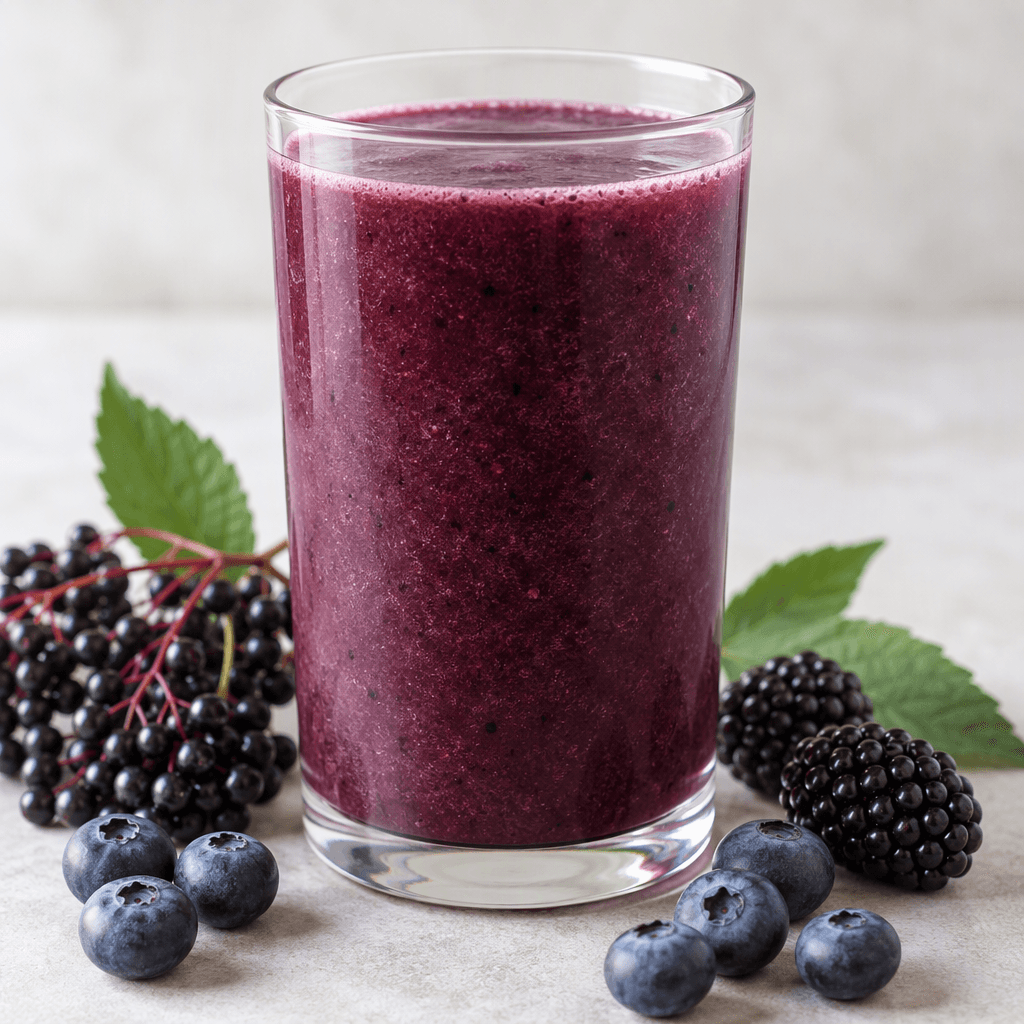
Probiotic drink (black mulberry, elderberry, blueberry) Calories
Fruit-based fermented drink with probiotic cultures
CALORIES
GI
POTASSIUM
FIBER
Quick answer
1 bottle (small) of Probiotic drink (black mulberry, elderberry, blueberry) (250 g) has 10 calories. That works out to 4 calories per 100 g. It contains 1.2 g of carbs, 0.5 g of protein, 0 g of fat and 0 g of fiber. Its 23.8 mg of Vitamin C covers 26% of the Daily Value. Its glycemic index is 38 (low), so it raises blood sugar slowly.
What is Probiotic drink (black mulberry, elderberry, blueberry)?
This probiotic drink is a fruit-based fermented beverage made with black mulberry, elderberry, blueberry and probiotic cultures. The berries give it a fruity flavour, often with a gentle tartness; its sweetness and texture can vary by product.
It is generally served chilled and sipped on its own, or poured into a smoothie or breakfast bowl. At 4 calories per 100 g, it is a very low-energy drink, with almost no fat or carbohydrate. For a simple pairing, try it alongside plain yoghurt or a light breakfast, and follow the label’s storage instructions.
Probiotic drink (black mulberry, elderberry, blueberry) Nutrition Facts
Selected: 100 g
4
KCAL / 100G
Carbs
0.5g
· 0% DV
Protein
0.2g
· 0% DV
Fat
0g
· 0% DV
Fiber
0g
· 0% DV
DV is the share of the daily value covered, on a 2,000 kcal reference diet.
Calories come from: Carbs 71% · Protein 29% · Fat 0%
Probiotic drink (black mulberry, elderberry, blueberry) Vitamins & Minerals
Vitamins
Vitamin C
9.5mg · 11% DV
B12
0.12µg · 5% DV
Vitamin K
6µg · 5% DV
B1
0.03mg · 3% DV
Minerals
Calcium
38mg · 4% DV
Phosphorus
28mg · 4% DV
Potassium ⭐
118mg · 3% DV
Magnesium
8mg · 2% DV
How Nutritious Is Probiotic drink (black mulberry, elderberry, blueberry)?
Nutrient density
Medium
How many vitamins, minerals and how much fiber this food carries per calorie. A high score means a lot of nutrition for few calories.
Satiety score
Medium
An EatBetter score computed from fiber, protein and calorie density. A high score means staying full longer on the same calories.
Both scores are calculated per 100 g and do not change with the selected portion. The satiety score is EatBetter's own calculation, not a clinical measure.
Probiotic drink (black mulberry, elderberry, blueberry) Glycemic Index
GLYCEMIC INDEX
GLYCEMIC LOAD
Accounts for portion size — a more realistic measure than GI alone.
How to Burn Off Probiotic drink (black mulberry, elderberry, blueberry)
To burn the 4 calories in 100 g:
🚶
Walking (5 km/h)
🏃
Running (8 km/h)
🚴
Cycling
🏊
Swimming
Times are calculated with the MET equation for a 70 kg adult. Actual burn varies with your weight, age and pace.
Is Probiotic drink (black mulberry, elderberry, blueberry) Processed?
NOVA 3
Processed
1. Unprocessed
2. Minimally Processed
3. Processed
4. Ultra-Processed
NOVA classifies foods into 4 groups by industrial processing. NOVA 1 (unprocessed) is the healthiest.
Does Probiotic drink (black mulberry, elderberry, blueberry) Contain Allergens?
Contains these allergens:
Which Diets Is Probiotic drink (black mulberry, elderberry, blueberry) Good For?
Vegan
— Not suitable
Vegetarian
✓ Suitable
Gluten-Free
✓ Suitable
Dairy-Free
— Not suitable
Mediterranean
✓ Suitable
Paleo
— Not suitable
Whole30
— Not suitable
DASH
— Not suitable
Keto
— Not suitable
Low FODMAP
— Not suitable
Probiotic drink (black mulberry, elderberry, blueberry) Fat Profile
SATURATED
0.05g
MONOUNSATURATED
0.02g
POLYUNSATURATED
0.04g
Omega 6:3 ratio 3:1
Below the ideal 4:1 — a good omega balance.
Compare Probiotic drink (black mulberry, elderberry, blueberry)
Foods Similar to Probiotic drink (black mulberry, elderberry, blueberry)
Frequently Asked Questions About Probiotic drink (black mulberry, elderberry, blueberry)
What is a probiotic drink with black mulberry, elderberry, and blueberry?
It is a fruit-based drink fermented with probiotic cultures. The exact cultures and whether they remain alive in the bottle depend on the product; it should not be treated as a cure for a health condition.
Does a probiotic drink with black mulberry, elderberry, and blueberry help gut health?
Its probiotic cultures may support the gut microbiota, but effects vary with the cultures used and the amount that remains viable. It is not a treatment for digestive disorders.
When should you drink a probiotic drink with black mulberry, elderberry, and blueberry?
There is no required time of day, and you can drink it with or without food. If fermented drinks bother your stomach, try having it with a meal rather than on an empty stomach.
How much probiotic drink with black mulberry, elderberry, and blueberry should you drink?
A small bottle is about 250 grams, which is a practical serving. There is no universal daily dose for probiotic drinks, so follow the product’s serving guidance and avoid drinking it if it causes discomfort.
What does a probiotic drink with black mulberry, elderberry, and blueberry taste like?
It generally combines fruity berry flavors with the tangy taste that can come from fermentation. The balance of sweetness and tartness varies by recipe, so the flavor may differ between brands.
Does a probiotic drink with black mulberry, elderberry, and blueberry contain added sugar?
The berries do not tell you whether sugar was added, and fermentation can change the drink’s sugars. Check the ingredient list for added sugar; the exact amount depends on the specific product.
Does a probiotic drink with black mulberry, elderberry, and blueberry contain caffeine?
Black mulberry, elderberry, blueberry, and probiotic cultures are not natural caffeine sources. The drink should be caffeine-free unless caffeine is added, which would be listed among the ingredients.
How should you store a probiotic drink with black mulberry, elderberry, and blueberry after opening?
Follow the bottle’s storage directions; if it is sold refrigerated, keep it cold after opening as well. Close the cap, refrigerate it, and use it within the after-opening period stated on the package.
Can you make a probiotic drink with black mulberry, elderberry, and blueberry at home?
Yes, but safe fermentation requires clean equipment and control of time and temperature. Use a starter culture with clear instructions, and discard the batch if you see mold or notice an off smell.
Is a probiotic drink with black mulberry, elderberry, and blueberry safe for people with a milk allergy?
No; this product is identified as containing a dairy allergen, so people with a milk allergy should avoid it. A milk allergy is different from lactose intolerance, and the product’s exact dairy ingredients matter.
Have another question about Probiotic drink (black mulberry, elderberry, blueberry)?
Ask the AI nutrition coach — calories, portions, alternatives and more, answered in seconds in the app.

Scan calories with your camera
Instant AI nutrition analysis

Nutrition data compiled from USDA FoodData Central and scientific sources.