

Ready & Packaged Foods
All →Vegetables & Legumes
All →Desserts & Confectionery
All →Meat & Protein
All →Grains & Bakery
All →Beverages
All →Milk & Dairy
All →

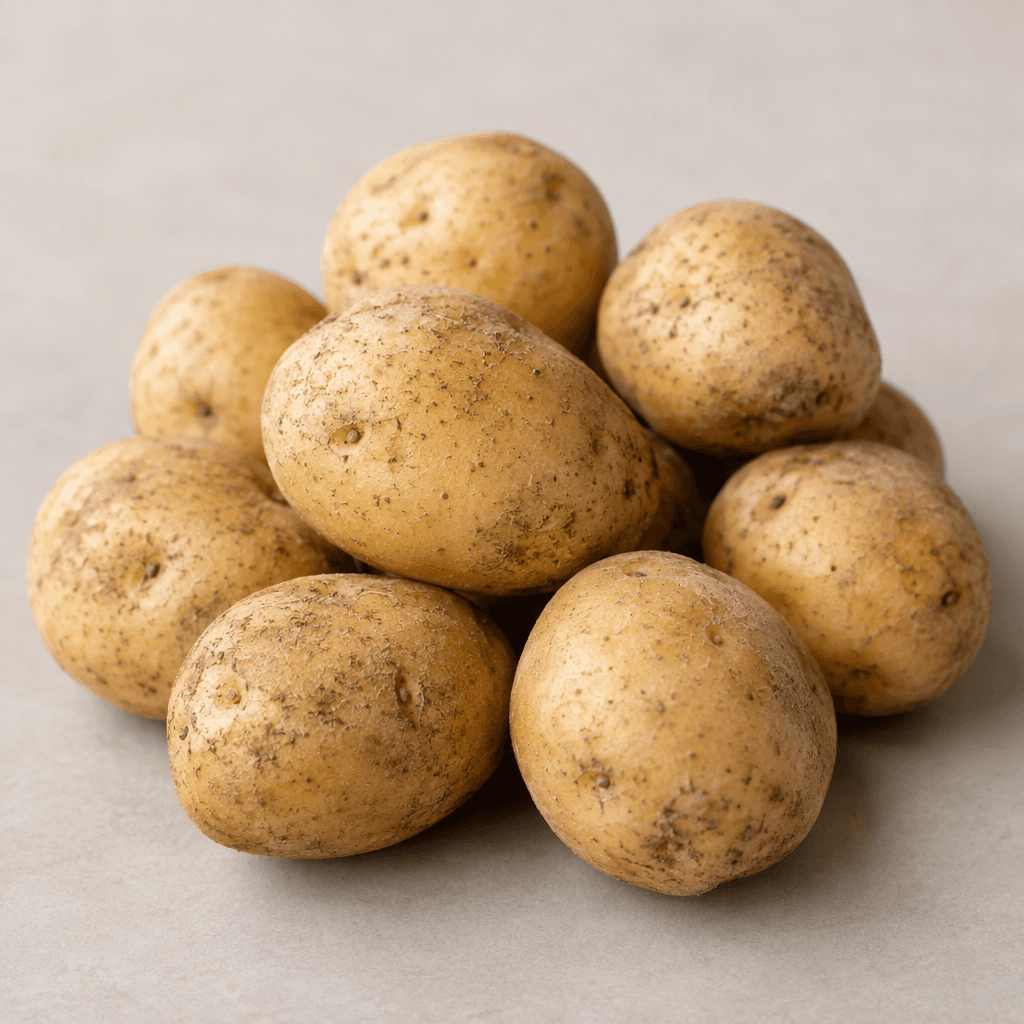
Potato (Small) Calories
Low fat, good potassium source, contains fiber
In season: Spring · Summer · Autumn · Winter
CALORIES
GI
POTASSIUM
FIBER
Quick answer
1 piece (small) of Potato (Small) (80 g) has 62 calories. That works out to 77 calories per 100 g. It contains 14 g of carbs, 1.6 g of protein, 0.1 g of fat and 1.8 g of fiber. Its 15.8 mg of Vitamin C covers 18% of the Daily Value. Its glycemic index is 78 (high), so it raises blood sugar quickly.
What is Potato (Small)?
Small potatoes are the compact tubers of the potato plant, first cultivated in the Andes of South America and now enjoyed around the world. Their thin skins and small size make them handy to cook whole. Boiled, they hold their shape in salads; roasted, they develop a tender centre and a lightly crisp outside. Serve them as a simple side, toss them with herbs, or add them to a tray of vegetables.
They are naturally low in fat and provide carbohydrates, fibre and potassium. For a lighter preparation, boil or roast them with just a little oil rather than deep-frying; they pair well with fresh herbs, a tangy dressing or a main dish of your choice.
Potato (Small) Nutrition Facts
Selected: 100 g
77
KCAL / 100G
Carbs
17.5g
· 6% DV
Protein
2g
· 4% DV
Fat
0.1g
· 0% DV
Fiber
2.2g
· 8% DV
DV is the share of the daily value covered, on a 2,000 kcal reference diet.
Calories come from: Carbs 89% · Protein 10% · Fat 1%
Potato (Small) Vitamins & Minerals
Vitamins
Vitamin C
19.7mg · 22% DV
B6
0.3mg · 18% DV
B1
0.08mg · 7% DV
B3
1.05mg · 7% DV
Minerals
Potassium ⭐
429mg · 13% DV
Phosphorus
44mg · 6% DV
Magnesium
23mg · 5% DV
Calcium
10mg · 1% DV
How Nutritious Is Potato (Small)?
Nutrient density
Medium
How many vitamins, minerals and how much fiber this food carries per calorie. A high score means a lot of nutrition for few calories.
Satiety score
Medium
An EatBetter score computed from fiber, protein and calorie density. A high score means staying full longer on the same calories.
Both scores are calculated per 100 g and do not change with the selected portion. The satiety score is EatBetter's own calculation, not a clinical measure.
Potato (Small) Glycemic Index
GLYCEMIC INDEX
GLYCEMIC LOAD
Accounts for portion size — a more realistic measure than GI alone.
How to Burn Off Potato (Small)
To burn the 77 calories in 100 g:
🚶
Walking (5 km/h)
🏃
Running (8 km/h)
🚴
Cycling
🏊
Swimming
Times are calculated with the MET equation for a 70 kg adult. Actual burn varies with your weight, age and pace.
Is Potato (Small) Processed?
NOVA 1
Unprocessed
1. Unprocessed
2. Minimally Processed
3. Processed
4. Ultra-Processed
NOVA classifies foods into 4 groups by industrial processing. NOVA 1 (unprocessed) is the healthiest.
Does Potato (Small) Contain Allergens?
No known major allergens
Which Diets Is Potato (Small) Good For?
Vegan
✓ Suitable
Vegetarian
✓ Suitable
Gluten-Free
✓ Suitable
Dairy-Free
— Not suitable
Mediterranean
✓ Suitable
Paleo
✓ Suitable
Whole30
— Not suitable
DASH
— Not suitable
Keto
— Not suitable
Low FODMAP
— Not suitable
Potato (Small) Fat Profile
SATURATED
0.03g
MONOUNSATURATED
0.01g
POLYUNSATURATED
0.04g
Omega 6:3 ratio 2:1
Below the ideal 4:1 — a good omega balance.
Compare Potato (Small)
Foods Similar to Potato (Small)
Frequently Asked Questions About Potato (Small)
How do you cook small potatoes?
Small potatoes can be boiled, roasted, steamed, or pan-fried. Keep pieces similar in size so they cook evenly, and test doneness with a fork; it should slide into the potato easily. Their thin skins usually do not need peeling.
Are small potatoes and new potatoes the same?
No. “Small potatoes” describes size, while “new potatoes” are potatoes harvested young, before their skins have fully set. New potatoes are often small, but a small potato can also be a mature potato from a naturally small variety.
Do small potatoes need to be peeled?
No, small potatoes usually do not need peeling. Their skins are thin and edible once the potatoes are washed and cooked. Scrub off dirt under running water, and discard potatoes with green, damaged, or spoiled skin.
How do you roast small potatoes so they get crispy?
Dry the washed potatoes thoroughly, then halve them and toss with a little oil. Arrange them cut-side down in a single layer on a hot baking tray, leaving space between pieces. Roast until browned outside and easily pierced with a fork.
How long do small potatoes take to boil?
Whole small potatoes generally take about 15–20 minutes to boil, though size and variety affect the timing. Start them in cold, salted water and simmer gently. They are ready when a fork reaches the center without resistance.
How should you store small potatoes?
Store small potatoes unwashed in a cool, dark, dry, well-ventilated place, such as a paper bag or open basket. Avoid the refrigerator, which can affect their texture and flavor, and keep them away from onions to help them last longer.
Can you eat small potatoes if they have sprouted?
A firm small potato with just a few tiny sprouts can be used after you cut out the sprouts and the surrounding area. Throw away potatoes that are green, soft, shriveled, or heavily sprouted; green parts can contain harmful natural compounds.
Can you freeze small potatoes?
Yes, but cook small potatoes before freezing them; freezing them raw can leave them watery or grainy. Boil or roast them, let them cool, and pack them airtight. Their texture may soften after thawing, so they work well in soups and casseroles.
Are small potatoes the same as fingerling potatoes?
No. Small potatoes may be round or oval and can come from many varieties; fingerling potatoes are a distinct group known for their narrow, elongated shape. A small potato is not necessarily a fingerling, even if it is similarly sized.
Should you wash small potatoes before cooking them?
Yes. Rinse small potatoes under running water and scrub away any soil, especially if you plan to eat the skins. Wash them just before cooking rather than before storage, since damp potatoes can spoil more quickly.
Have another question about Potato (Small)?
Ask the AI nutrition coach — calories, portions, alternatives and more, answered in seconds in the app.

Scan calories with your camera
Instant AI nutrition analysis

Nutrition data compiled from USDA FoodData Central and scientific sources.