

Ready & Packaged Foods
All →Vegetables & Legumes
All →Desserts & Confectionery
All →Meat & Protein
All →Grains & Bakery
All →Beverages
All →Milk & Dairy
All →

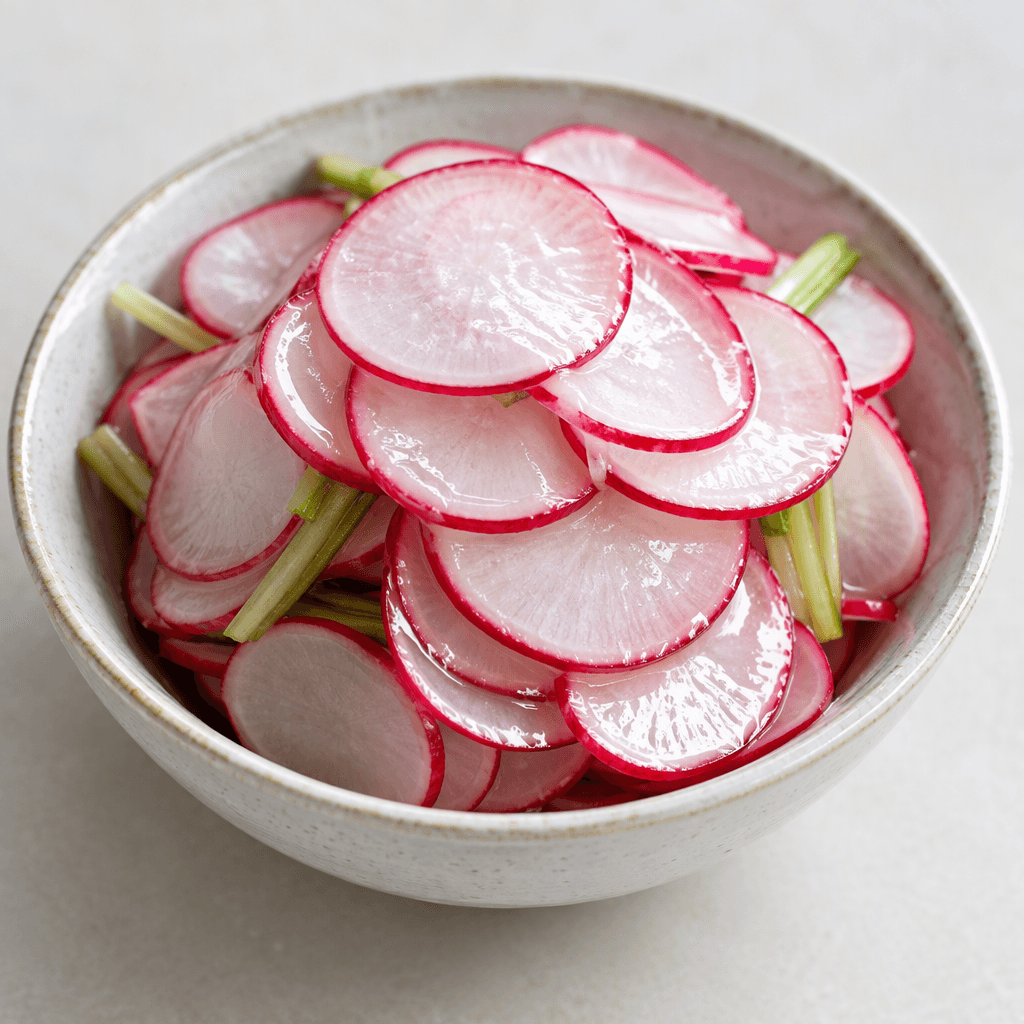
Pickled Radish Calories
Fermented, low calorie, probiotic source
In season: Spring · Autumn · Winter
CALORIES
GI
POTASSIUM
FIBER
Quick answer
1 serving (medium) of Pickled Radish (50 g) has 9 calories. That works out to 18 calories per 100 g. It contains 1.8 g of carbs, 0.3 g of protein, 0.1 g of fat and 0.8 g of fiber. Its 330 mg of Sodium covers 14% of the Daily Value. Its glycemic index is 15 (low), so it raises blood sugar slowly.
What is Pickled Radish?
Pickled radish is made by soaking sliced radish in a salty brine, sometimes with vinegar; when fermented, it develops a tangy, slightly sharp flavour. The slices may stay crisp or soften as they cure, and their colour can deepen in the brine. It is enjoyed in different forms around the world, from homemade jars to restaurant sides.
Serve it alongside rice, grilled foods or sandwiches, or add a few slices to a salad or a savoury snack plate for crunch and acidity. It is a light vegetable accompaniment, with 18 calories per 100 g and some fibre. If the brine tastes especially salty, drain or briefly rinse the radish before serving; its tartness pairs well with rich or mildly flavoured dishes.
Pickled Radish Nutrition Facts
Selected: 100 g
18
KCAL / 100G
Carbs
3.5g
· 1% DV
Protein
0.6g
· 1% DV
Fat
0.1g
· 0% DV
Fiber
1.6g
· 6% DV
DV is the share of the daily value covered, on a 2,000 kcal reference diet.
Calories come from: Carbs 81% · Protein 14% · Fat 5%
Pickled Radish Vitamins & Minerals
Vitamins
Vitamin C
13mg · 14% DV
Folate
26µg · 7% DV
B5
0.18mg · 4% DV
B6
0.07mg · 4% DV
Minerals
Sodium
660mg · 29% DV
Potassium ⭐
180mg · 5% DV
Calcium
25mg · 3% DV
Phosphorus
22mg · 3% DV
How Nutritious Is Pickled Radish?
Nutrient density
High
How many vitamins, minerals and how much fiber this food carries per calorie. A high score means a lot of nutrition for few calories.
Satiety score
Medium
An EatBetter score computed from fiber, protein and calorie density. A high score means staying full longer on the same calories.
Both scores are calculated per 100 g and do not change with the selected portion. The satiety score is EatBetter's own calculation, not a clinical measure.
Pickled Radish Glycemic Index
GLYCEMIC INDEX
GLYCEMIC LOAD
Accounts for portion size — a more realistic measure than GI alone.
How to Burn Off Pickled Radish
To burn the 18 calories in 100 g:
🚶
Walking (5 km/h)
🏃
Running (8 km/h)
🚴
Cycling
🏊
Swimming
Times are calculated with the MET equation for a 70 kg adult. Actual burn varies with your weight, age and pace.
Is Pickled Radish Processed?
NOVA 3
Processed
1. Unprocessed
2. Minimally Processed
3. Processed
4. Ultra-Processed
NOVA classifies foods into 4 groups by industrial processing. NOVA 1 (unprocessed) is the healthiest.
Does Pickled Radish Contain Allergens?
No known major allergens
Which Diets Is Pickled Radish Good For?
Vegan
✓ Suitable
Vegetarian
✓ Suitable
Gluten-Free
✓ Suitable
Dairy-Free
— Not suitable
Mediterranean
✓ Suitable
Paleo
✓ Suitable
Whole30
— Not suitable
DASH
— Not suitable
Keto
— Not suitable
Low FODMAP
— Not suitable
Pickled Radish Fat Profile
SATURATED
0.02g
MONOUNSATURATED
0.01g
POLYUNSATURATED
0.02g
Omega 6:3 ratio 1:1
Below the ideal 4:1 — a good omega balance.
Compare Pickled Radish
Foods Similar to Pickled Radish
Frequently Asked Questions About Pickled Radish
What does pickled radish taste like?
Pickled radish tastes tangy, salty, and crisp, with a peppery note from the fresh radish. Its flavor varies with the brine: vinegar makes it sharply sour, while natural fermentation develops a mellower, more complex tang.
How do you make pickled radish?
Pickled radish is made by covering clean radish slices with a salt brine, often with garlic, and letting them pickle. Some recipes use vinegar for a quicker result; naturally fermented versions sour as beneficial microbes develop.
How long does pickled radish last in the fridge?
Pickled radish keeps longer when refrigerated and submerged in its brine. Use a clean utensil each time, and discard it if you see mold or notice an off smell or an unusually slimy texture.
Is pickled radish fermented?
Some pickled radish is fermented, but not all of it. Radish left to sour in a salt brine ferments naturally; a quick pickle made with vinegar gets its acidity from the vinegar instead.
Why does pickled radish turn pink?
Pickled radish can turn pink when pigment from the red skin leaches into the brine. The color is especially noticeable with thin slices and, by itself, does not mean the radish has spoiled.
Can you freeze pickled radish?
You can freeze pickled radish, but it usually loses its crisp texture as it thaws. For a crunchy result, keep it refrigerated in its brine rather than freezing it.
Why is my pickled radish soft?
Pickled radish often becomes soft if it ferments for too long in a warm place or starts with older radishes. Use firm, fresh radishes and refrigerate the jar once the flavor is as tangy as you like.
What can you serve with pickled radish?
Pickled radish pairs well with rich or savory foods, including grilled meats, rice dishes, and sandwiches. Its sharp, salty acidity adds contrast rather than making a meal taste heavier.
Can you eat pickled radish straight from the jar?
Yes, you can eat pickled radish straight from the jar as a side or topping. Because the brine can be salty, a small serving is often enough to add a sharp, crunchy contrast to a meal.
Is pickled radish the same as daikon?
No. Daikon is a type of large white radish, while pickled radish is a preparation that can be made from different radishes, including daikon. The variety and brine determine its flavor and texture.
Have another question about Pickled Radish?
Ask the AI nutrition coach — calories, portions, alternatives and more, answered in seconds in the app.

Scan calories with your camera
Instant AI nutrition analysis

Nutrition data compiled from USDA FoodData Central and scientific sources.