

Ready & Packaged Foods
All →Vegetables & Legumes
All →Desserts & Confectionery
All →Meat & Protein
All →Grains & Bakery
All →Beverages
All →Milk & Dairy
All →

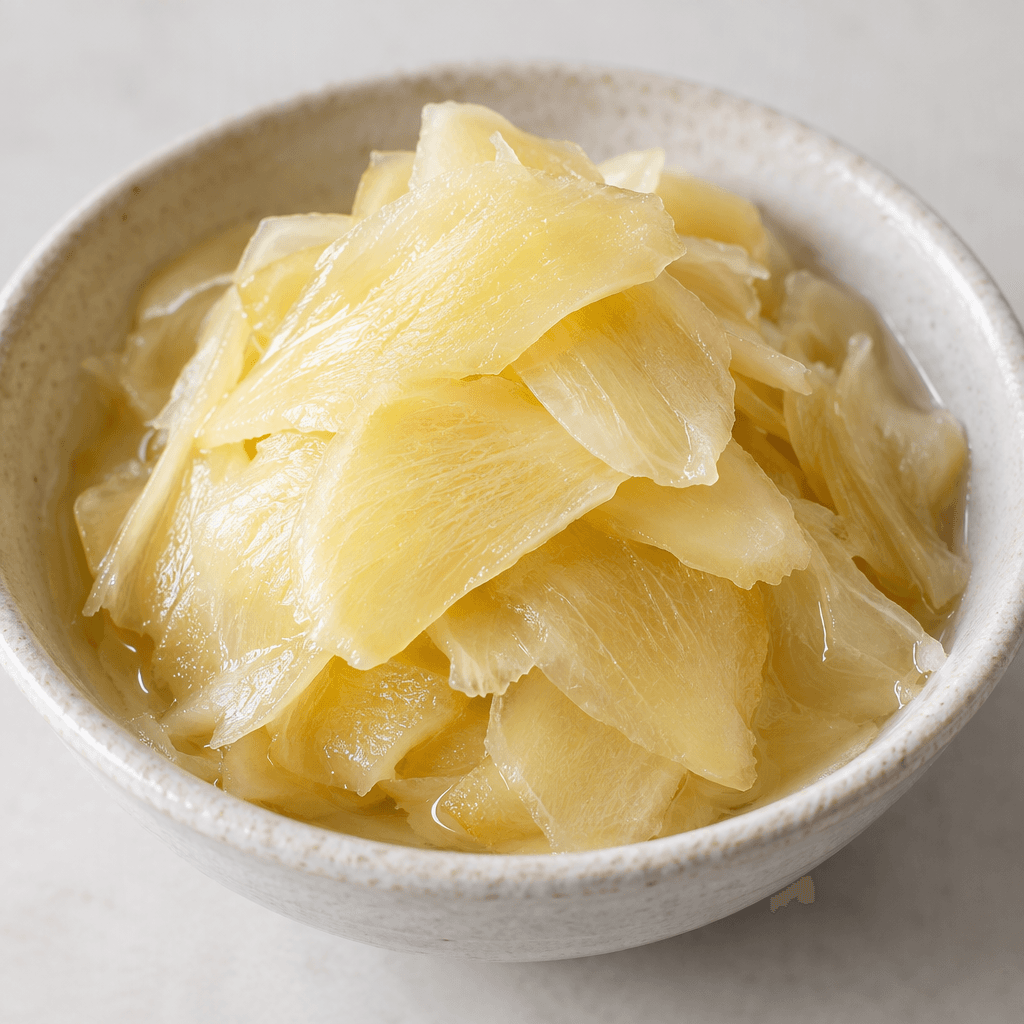
Pickled Ginger Calories
Refreshing, low-calorie, antioxidant-rich pickled ginger for sushi
In season: Spring · Summer · Autumn · Winter
CALORIES
GI
POTASSIUM
FIBER
Quick answer
1 tablespoon (medium) of Pickled Ginger (15 g) has 9 calories. That works out to 60 calories per 100 g. It contains 2 g of carbs, 0.1 g of protein, 0 g of fat and 0.2 g of fiber. Its glycemic index is 35 (low), so it raises blood sugar slowly.
What is Pickled Ginger?
Pickled ginger is thinly sliced ginger preserved in a sweet-tart vinegar brine. In Japanese cooking, it is commonly known as gari; the slices are often pale ivory or yellow, with a delicate, slightly fibrous texture.
Its sharp, refreshing flavour is served alongside sushi, where it offers a bright contrast between bites, and it also pairs well with rice bowls and other Asian dishes. Outside Japan, it is readily found at sushi restaurants and in shops selling Asian ingredients. Pickled ginger is low in fat, though the brine can add sugar. Use a small serving to complement a meal, or pair it with plain rice and vegetables for a lighter plate.
Pickled Ginger Nutrition Facts
Selected: 100 g
60
KCAL / 100G
Carbs
13.5g
· 5% DV
Protein
0.8g
· 2% DV
Fat
0.2g
· 0% DV
Fiber
1.2g
· 4% DV
DV is the share of the daily value covered, on a 2,000 kcal reference diet.
Calories come from: Carbs 92% · Protein 5% · Fat 3%
Pickled Ginger Vitamins & Minerals
Vitamins
B6
0.06mg · 4% DV
Vitamin C
4mg · 4% DV
B5
0.15mg · 3% DV
B1
0.02mg · 2% DV
Minerals
Sodium
570mg · 25% DV
Iron
1mg · 6% DV
Magnesium
11mg · 3% DV
Phosphorus
19mg · 3% DV
How Nutritious Is Pickled Ginger?
Nutrient density
Medium
How many vitamins, minerals and how much fiber this food carries per calorie. A high score means a lot of nutrition for few calories.
Satiety score
Medium
An EatBetter score computed from fiber, protein and calorie density. A high score means staying full longer on the same calories.
Both scores are calculated per 100 g and do not change with the selected portion. The satiety score is EatBetter's own calculation, not a clinical measure.
Pickled Ginger Glycemic Index
GLYCEMIC INDEX
GLYCEMIC LOAD
Accounts for portion size — a more realistic measure than GI alone.
How to Burn Off Pickled Ginger
To burn the 60 calories in 100 g:
🚶
Walking (5 km/h)
🏃
Running (8 km/h)
🚴
Cycling
🏊
Swimming
Times are calculated with the MET equation for a 70 kg adult. Actual burn varies with your weight, age and pace.
Is Pickled Ginger Processed?
NOVA 3
Processed
1. Unprocessed
2. Minimally Processed
3. Processed
4. Ultra-Processed
NOVA classifies foods into 4 groups by industrial processing. NOVA 1 (unprocessed) is the healthiest.
Does Pickled Ginger Contain Allergens?
No known major allergens
Which Diets Is Pickled Ginger Good For?
Vegan
✓ Suitable
Vegetarian
✓ Suitable
Gluten-Free
✓ Suitable
Dairy-Free
— Not suitable
Mediterranean
✓ Suitable
Paleo
✓ Suitable
Whole30
— Not suitable
DASH
— Not suitable
Keto
— Not suitable
Low FODMAP
— Not suitable
Pickled Ginger Fat Profile
SATURATED
0.05g
MONOUNSATURATED
0.03g
POLYUNSATURATED
0.03g
Omega 6:3 ratio 2:1
Below the ideal 4:1 — a good omega balance.
Compare Pickled Ginger
Foods Similar to Pickled Ginger
Frequently Asked Questions About Pickled Ginger
Why is Pickled Ginger served with sushi?
Pickled Ginger is served between sushi pieces to refresh the palate, so the flavors of the next piece are easier to distinguish. It is usually eaten on its own between bites rather than placed on top of sushi.
What is Pickled Ginger made of?
Pickled Ginger is made by thinly slicing ginger and marinating it in a vinegar mixture, often with salt and sugar. The Japanese sushi accompaniment called gari is a well-known style; it is pickled, not the same as fermented cabbage.
How do you eat Pickled Ginger?
Eat Pickled Ginger in small bites, traditionally between pieces of sushi. You can also add the slices to salads, sandwiches, noodle dishes, or fish; its sharp, tangy flavor can overwhelm a dish if you use too much.
Why is Pickled Ginger sometimes pink?
Pickled Ginger can turn naturally pink when pigments in young ginger react with acidic vinegar. Some makers add coloring instead. A pink hue alone does not mean the ginger has spoiled; look for signs such as mold or an off smell.
Can you make Pickled Ginger at home?
Yes. Thinly slice peeled ginger, cover it with a hot mixture of vinegar, salt, and optionally sugar, then let it cool in a clean jar. Keep homemade Pickled Ginger refrigerated and use clean utensils when serving it.
What does Pickled Ginger taste like?
Pickled Ginger tastes tangy and aromatic, often with a touch of sweetness and ginger’s characteristic sharpness. Thin slices made from young ginger tend to be more delicate, while ginger from more mature roots can taste stronger and feel more fibrous.
What can you use instead of Pickled Ginger with sushi?
Thinly sliced fresh ginger briefly marinated in vinegar is the closest easy substitute for Pickled Ginger. Fresh ginger alone is sharper and lacks the pickle’s tangy-sweet flavor, so it will not taste exactly like sushi gari.
How long does Pickled Ginger last after opening?
Keep opened Pickled Ginger tightly sealed in the refrigerator, with the slices covered by their brine. Use a clean utensil to remove portions. Discard it if you see mold, notice an unpleasant smell, or observe other clear signs of spoilage.
Can Pickled Ginger help with digestion?
Pickled Ginger is often eaten as a palate cleanser, but it should not be relied on to treat digestive problems. Its vinegar and ginger flavor may bother people prone to reflux or stomach irritation, particularly when eaten in large amounts.
Can you cook with Pickled Ginger?
Yes. Add Pickled Ginger to salads, sandwiches, noodle bowls, or fish dishes for a bright, tangy flavor. For a more noticeable fresh aroma, stir it in near the end of cooking rather than simmering it for a long time.
Have another question about Pickled Ginger?
Ask the AI nutrition coach — calories, portions, alternatives and more, answered in seconds in the app.

Scan calories with your camera
Instant AI nutrition analysis

Nutrition data compiled from USDA FoodData Central and scientific sources.