

Ready & Packaged Foods
All →Vegetables & Legumes
All →Desserts & Confectionery
All →Meat & Protein
All →Grains & Bakery
All →Beverages
All →Milk & Dairy
All →

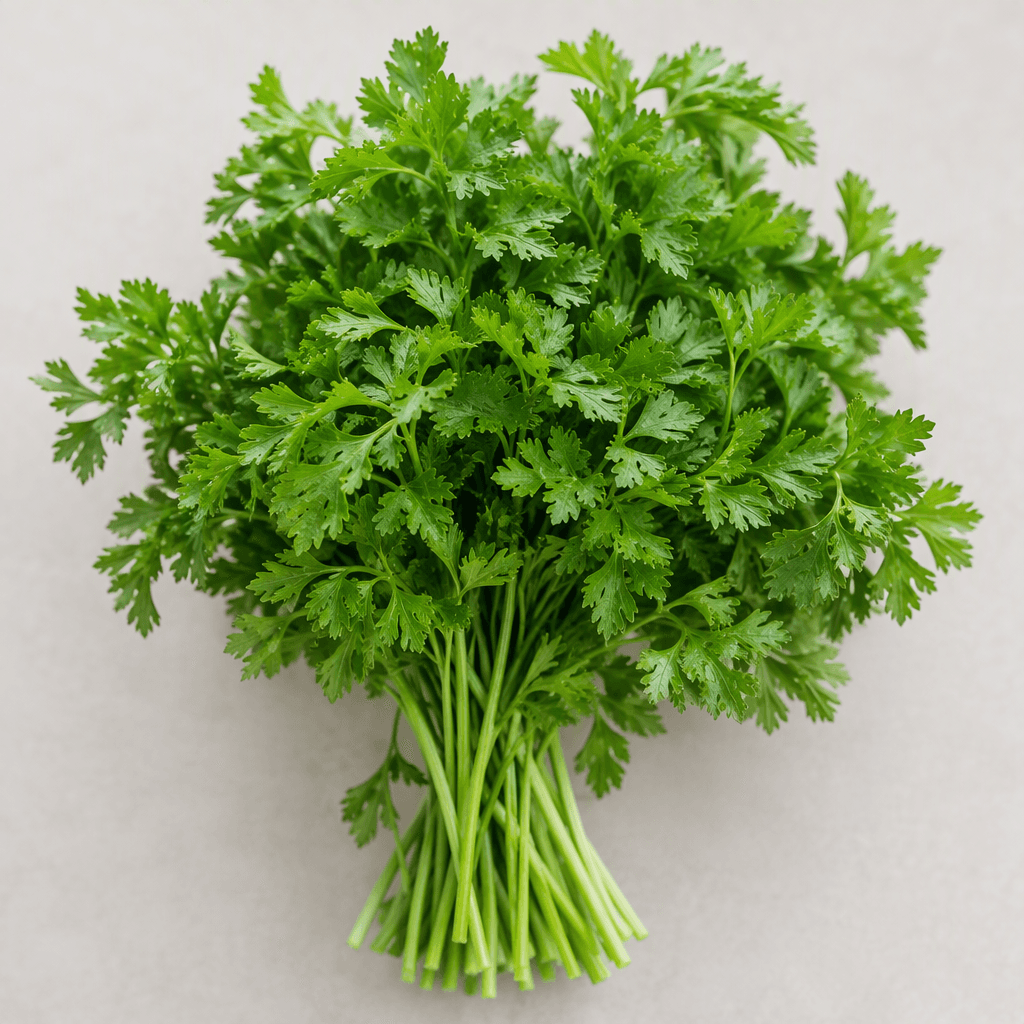
Parsley (Fresh) Calories
Very high in vitamin C and K, low calorie, antioxidant source
In season: Spring · Summer · Autumn · Winter
CALORIES
GI
POTASSIUM
FIBER
Quick answer
1 tablespoon (chopped) of Parsley (Fresh) (4 g) has 1 calories. That works out to 36 calories per 100 g. It contains 0.3 g of carbs, 0.1 g of protein, 0 g of fat and 0.1 g of fiber. Its 65.6 µg of Vitamin K covers 55% of the Daily Value. Its glycemic index is 5 (low), so it raises blood sugar slowly.
What is Parsley (Fresh)?
Fresh parsley has slender stems and clusters of deeply cut green leaves. Although often treated as a garnish, it is an aromatic herb used in cooking across the Mediterranean, the Middle East and beyond. Its flavour is clean and grassy, with a gentle peppery edge; the leaves are tender when raw and soften in hot dishes.
Chop it into salads, sauces, soups and grain dishes, or scatter it over eggs, roasted vegetables and fish just before serving. It is especially familiar in tabbouleh and Mediterranean herb sauces, while the stems can flavour stocks. Parsley is low in calories and provides fibre as well as vitamins C and K. For the brightest flavour and colour, add most of it near the end of cooking or use it fresh with lemon.
Parsley (Fresh) Nutrition Facts
Selected: 100 g
36
KCAL / 100G
Carbs
6.3g
· 2% DV
Protein
3g
· 6% DV
Fat
0.8g
· 1% DV
Fiber
3.3g
· 12% DV
DV is the share of the daily value covered, on a 2,000 kcal reference diet.
Calories come from: Carbs 57% · Protein 27% · Fat 16%
Parsley (Fresh) Vitamins & Minerals
Vitamins
Vitamin K
1640µg · 1367% DV
Vitamin C
133mg · 148% DV
Vitamin A
842µg · 94% DV
Folate
152µg · 38% DV
Minerals
Iron
6mg · 33% DV
Potassium ⭐
554mg · 16% DV
Calcium
138mg · 14% DV
Magnesium
50mg · 12% DV
How Nutritious Is Parsley (Fresh)?
Nutrient density
Very high
How many vitamins, minerals and how much fiber this food carries per calorie. A high score means a lot of nutrition for few calories.
Satiety score
Medium
An EatBetter score computed from fiber, protein and calorie density. A high score means staying full longer on the same calories.
Both scores are calculated per 100 g and do not change with the selected portion. The satiety score is EatBetter's own calculation, not a clinical measure.
Parsley (Fresh) Glycemic Index
GLYCEMIC INDEX
GLYCEMIC LOAD
Accounts for portion size — a more realistic measure than GI alone.
How to Burn Off Parsley (Fresh)
To burn the 36 calories in 100 g:
🚶
Walking (5 km/h)
🏃
Running (8 km/h)
🚴
Cycling
🏊
Swimming
Times are calculated with the MET equation for a 70 kg adult. Actual burn varies with your weight, age and pace.
Is Parsley (Fresh) Processed?
NOVA 1
Unprocessed
1. Unprocessed
2. Minimally Processed
3. Processed
4. Ultra-Processed
NOVA classifies foods into 4 groups by industrial processing. NOVA 1 (unprocessed) is the healthiest.
Does Parsley (Fresh) Contain Allergens?
No known major allergens
Which Diets Is Parsley (Fresh) Good For?
Vegan
✓ Suitable
Vegetarian
✓ Suitable
Gluten-Free
✓ Suitable
Dairy-Free
— Not suitable
Mediterranean
✓ Suitable
Paleo
✓ Suitable
Whole30
— Not suitable
DASH
— Not suitable
Keto
✓ Suitable
Low FODMAP
— Not suitable
Parsley (Fresh) Fat Profile
SATURATED
0.14g
MONOUNSATURATED
0.22g
POLYUNSATURATED
0.23g
Omega 6:3 ratio 0.6:1
Below the ideal 4:1 — a good omega balance.
Compare Parsley (Fresh)
Foods Similar to Parsley (Fresh)
Frequently Asked Questions About Parsley (Fresh)
How do you store fresh parsley so it stays fresh?
Keep fresh parsley in the refrigerator with the stems in a little water, or wrap it loosely in a damp paper towel and place it in a container. Remove yellow or slimy leaves, and avoid storing the bunch while wet, which speeds spoilage.
Can you freeze fresh parsley?
Yes, fresh parsley freezes well for cooked dishes. Wash and dry it thoroughly, chop it, and pack it in an airtight freezer bag or container. Its leaves will soften after thawing, so use frozen parsley in soups, sauces, and stews rather than as a fresh garnish.
How do you wash fresh parsley properly?
Rinse fresh parsley under cool running water, separating the leaves so you can remove grit trapped in their folds. Dry it thoroughly with a clean towel or salad spinner before chopping. Dry leaves keep better in the fridge and are easier to chop neatly.
Can you eat parsley stems?
Yes, parsley stems are edible and have a stronger flavor than the leaves. Finely chop the tender upper stems for salads, sauces, or soups. The thicker lower ends can be woody, so save them for stock or discard them if their texture is unpleasant.
What is the difference between flat-leaf and curly parsley?
Flat-leaf parsley has broader leaves and a more pronounced flavor, making it a common choice for chopping into dishes. Curly parsley has tightly ruffled leaves and is often used as a garnish. Either type works in most recipes; choose based on flavor and texture.
Can you use parsley instead of cilantro?
Yes, parsley can replace cilantro when you need a leafy garnish, but the flavor will be different. Parsley tastes fresh and grassy, while cilantro has a more distinctive citrusy, sometimes soapy flavor. Add parsley with lemon or lime if you want a brighter finish.
Should fresh parsley be added before or after cooking?
Add fresh parsley near the end of cooking or just before serving to preserve its bright aroma. Long cooking dulls its flavor. If a recipe calls for parsley in a stock or stew, you can simmer the stems for flavor and add chopped leaves at the end.
How do you chop fresh parsley without bruising it?
Dry the parsley completely, gather the leaves into a loose bundle, and use a sharp knife to chop with smooth strokes. Avoid repeatedly crushing or rocking the knife over the leaves, which can bruise them and make them damp. Chop just before adding to a dish.
Can you eat fresh parsley raw?
Yes, fresh parsley is commonly eaten raw in salads, sandwiches, and as a garnish. Wash it carefully first, since soil can cling to the leaves and stems. Its fresh, peppery flavor also pairs well with lemon, tomatoes, and olive oil.
What dishes is fresh parsley best used in?
Fresh parsley works especially well in tabbouleh, chimichurri, salsa verde, salads, and as a finishing herb for soups or roasted vegetables. Add it near the end when you want its fresh flavor to stand out; use the stems to flavor stocks and broths.
Have another question about Parsley (Fresh)?
Ask the AI nutrition coach — calories, portions, alternatives and more, answered in seconds in the app.

Scan calories with your camera
Instant AI nutrition analysis

Nutrition data compiled from USDA FoodData Central and scientific sources.