

Ready & Packaged Foods
All →Vegetables & Legumes
All →Desserts & Confectionery
All →Meat & Protein
All →Grains & Bakery
All →Beverages
All →Milk & Dairy
All →

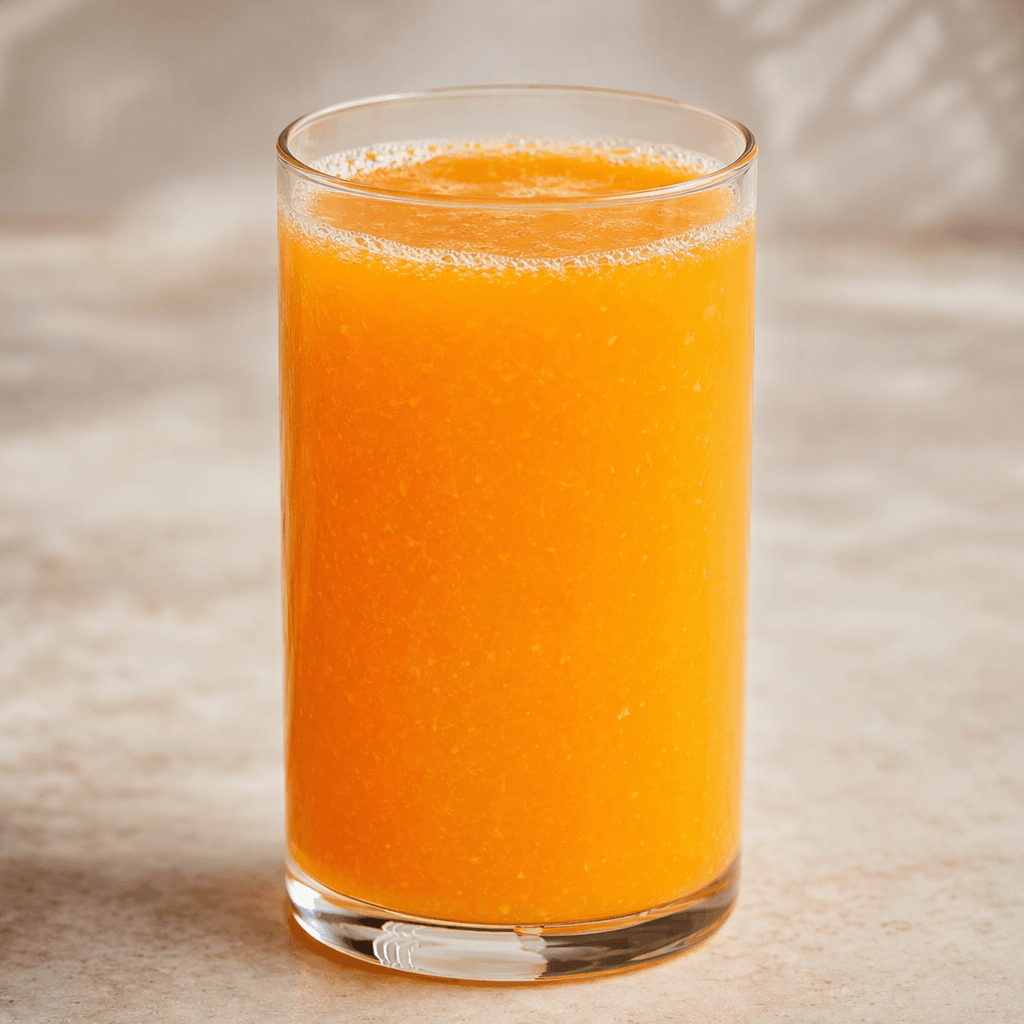
Orange Juice Calories
High in vitamin C, refreshing, contains natural sugars
In season: Winter · Spring
CALORIES
GI
POTASSIUM
FIBER
Quick answer
1 cup (medium) of Orange Juice (240 g) has 108 calories. That works out to 45 calories per 100 g. It contains 25 g of carbs, 1.7 g of protein, 0.5 g of fat and 0.5 g of fiber. Its 120 mg of Vitamin C covers 133% of the Daily Value. Its glycemic index is 50 (medium), so it raises blood sugar at a moderate pace.
What is Orange Juice?
Orange juice is made by squeezing oranges, and may contain fine bits of pulp. It can be freshly squeezed at home or bought ready to drink. Its flavour ranges from sweet to pleasantly tart, depending on the oranges, while pulp gives it a slightly fuller texture.
Served chilled, it is a familiar breakfast and brunch drink in many places, often poured alongside eggs, toast or other morning foods; it also works as a simple refreshment on its own. Orange juice provides vitamin C and natural sugars, with 45 calories per 100 g. For a more filling choice, have a whole orange instead, or check the label for added sugar when buying packaged juice.
Orange Juice Nutrition Facts
Selected: 100 g
45
KCAL / 100G
Carbs
10.4g
· 4% DV
Protein
0.7g
· 1% DV
Fat
0.2g
· 0% DV
Fiber
0.2g
· 1% DV
DV is the share of the daily value covered, on a 2,000 kcal reference diet.
Calories come from: Carbs 90% · Protein 6% · Fat 4%
Orange Juice Vitamins & Minerals
Vitamins
Vitamin C
50mg · 56% DV
B1
0.09mg · 8% DV
Folate
30µg · 8% DV
B5
0.2mg · 4% DV
Minerals
Potassium ⭐
200mg · 6% DV
Magnesium
10mg · 2% DV
Phosphorus
17mg · 2% DV
Calcium
11mg · 1% DV
How Nutritious Is Orange Juice?
Nutrient density
High
How many vitamins, minerals and how much fiber this food carries per calorie. A high score means a lot of nutrition for few calories.
Satiety score
Medium
An EatBetter score computed from fiber, protein and calorie density. A high score means staying full longer on the same calories.
Both scores are calculated per 100 g and do not change with the selected portion. The satiety score is EatBetter's own calculation, not a clinical measure.
Orange Juice Glycemic Index
GLYCEMIC INDEX
GLYCEMIC LOAD
Accounts for portion size — a more realistic measure than GI alone.
How to Burn Off Orange Juice
To burn the 45 calories in 100 g:
🚶
Walking (5 km/h)
🏃
Running (8 km/h)
🚴
Cycling
🏊
Swimming
Times are calculated with the MET equation for a 70 kg adult. Actual burn varies with your weight, age and pace.
Is Orange Juice Processed?
NOVA 2
Minimally Processed
1. Unprocessed
2. Minimally Processed
3. Processed
4. Ultra-Processed
NOVA classifies foods into 4 groups by industrial processing. NOVA 1 (unprocessed) is the healthiest.
Does Orange Juice Contain Allergens?
No known major allergens
Which Diets Is Orange Juice Good For?
Vegan
✓ Suitable
Vegetarian
✓ Suitable
Gluten-Free
✓ Suitable
Dairy-Free
— Not suitable
Mediterranean
✓ Suitable
Paleo
— Not suitable
Whole30
— Not suitable
DASH
— Not suitable
Keto
— Not suitable
Low FODMAP
— Not suitable
Orange Juice Fat Profile
SATURATED
0.02g
MONOUNSATURATED
0.03g
POLYUNSATURATED
0.04g
Omega 6:3 ratio 1:1
Below the ideal 4:1 — a good omega balance.
Compare Orange Juice
Foods Similar to Orange Juice
Frequently Asked Questions About Orange Juice
Is Orange Juice good for you?
Yes, Orange Juice provides vitamin C and can be a refreshing drink. It has much less fiber than a whole orange, though, so eating the fruit is usually more filling and keeps more of its natural fiber.
Does Orange Juice have a lot of sugar?
Yes, Orange Juice contains naturally occurring sugars, even when nothing has been added. Its sweetness can make it easy to drink the juice of several oranges quickly, so check whether a smaller serving better suits your usual intake.
Is Orange Juice healthier than eating an orange?
A whole orange is usually more filling because it retains its fiber and takes longer to eat. Orange Juice still supplies vitamin C, but drinking it is less satisfying for many people than eating the fruit.
How long does fresh Orange Juice last in the fridge?
Fresh Orange Juice is best refrigerated in a sealed container and consumed promptly, ideally the same day. Its flavor and freshness fade as it sits; discard it if its smell or appearance changes, and do not leave it out for extended periods.
Can you freeze Orange Juice?
Yes, Orange Juice can be frozen in a freezer-safe container with room for expansion. The pulp may separate after thawing, so stir it before drinking, thaw it in the refrigerator, and do not refreeze juice that has already thawed.
Why does fresh Orange Juice taste bitter?
Fresh Orange Juice can taste bitter when bitter compounds from the white pith or seeds get into it. Remove seeds and avoid pressing the peel too hard when squeezing; drinking the juice soon after preparation also preserves its fresher flavor.
Is pulp in Orange Juice good for you?
Yes, pulp adds some of the orange’s fiber and gives Orange Juice a thicker texture. It does not make juice equivalent to a whole orange, which retains more fiber and is generally more filling.
Can people with diabetes drink Orange Juice?
People with diabetes can include Orange Juice in some meal plans, but its natural sugars can raise blood glucose. Serving size and individual response matter, so discuss an appropriate amount with your clinician or dietitian if you need personalized guidance.
Does Orange Juice help you stay hydrated?
Yes, Orange Juice contributes fluid and can help with hydration. Water is still the simplest everyday drink, while juice is better treated as a flavorful addition rather than your main source of fluids.
Can Orange Juice cause heartburn?
Yes, Orange Juice may trigger heartburn in people who are sensitive to acidic drinks. If you notice symptoms, try having it with food or avoiding it; persistent or severe heartburn warrants medical advice.
Have another question about Orange Juice?
Ask the AI nutrition coach — calories, portions, alternatives and more, answered in seconds in the app.

Scan calories with your camera
Instant AI nutrition analysis

Nutrition data compiled from USDA FoodData Central and scientific sources.