

Ready & Packaged Foods
All →Vegetables & Legumes
All →Desserts & Confectionery
All →Meat & Protein
All →Grains & Bakery
All →Beverages
All →Milk & Dairy
All →

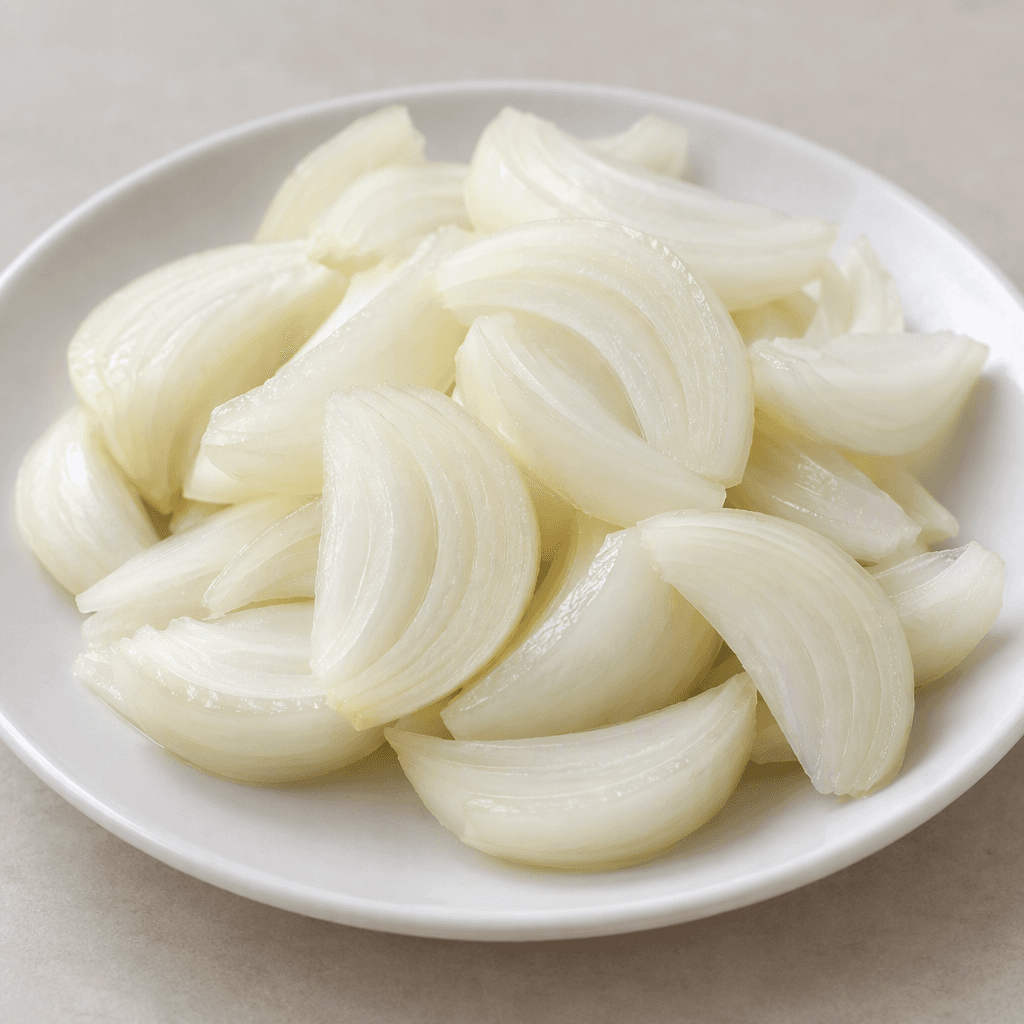
Onion (Boiled) Calories
Low calorie, source of fiber, contains vitamin C
In season: Spring · Summer · Autumn · Winter
CALORIES
GI
POTASSIUM
FIBER
Quick answer
1 piece (medium) of Onion (Boiled) (80 g) has 30 calories. That works out to 38 calories per 100 g. It contains 6.9 g of carbs, 0.9 g of protein, 0.1 g of fat and 1.4 g of fiber. Its 0.1 mg of B6 covers 6% of the Daily Value. Its glycemic index is 15 (low), so it raises blood sugar slowly.
What is Onion (Boiled)?
Boiled onion is onion cooked in water, either whole or cut into pieces, until its layered flesh turns soft and translucent. The flavour becomes milder and gently sweet compared with raw onion, and the pieces are easy to fold into other dishes.
Across many cuisines, it is used in soups, stews and broths, or served as a simple side; the cooking liquid can add savoury sweetness to a dish. It is very low in fat and provides fibre, with 1.7 g per 100 g. Pair it with beans, lentils or other vegetables for a more substantial meal, or use it to add flavour to a lighter soup without relying on much oil.
Onion (Boiled) Nutrition Facts
Selected: 100 g
38
KCAL / 100G
Carbs
8.6g
· 3% DV
Protein
1.1g
· 2% DV
Fat
0.1g
· 0% DV
Fiber
1.7g
· 6% DV
DV is the share of the daily value covered, on a 2,000 kcal reference diet.
Calories come from: Carbs 87% · Protein 11% · Fat 2%
Onion (Boiled) Vitamins & Minerals
Vitamins
B6
0.13mg · 8% DV
Vitamin C
6.5mg · 7% DV
Folate
19µg · 5% DV
B1
0.04mg · 3% DV
Minerals
Phosphorus
29mg · 4% DV
Potassium ⭐
146mg · 4% DV
Calcium
23mg · 2% DV
Magnesium
9mg · 2% DV
How Nutritious Is Onion (Boiled)?
Nutrient density
Medium
How many vitamins, minerals and how much fiber this food carries per calorie. A high score means a lot of nutrition for few calories.
Satiety score
Medium
An EatBetter score computed from fiber, protein and calorie density. A high score means staying full longer on the same calories.
Both scores are calculated per 100 g and do not change with the selected portion. The satiety score is EatBetter's own calculation, not a clinical measure.
Onion (Boiled) Glycemic Index
GLYCEMIC INDEX
GLYCEMIC LOAD
Accounts for portion size — a more realistic measure than GI alone.
How to Burn Off Onion (Boiled)
To burn the 38 calories in 100 g:
🚶
Walking (5 km/h)
🏃
Running (8 km/h)
🚴
Cycling
🏊
Swimming
Times are calculated with the MET equation for a 70 kg adult. Actual burn varies with your weight, age and pace.
Is Onion (Boiled) Processed?
NOVA 2
Minimally Processed
1. Unprocessed
2. Minimally Processed
3. Processed
4. Ultra-Processed
NOVA classifies foods into 4 groups by industrial processing. NOVA 1 (unprocessed) is the healthiest.
Does Onion (Boiled) Contain Allergens?
No known major allergens
Which Diets Is Onion (Boiled) Good For?
Vegan
✓ Suitable
Vegetarian
✓ Suitable
Gluten-Free
✓ Suitable
Dairy-Free
— Not suitable
Mediterranean
✓ Suitable
Paleo
✓ Suitable
Whole30
— Not suitable
DASH
— Not suitable
Keto
— Not suitable
Low FODMAP
— Not suitable
Onion (Boiled) Fat Profile
SATURATED
0.02g
MONOUNSATURATED
0.01g
POLYUNSATURATED
0.03g
Omega 6:3 ratio 2:1
Below the ideal 4:1 — a good omega balance.
Compare Onion (Boiled)
Foods Similar to Onion (Boiled)
Frequently Asked Questions About Onion (Boiled)
Is boiled onion good for you?
Yes, boiled onion can be a nutritious addition to meals, providing fibre and vitamin C while becoming mild and soft when cooked. It is a food, not a remedy, and does not prevent or treat disease on its own.
Does boiling onion destroy its nutrients?
No, boiling does not destroy all the nutrients in onion, but some vitamin C can be lost through heat and pass into the cooking water. Use the broth in soups or sauces if you want to retain nutrients that leach out.
How do you boil an onion?
To boil an onion, peel it and cook it whole or in pieces in water until tender. Smaller pieces soften sooner; drain them for a side dish, or keep the cooking liquid to add mild onion flavour to another recipe.
Does boiled onion cause gas?
Yes, boiled onion can still cause gas or bloating in some people. Onions contain fermentable carbohydrates that may trigger symptoms, and boiling softens the onion but does not reliably remove those compounds.
Is boiled onion easier to digest than raw onion?
Often, yes: boiling softens onion and mellows its sharp taste, which some people find easier to tolerate than raw onion. It may still cause digestive symptoms because cooking does not eliminate all of its fermentable carbohydrates.
Can you drink boiled onion water?
Yes, boiled onion water is edible and can be used as a mild-flavoured broth in cooking. Some nutrients move into the water, but drinking it is not a proven way to treat a cough or other illness.
How long does boiled onion last in the fridge?
Boiled onion keeps for about 3–4 days in a covered container in the refrigerator. Refrigerate it promptly after cooking, and discard it if it develops an off smell, a slimy texture, or visible mould.
Can you freeze boiled onion?
Yes, boiled onion freezes well for use in cooked dishes. Let it cool, divide it into portions, and seal it in a freezer-safe container; thawed onion may be softer, so it works best in soups, sauces, and casseroles.
What can you use boiled onion for?
Boiled onion works as a side dish, or you can add it to soups, stews, sauces, and purées. Its flavour is milder than raw onion, so it blends easily into dishes where you want softness rather than crunch.
Does boiled onion help a cough?
No, boiled onion has not been shown to treat a cough. Onion water is a traditional home remedy, but it does not cure the cause; seek medical care for a severe or persistent cough or breathing difficulty.
Have another question about Onion (Boiled)?
Ask the AI nutrition coach — calories, portions, alternatives and more, answered in seconds in the app.

Scan calories with your camera
Instant AI nutrition analysis

Nutrition data compiled from USDA FoodData Central and scientific sources.