

Ready & Packaged Foods
All →Vegetables & Legumes
All →Desserts & Confectionery
All →Meat & Protein
All →Grains & Bakery
All →Beverages
All →Milk & Dairy
All →

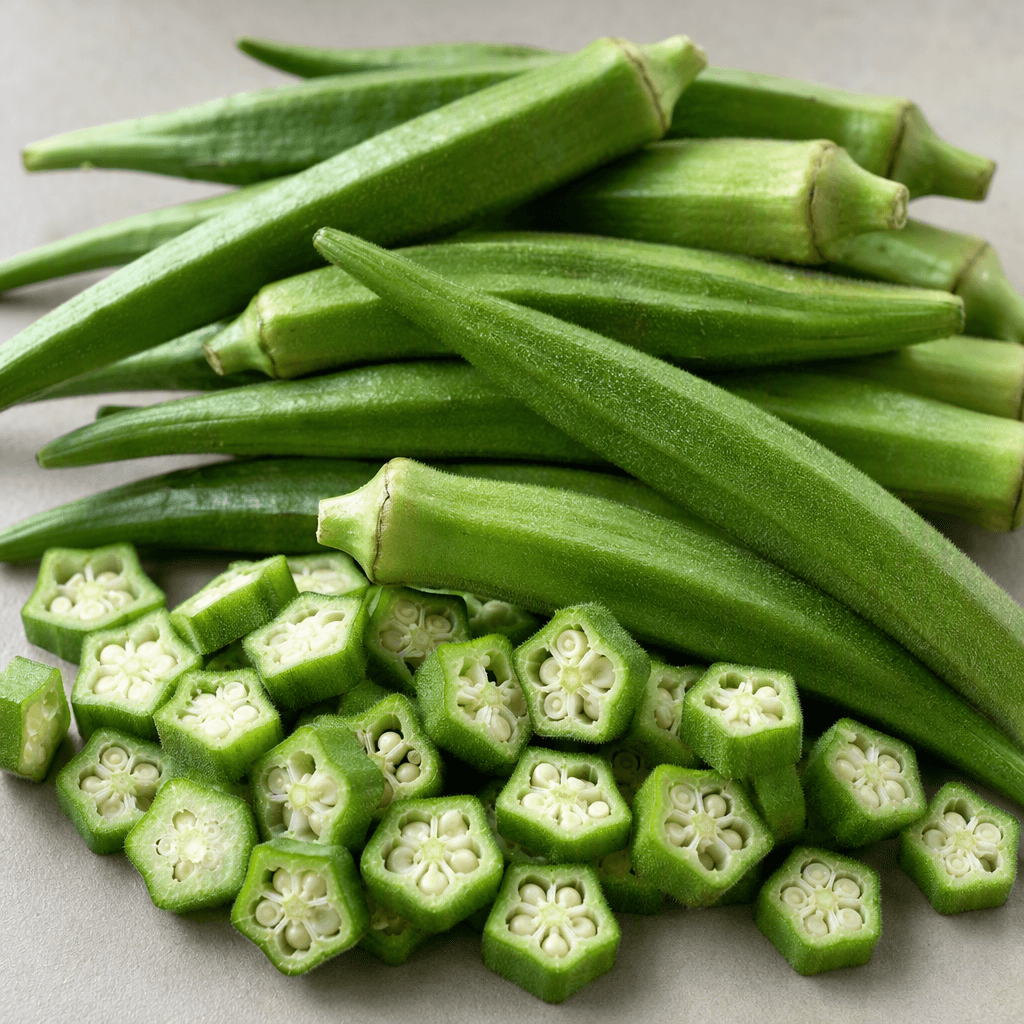
Okra Calories
Rich in vitamin C and fiber, low-calorie vegetable
In season: Summer · Autumn
CALORIES
GI
POTASSIUM
FIBER
Quick answer
100 g of Okra has 33 calories. It contains 7.5 g of carbs, 2 g of protein, 0.2 g of fat and 3.2 g of fiber. Its 0.8 mg of Manganese covers 34% of the Daily Value. Its glycemic index is 20 (low), so it raises blood sugar slowly.
What is Okra?
Okra is a warm-weather vegetable whose tender green pods are eaten along with their small, pale seeds. It is common in cuisines across Africa, South Asia, the Middle East and the American South, where it may be cooked as a vegetable dish or added to soups and stews.
Its mild, grassy flavour becomes soft and savoury with cooking. The pods release a natural thickening juice, prized in gumbo and other stews; for a less slippery texture, cook them whole with a little acid such as lemon or tomato. Okra is a light vegetable that provides fibre and vitamin C. Serve it with rice, or pair roasted or sautéed pods with a simple main.
Okra Nutrition Facts
Selected: 100 g
33
KCAL / 100G
Carbs
7.5g
· 3% DV
Protein
2g
· 4% DV
Fat
0.2g
· 0% DV
Fiber
3.2g
· 11% DV
DV is the share of the daily value covered, on a 2,000 kcal reference diet.
Calories come from: Carbs 75% · Protein 20% · Fat 5%
Okra Vitamins & Minerals
Vitamins
Vitamin C
23mg · 26% DV
Vitamin K
31µg · 26% DV
Biotin
6µg · 20% DV
B1
0.2mg · 17% DV
Minerals
Manganese
1mg · 43% DV
Magnesium
57mg · 14% DV
Zinc
1mg · 9% DV
Phosphorus
61mg · 9% DV
How Nutritious Is Okra?
Nutrient density
Very high
How many vitamins, minerals and how much fiber this food carries per calorie. A high score means a lot of nutrition for few calories.
Satiety score
Medium
An EatBetter score computed from fiber, protein and calorie density. A high score means staying full longer on the same calories.
Both scores are calculated per 100 g and do not change with the selected portion. The satiety score is EatBetter's own calculation, not a clinical measure.
Okra Glycemic Index
GLYCEMIC INDEX
GLYCEMIC LOAD
Accounts for portion size — a more realistic measure than GI alone.
How to Burn Off Okra
To burn the 33 calories in 100 g:
🚶
Walking (5 km/h)
🏃
Running (8 km/h)
🚴
Cycling
🏊
Swimming
Times are calculated with the MET equation for a 70 kg adult. Actual burn varies with your weight, age and pace.
Is Okra Processed?
NOVA 1
Unprocessed
1. Unprocessed
2. Minimally Processed
3. Processed
4. Ultra-Processed
NOVA classifies foods into 4 groups by industrial processing. NOVA 1 (unprocessed) is the healthiest.
Does Okra Contain Allergens?
No known major allergens
Which Diets Is Okra Good For?
Vegan
✓ Suitable
Vegetarian
✓ Suitable
Gluten-Free
✓ Suitable
Dairy-Free
— Not suitable
Mediterranean
✓ Suitable
Paleo
✓ Suitable
Whole30
— Not suitable
DASH
— Not suitable
Keto
✓ Suitable
Low FODMAP
— Not suitable
Okra Fat Profile
SATURATED
0.04g
MONOUNSATURATED
0.02g
POLYUNSATURATED
0.05g
Omega 6:3 ratio 3:1
Below the ideal 4:1 — a good omega balance.
Compare Okra
Foods Similar to Okra
Frequently Asked Questions About Okra
How do you cook okra without it getting slimy?
Keep okra dry, avoid cutting into the pods, and don’t stir it repeatedly while it cooks. A little lemon juice or vinegar can also limit the slippery texture; roasting or quick sautéing usually makes okra less slimy than slow, wet cooking.
What does okra taste like?
Okra has a mild, grassy flavor, often compared with green beans or eggplant. Its texture changes with cooking: roasting keeps it relatively firm, while stewing makes the pods softer and can bring out their characteristic slippery interior.
How do you prepare okra for cooking?
Rinse okra and dry it thoroughly, then trim only the tough stem tip without cutting into the pod. Slicing through the body exposes the seeds and interior, which can make okra release more of its characteristic mucilage during cooking.
How do you roast okra?
To roast okra, dry the pods well, trim the stems, and toss them with a little oil and seasoning. Spread them in a single layer so they brown instead of steam, and turn them as needed until tender and lightly browned.
How can you tell if okra is fresh?
Fresh okra is firm, bright green, and free of dark spots or wrinkling. Choose small or medium pods that snap when gently bent; oversized pods are more likely to be tough and fibrous.
Can you freeze fresh okra?
Yes, okra freezes well. Wash and dry the pods, trim the stems, and blanch them briefly before cooling and packing them in an airtight freezer bag. You can also freeze them without blanching, though the texture may be softer after thawing.
How long does okra last in the fridge?
Fresh okra usually keeps for a few days in the refrigerator. Store it unwashed and dry in a breathable bag in the crisper drawer; wash it just before cooking to help prevent moisture-related spoilage.
Can you eat okra raw?
Yes, you can eat raw okra. Rinse it well, trim off the stem, and choose fresh, tender pods; raw okra is crisp and has a mild flavor, though its interior can feel slippery when cut.
Why is my okra tough?
Okra is often tough because the pods were harvested when overmature. Large, fibrous pods may stay chewy even after cooking, so choose smaller, firm okra and remove any tough stem ends before preparing it.
Is okra good for people with diabetes?
Okra can be part of meals for people with diabetes, but it is not a treatment and does not replace prescribed care. How a meal affects blood sugar also depends on what is served with the okra and the person’s treatment plan.
Have another question about Okra?
Ask the AI nutrition coach — calories, portions, alternatives and more, answered in seconds in the app.

Scan calories with your camera
Instant AI nutrition analysis

Nutrition data compiled from USDA FoodData Central and scientific sources.