

Ready & Packaged Foods
All →Vegetables & Legumes
All →Desserts & Confectionery
All →Meat & Protein
All →Grains & Bakery
All →Beverages
All →Milk & Dairy
All →

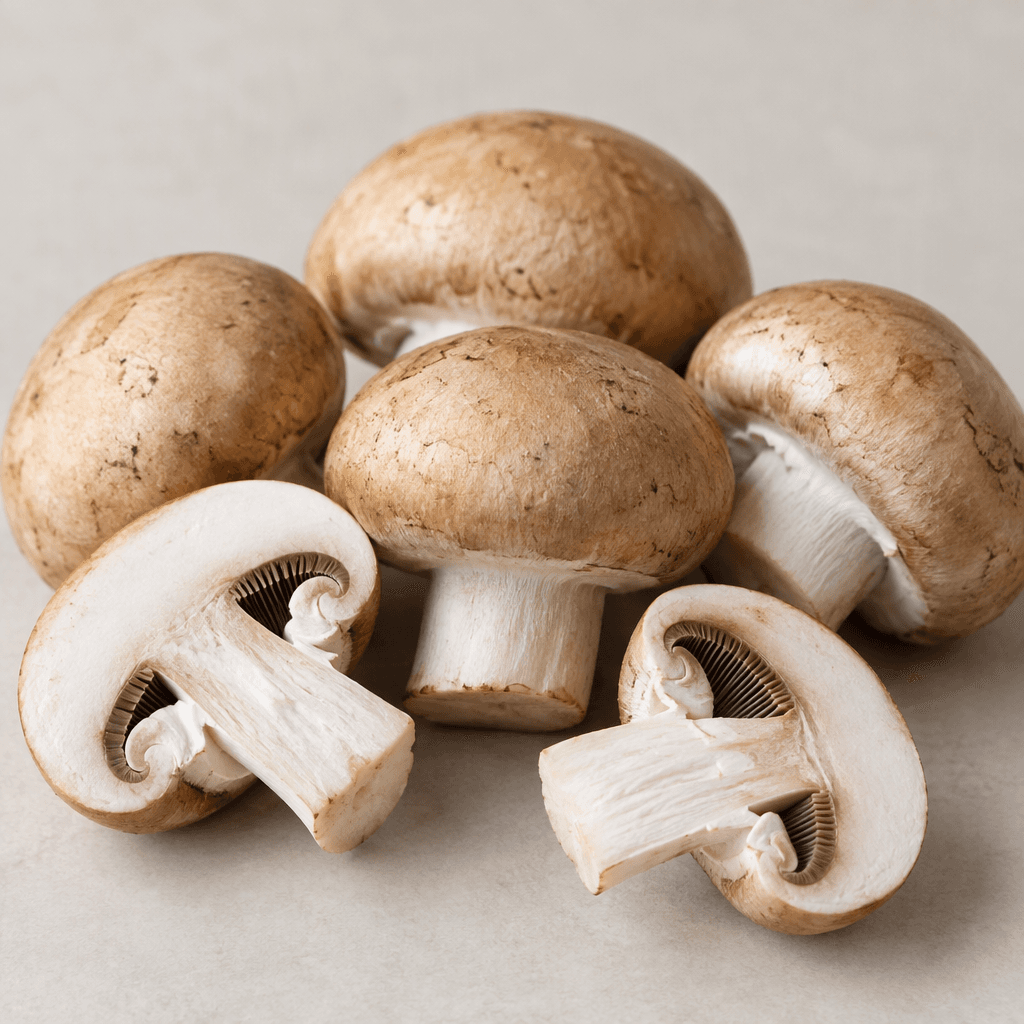
Mushroom Calories
Low calorie, good fiber source, contains B vitamins and selenium
In season: Spring · Summer · Autumn · Winter
CALORIES
GI
POTASSIUM
FIBER
Quick answer
1 cup (medium) of Mushroom (70 g) has 15 calories. That works out to 22 calories per 100 g. It contains 2.3 g of carbs, 2.2 g of protein, 0.2 g of fat and 0.7 g of fiber. Its 11.2 µg of Biotin covers 37% of the Daily Value. Its glycemic index is 15 (low), so it raises blood sugar slowly.
What is Mushroom?
Mushrooms are edible fungi, and the familiar fresh variety with pale stems and rounded caps is commonly cultivated. They are sold whole or sliced, with caps ranging from cream to light brown. Their mild, earthy flavour and tender, juicy texture make them easy to add to many dishes without overpowering other ingredients.
They are sautéed, roasted or grilled, and used in soups, pasta, omelettes and savoury pies in kitchens around the world. Cook them over fairly high heat so they brown rather than simply steam. Mushrooms are low in calories and provide fibre, B vitamins and selenium. For a lighter meal, cook them with a little oil and serve alongside vegetables, grains or eggs.
Mushroom Nutrition Facts
Selected: 100 g
22
KCAL / 100G
Carbs
3.3g
· 1% DV
Protein
3.1g
· 6% DV
Fat
0.3g
· 0% DV
Fiber
1g
· 4% DV
DV is the share of the daily value covered, on a 2,000 kcal reference diet.
Calories come from: Carbs 47% · Protein 44% · Fat 9%
Mushroom Vitamins & Minerals
Vitamins
Biotin
16µg · 53% DV
B2
0.4mg · 31% DV
B5
1.5mg · 30% DV
B3
3.6mg · 23% DV
Minerals
Selenium
9.3µg · 17% DV
Phosphorus
86mg · 12% DV
Zinc
1mg · 9% DV
Potassium ⭐
318mg · 9% DV
How Nutritious Is Mushroom?
Nutrient density
High
How many vitamins, minerals and how much fiber this food carries per calorie. A high score means a lot of nutrition for few calories.
Satiety score
Medium
An EatBetter score computed from fiber, protein and calorie density. A high score means staying full longer on the same calories.
Both scores are calculated per 100 g and do not change with the selected portion. The satiety score is EatBetter's own calculation, not a clinical measure.
Mushroom Glycemic Index
GLYCEMIC INDEX
GLYCEMIC LOAD
Accounts for portion size — a more realistic measure than GI alone.
How to Burn Off Mushroom
To burn the 22 calories in 100 g:
🚶
Walking (5 km/h)
🏃
Running (8 km/h)
🚴
Cycling
🏊
Swimming
Times are calculated with the MET equation for a 70 kg adult. Actual burn varies with your weight, age and pace.
Is Mushroom Processed?
NOVA 1
Unprocessed
1. Unprocessed
2. Minimally Processed
3. Processed
4. Ultra-Processed
NOVA classifies foods into 4 groups by industrial processing. NOVA 1 (unprocessed) is the healthiest.
Does Mushroom Contain Allergens?
No known major allergens
Which Diets Is Mushroom Good For?
Vegan
✓ Suitable
Vegetarian
✓ Suitable
Gluten-Free
✓ Suitable
Dairy-Free
— Not suitable
Mediterranean
✓ Suitable
Paleo
✓ Suitable
Whole30
— Not suitable
DASH
— Not suitable
Keto
✓ Suitable
Low FODMAP
— Not suitable
Mushroom Fat Profile
SATURATED
0.05g
MONOUNSATURATED
0.01g
POLYUNSATURATED
0.09g
Omega 6:3 ratio 8:1
Above the ideal 4:1 (8:1).
Compare Mushroom
Foods Similar to Mushroom
Frequently Asked Questions About Mushroom
Are mushrooms vegetables or fungi?
Mushrooms are fungi, not plants, although they are commonly grouped with vegetables in cooking. Their distinct biological group is why they differ from leafy vegetables in structure and how they grow.
How do you clean mushrooms without making them soggy?
Brush off loose dirt or wipe mushrooms with a damp cloth; if they need rinsing, do it quickly under running water and dry them well. Avoid soaking them, since they readily take up moisture.
How long do fresh mushrooms last in the fridge?
Fresh mushrooms usually keep for several days when refrigerated dry in a paper bag or a container that allows airflow. Keep them unwashed until use, and discard any that become slimy or smell unpleasant.
Can you eat mushroom stems?
Yes, the stems of common cultivated mushrooms are edible. Trim off any dry or dirty ends, then slice or chop the rest into stir-fries, soups, or omelets along with the caps.
Why do mushrooms shrink so much when cooked?
Mushrooms lose much of their water during cooking, so they shrink as that moisture evaporates. Give them room in the pan and cook in batches if needed; overcrowding makes them steam instead of brown.
Can you freeze mushrooms?
Yes, mushrooms freeze best after being sautéed or briefly cooked, then cooled and packed airtight. Freezing them raw is also possible, but they are more likely to become soft when thawed.
Can you eat mushrooms raw?
Yes, common cultivated mushrooms can be eaten raw, for example in a salad. Cooking them softens their texture and may make them easier to digest for people who find raw mushrooms uncomfortable.
How can you tell if mushrooms have gone bad?
Discard mushrooms that are slimy, strongly unpleasant-smelling, or very soft and deteriorating. A little darkening alone does not always mean they are spoiled, so consider the smell and texture too.
Can mushrooms provide vitamin D?
Yes, mushrooms exposed to ultraviolet light can contain vitamin D, while ordinary growing and storage conditions may leave them with little. The amount varies, so sunlight exposure or packaging claims matter.
Is it safe to eat wild mushrooms?
Only eat wild mushrooms identified with certainty by a qualified expert; poisonous species can closely resemble edible ones. Cooking, tasting a small piece, or using an online photo cannot reliably make an unknown mushroom safe.
Have another question about Mushroom?
Ask the AI nutrition coach — calories, portions, alternatives and more, answered in seconds in the app.

Scan calories with your camera
Instant AI nutrition analysis

Nutrition data compiled from USDA FoodData Central and scientific sources.